

A title commitment, a survey and a title policy are not four versions of the same document. The commitment tells you what the title company is prepared to insure and under what conditions; the survey shows where the land and improvements sit; the owner’s policy protects the buyer against covered title risks; and the loan policy protects the lender. A buyer should compare all of them before the contract’s objection deadline, not wait until the closing table.
When I review a title package with a buyer, I am looking for two separate questions: “Can the seller deliver the title promised in the contract?” and “Can the buyer use the property the way they expect?” The title company, surveyor, lender and attorney answer different parts of that picture.
The four documents solve four different problems
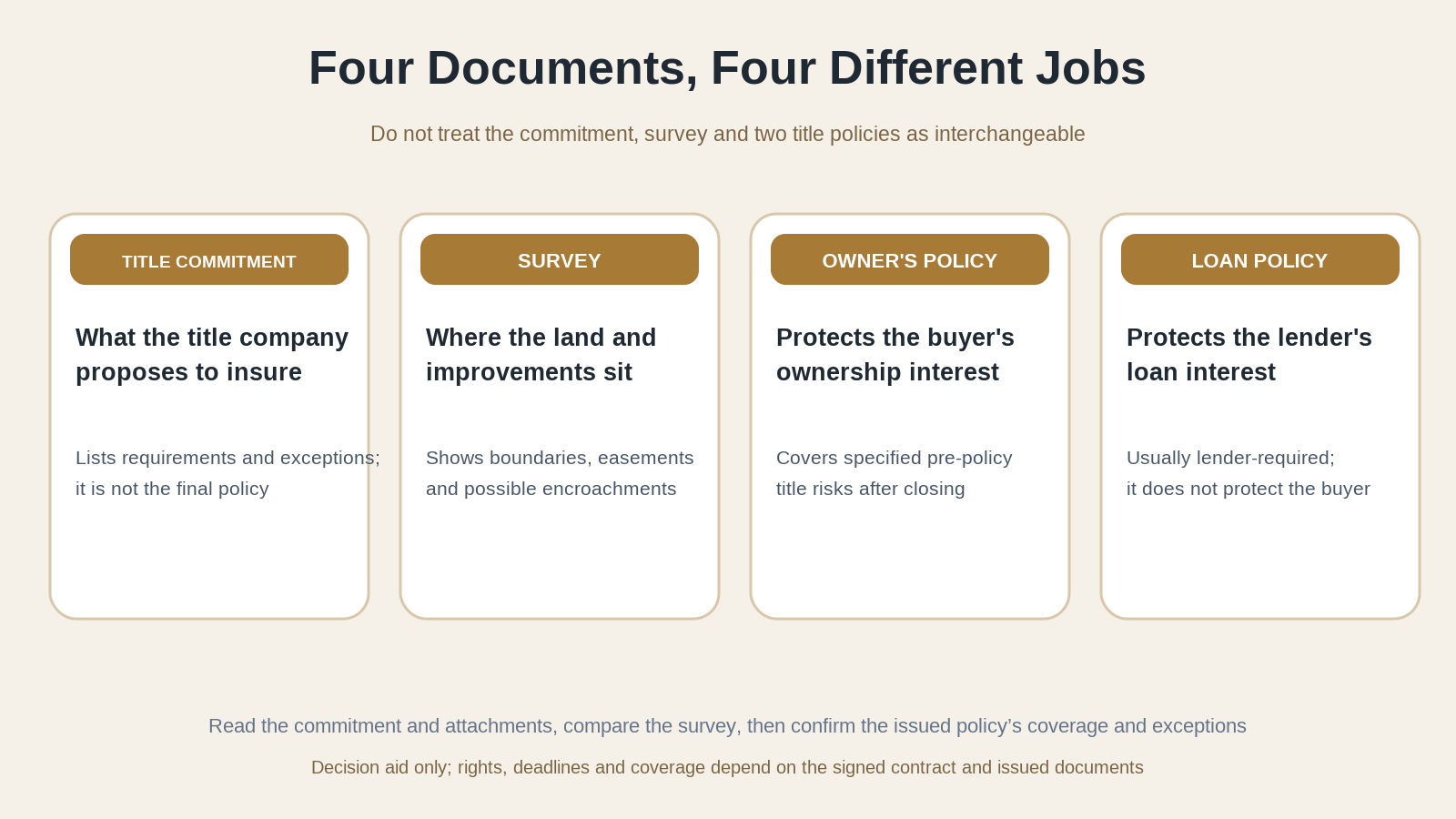
1. Title Commitment: the proposed terms of coverage
The Texas Department of Insurance describes a commitment as the title company’s willingness to issue a policy subject to stated requirements, exceptions and terms. It comes before closing. It is not the final policy, a guarantee that no problem exists, or an abstract of title.
A Texas commitment is commonly organized into schedules. Read the actual document, but use this plain-language map:
- Schedule A identifies the proposed insured, policy amount, property interest and legal description. Check every name and compare the legal description with the contract and survey.
- Schedule B lists exceptions—matters the policy will not cover. Restrictions, easements, mineral matters and survey-related items often appear here.
- Schedule C lists requirements that must be satisfied before the title company will issue the policy, such as releases, payoff items, probate documents or proof of authority to sign.
- Other schedules and attachments may disclose parties, premiums or recorded documents. Open the documents behind the exception numbers; the one-line label is not enough.
Schedule C is not a buyer wish list, and Schedule B is not a list to ignore. One tells the parties what must be cleared for issuance; the other tells the buyer what risk may remain outside coverage. If an exception limits access, future construction or an intended use, the timing to raise it may come from the signed contract.
2. Survey: the physical picture of the property
A survey can show boundary lines, the location of the house and other improvements, recorded easements, building lines, fences and possible encroachments. It does not inspect the home, determine market value, guarantee acreage, or by itself decide a legal ownership dispute.
The current TREC One to Four Family Residential Contract (Resale), Form 20-19 effective July 1, 2026, lets the parties select among an existing survey or a new survey and assign cost. An existing survey still has to be accompanied by the required affidavit or declaration when that option is used, and the title company or lender may decide it is not acceptable. The number of days is filled into the contract; it is not universal.
On the survey, I ask buyers to slow down around these areas:
- Does the legal description match the commitment and contract?
- Do the house, garage, pool, patio, driveway, fence and outbuildings appear in the expected locations?
- Does any improvement cross a boundary, easement or building line?
- Is access to the public street clear, or does access depend on an easement?
- Are there overhead lines, pipelines, drainage or utility easements that affect future plans?
- Has anything visibly changed since an existing survey was prepared?
A fence is useful evidence of how people occupy the yard, but it is not automatically the legal boundary. If a pool, addition, driveway or fence appears to cross a line, do not solve the issue by eyeballing it. Ask the title company and surveyor what the document shows, and use a Texas attorney when legal rights or a boundary dispute need interpretation.
3. Owner’s title policy: protection for the buyer
An owner’s policy protects the homeowner against losses from covered ownership problems that arose before the purchase and were not known at the time. TDI examples include fraud, forgery, errors in earlier deeds and some undisclosed claims. Coverage is controlled by the issued policy, including its exclusions, exceptions, conditions and policy amount.
Texas does not generally require a buyer to purchase title insurance, but TDI says an owner’s policy is issued in a home purchase unless the buyer rejects it in writing. The common TREC resale contract also states who pays for the owner’s policy. That is a contract term, not a statewide rule that one side always pays.
TDI says the owner’s policy premium is paid once and the policy generally lasts as long as the insured owner or heirs own the land, subject to the policy’s terms. If title is later moved into an LLC, trust, business or another person’s name, do not assume coverage automatically follows; read the continuation provisions and ask the title company or an attorney.
4. Loan policy: protection for the lender
Most mortgage lenders require a loan policy. It protects the lender’s interest up to the covered loan amount; it does not protect the buyer’s equity merely because the buyer paid the charge at closing. As the loan is paid down, the lender’s interest changes. A buyer who wants protection for personal ownership needs to evaluate the owner’s policy separately.
In Texas, title policy forms and premium rates are regulated. That does not mean every closing quote will be identical: escrow, tax certificate, recording, courier and other service charges can differ. Compare an itemized quote and the Closing Disclosure, not just one line labeled “title.”
The contract clock matters more than the size of the PDF
Under TREC Form 20-19, the seller is generally to furnish the commitment within 20 days after the title company receives the contract, with a limited automatic extension described in the form. The buyer’s objection period is different: the parties fill in the number of days, and the deadline is the earlier of that period after receipt of the commitment, exception documents and survey, or closing. The form also explains cure and waiver consequences.
That is why a buyer should record four dates: when the commitment arrived, when the exception documents arrived, when the survey arrived or was deemed received, and the actual objection deadline in the signed contract. Do not assume the option-period deadline and title-objection deadline are the same. For the larger sequence, see the Houston contract-to-closing timeline.
My pre-closing title review checklist
- Confirm buyer names and the planned way title will be held. Ownership and estate-planning consequences belong with an attorney and tax adviser.
- Match the street address and legal description across the contract, commitment, survey, lender file and deed draft.
- Read every Schedule B exception and open the recorded restriction, easement or other exception document that could affect use.
- Track each Schedule C requirement and identify who is clearing it before closing.
- Compare the survey with the property as it appears today; flag additions, pools, fences, sheds, patios or driveway changes.
- Verify access, easements, restrictions, mineral reservations and HOA-related documents against the buyer’s intended use.
- Ask the title company what endorsements are available or required and what each one changes. Do not assume an endorsement covers every related risk.
- Review the final owner’s policy after closing and store it with the deed and survey. If it does not arrive, follow up with the title company.
Red flags that deserve a pause
- A buyer or seller name, marital status, entity name or signing authority does not match the transaction documents.
- The legal description differs among the contract, commitment and survey.
- Old mortgages, tax liens, judgments, probate issues or unreleased claims remain in the requirements.
- A recorded easement crosses a planned pool, addition, driveway or other improvement area.
- The survey shows an encroachment, overlap, shortage, access issue or improvement outside a boundary or building line.
- Restrictions conflict with the buyer’s intended rental, business, parking, construction or property use.
- Mineral reservations or surface-use rights are unclear.
- A last-minute revised commitment, survey or exception document adds a new matter.
A red flag is not always a deal breaker. It is a signal to identify the correct professional, the available cure, the timing and the residual risk before the buyer waives an objection or sends closing funds.
What title insurance does not replace
Title insurance is not homeowners insurance, flood insurance, a home inspection, a survey, an appraisal, a warranty of property condition or a promise that a future use will be approved. It also does not cover every title issue. The issued policy controls, and matters specifically excepted or excluded may be outside coverage.
For physical-loss coverage before closing, read How to Review Houston Home Insurance Before Closing. For offer-stage decisions about who selects and pays the title company or policy, see Making an Offer on a Houston Home: Price Is Not the Only Term That Matters.
Frequently asked questions
Does a clean title commitment mean the property has no title risk?
No. A commitment is an offer to issue coverage under stated conditions. Read the requirements, exceptions and attached documents; then review the actual policy after closing.
Can the seller’s old survey always be reused?
No. The contract selection, required affidavit or declaration, visible changes, title company and lender requirements all matter. A new survey may still be required.
Does the lender’s policy protect my down payment and equity?
No. The loan policy protects the lender’s insured interest. Buyer protection comes from the owner’s policy, subject to its amount, coverage, exclusions and exceptions.
Who chooses the title company in Texas?
The contract identifies the title company, and the choice can be negotiated. TDI says a buyer may choose a title company, and federal law generally prohibits a seller from requiring a borrower to use a particular title insurer as a condition of sale. The practical selection should be resolved in the offer, not after acceptance.
Joyce's Featured Listings

AI-generated illustration: a Greater Houston housing scene, not a real or currently available listing.
Now that you know which documents define ownership, boundaries and uncovered risk, browse Joyce’s Featured Listings to see what current budgets and home types look like. Every property still needs its own title, survey, tax, insurance and condition review.
View Joyce's Featured Listings →
Have a title commitment or survey and do not know what to flag?
Send me the property address, your intended use, the commitment, exception documents, survey and the objection deadline shown in your contract. I can help organize the practical questions for the title company, surveyor and lender, and identify when a Texas attorney is the right next call.
About Joyce Tang

Joyce Tang is a Greater Houston real estate agent and investor, co-founder of the North American Real Estate Association, founder of JoyHome and JoyNest, and co-leader of the Dr. Wang Real Estate Team.
She has helped more than 200 families buy or sell homes and has participated in more than 40 renovation projects. Her approach examines not only price, but also location, carrying cost, cash flow, risk and future exit options.
Sources and disclaimer
Sources checked October 20, 2026: Texas Department of Insurance guidance on title insurance, title commitments and policies, owner’s policies and Texas title insurance basics; the Texas Real Estate Commission page and current TREC Form 20-19; and CFPB guidance on owner’s title insurance and shopping for title and closing services.
This article is general real-estate education, not legal, title, survey, lending, tax or estate-planning advice. Contract rights and deadlines depend on the signed documents; insurance coverage depends on the issued policy. Ask the title company about its commitment and policy, the surveyor about survey work, the lender about loan requirements, and a licensed Texas attorney about legal interpretation, ownership structure, boundary disputes or objections.
Cover photo from Pexels by Atlantic Ambience, used under the Pexels License. It is a general property-document scene and does not depict Joyce’s client, a Texas title company, a specific property or an actual transaction.