

When making an offer on a Houston home, price matters—but the seller usually compares the full package: net proceeds, the reliability of the buyer’s funds and financing, option and appraisal risk, closing timing, and every other condition that could affect completion. The right offer is not the one that waives everything. It is the one that is competitive without creating a downside the buyer cannot carry.
Before signing, answer two questions: If the seller accepts, can I perform exactly as written? If inspection, appraisal, or financing goes wrong, how much risk am I actually willing and able to absorb?
Do the property work—and set your limits—before writing
No single offer formula fits every property. Days on market, price changes, comparable sales, condition, the seller’s timing, and known competition can all change the strategy. The buyer still needs a cash plan and clear boundaries before trying to improve the terms.
- Update the loan preapproval and confirm loan type, down payment, rate assumptions, estimated cash to close, and the earliest credible closing date.
- Prepare proof of funds that supports the offer while redacting unrelated account numbers and private information.
- Use recent comparable sales, active competition, condition, and listing history instead of anchoring to one automated estimate or the list price alone.
- Set a maximum price, appraisal-gap limit, repair-risk limit, and the contract protections that are not negotiable for you.
- Ask through the agents about objective transaction needs such as closing timing or short post-closing possession—not personal characteristics protected by fair-housing law.
A seller may compare much more than the headline price
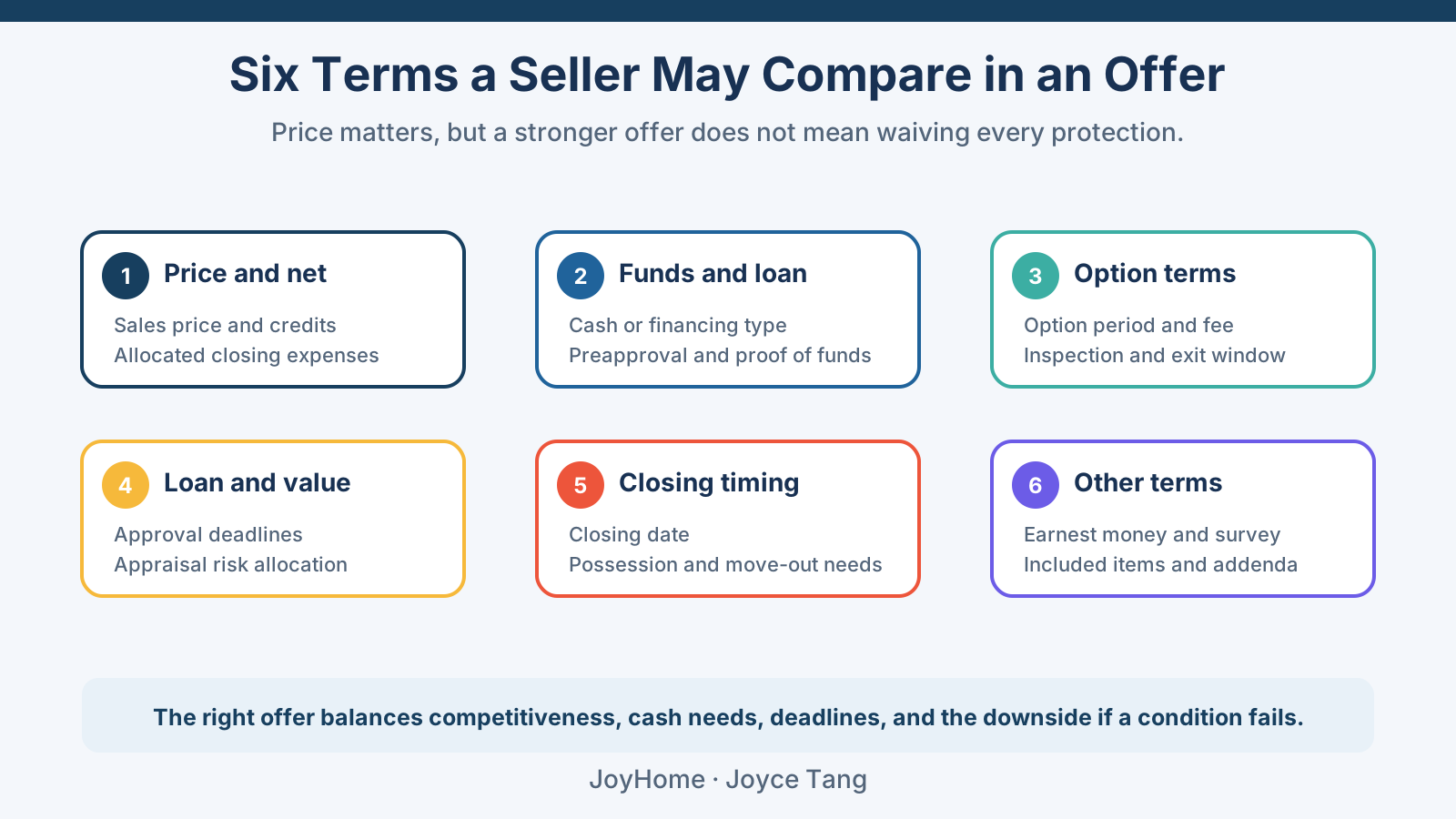
These six dimensions are not a fixed scoring system. One seller may prioritize net proceeds and certainty; the buyer still has to weigh cash, timing, and risk.
1. A higher price may not produce the highest seller net
Two offers can have different prices while also allocating the owner’s title policy, survey, HOA documents, and other closing expenses differently. A buyer may request a seller contribution toward buyer expenses or a contribution toward buyer-broker compensation. The current TREC 20-19 form separates those items in Paragraph 12, so comparing only price minus a generic “closing cost” number can be misleading.
For a buyer, a seller contribution can sometimes reduce cash to close more effectively than a small price reduction. But permitted amounts and actual use depend on the loan program, appraisal, and eligible expenses. The lender should model the exact property and loan before the offer promises a number that cannot be fully used.
2. Loan type matters, but documentation and credible timing matter too
A cash offer does not automatically win, and a financed offer is not automatically weak. Sellers may consider how current the preapproval is, whether the loan amount matches the contract, whether down payment and closing funds are documented, whether the lender is reachable, and whether approval and closing dates are realistic.
The TREC 40-11 Third Party Financing Addendum identifies the financing type and separately addresses Buyer Approval—assets, income, credit, and available loan terms—and Property Approval, which can include appraisal, insurability, and lender-required repairs. A preapproval letter does not erase those distinctions or deadlines.
3. Earnest money, option fee, and option length work together
Earnest money supports the buyer’s performance obligation. The option fee relates to the negotiated unrestricted termination window. Increasing an amount or shortening the option period may signal certainty, but it also increases the buyer’s time pressure or financial exposure.
Do not promise an inspection timeline that available inspectors cannot meet. Check inspector availability, insurance timing, and holidays before choosing the number of days. For payment and the 5:00 p.m. termination deadline, read What Is the Option Period in a Texas Home Purchase?.
4. Appraisal language determines the cash risk behind a high offer
When a financed buyer offers above the likely appraised value, decide in advance what happens if the appraisal is low. Will the buyer retain a termination right, cover part of the gap, or accept all of it? The lender determines the lending value under its rules, so the buyer’s cash requirement may increase.
TREC Form 49-1 provides options involving waiver, partial waiver, or an additional termination right, but the form states that it is not for FHA- or VA-financed transactions. Those programs have separate requirements. Any change to appraisal protection changes legal and cash risk and should be matched to the actual financing and contract—not copied from another offer.
5. Closing and possession can solve a seller’s real problem
A seller may be coordinating another closing or may need proceeds quickly. A closing date that fits the seller and can actually be met by the lender and title company can be more useful than an unrealistic promise to close “as fast as possible.”
Closing is not the same as possession. The current TREC form allows possession at closing and funding or under a written temporary residential lease. If the seller remains after closing, rent, deposit, insurance, damage, and move-out risk need to be addressed in the proper lease—not reduced to “a few free days.”
6. Other contract terms can change the real value of the offer
Who pays for title, whether an existing survey can be used, which appliances or non-realty items remain, a contingency on the buyer selling another property, HOA documents, and statutory notices can affect cost or the probability of closing. Completeness also matters: seller agents notice missing addenda, inconsistent names, and loan numbers that do not match.
Do not use Special Provisions as a place to improvise complicated legal terms. The current TREC contract warns that brokers and sales agents may not practice law by adding, deleting, or modifying contract provisions. Nonstandard rights and complex transactions should be drafted by a party or an attorney.
What does a “cleaner offer” really mean?
To me, clean does not mean unprotected. It means the offer does not contain conflicting, unrealistic, or unsupported terms. Price, financing, down payment, concessions, appraisal terms, and closing should work together, with complete addenda and documents that support the promises.
- The preapproval and loan type match the offer, and the lender knows the target property and timeline.
- The same dollars are not counted three times for cash to close, an appraisal gap, and emergency repairs.
- Option, financing approval, appraisal, and closing deadlines can realistically be met.
- Seller contributions, title expenses, and brokerage contributions appear in the correct places.
- Included and excluded items are written clearly instead of relying on a conversation at the showing.
- All applicable addenda are submitted with the offer so the seller does not have to guess.
When can a buyer strengthen terms—and when is it too much?
The property is competitive and the buyer has substantial liquidity
The buyer can consider a higher price, additional earnest money, a shorter but workable option period, fewer requested seller expenses, or adjusted appraisal protection within an affordable limit. For each change, write down the worst-case additional cash and the exit right being reduced.
The buyer needs a seller contribution to close
The goal is not to imitate a no-concession buyer. It is to make the loan file, cash plan, and requested amount precise. Compare a higher price with a contribution against a lower price without one, including monthly payment, appraisal risk, and actual cash to close.
The house is older or major systems are uncertain
Competition does not make roof, foundation, HVAC, drainage, or insurance risk disappear. Review Eight Home-Inspection Items Most Likely to Become Major Expenses and decide how much inspection flexibility the cash reserves can support.
In multiple offers, set the stopping point before the counteroffer arrives
A “highest and best” request can turn the question into “How much more will win?” A better discipline is to set three limits first: maximum price, maximum additional cash, and maximum uninspected or appraisal risk. If a counteroffer crosses any one of them, reassess instead of chasing the time already invested.
I also discourage buyer photos or emotional letters that describe family structure, religion, ethnicity, disability, or other personal characteristics. Residential offers should be evaluated on price, funds, timing, and property terms without bringing fair-housing-protected traits into the decision.
Offer checklist before signing
- Confirm buyer names, property address, price, cash portion, and financing amount are consistent.
- Update preapproval and proof of funds to support down payment, closing expenses, and any appraisal gap.
- Make earnest money, option fee, option length, and delivery deadlines realistic and intentional.
- Include seller contributions, title, survey, HOA, and other allocated expenses in the cash plan.
- Match financing approval, appraisal protection, and addenda to the actual loan type.
- Confirm closing, possession, and any temporary lease match both parties’ real schedules.
- Write included, excluded, and non-realty items clearly.
- Model the worst cash result if inspection, insurance, appraisal, or financing creates a problem.
- Choose an offer-expiration time that allows a reasonable response without leaving the buyer exposed indefinitely.
- Send any nonstandard provision requiring legal judgment to a licensed attorney.
Frequently asked questions
Does the seller have to choose the highest price?
Generally, no. A seller may consider price, net proceeds, funding certainty, deadlines, risk, and the seller’s goals, or may counter or reject an offer. The decision must still comply with applicable law and may not discriminate based on a protected characteristic.
Is a cash offer always stronger than a financed offer?
No. Cash may remove financing and lender-appraisal uncertainty, but price, closing, option, and other terms still matter. A complete, reliable financed offer that fits the seller’s goals can be the better package.
Can an accepted offer be changed later?
Only through a valid written agreement by the parties. A buyer may request repairs or a credit after inspection, but the seller does not have to agree, and negotiation does not automatically extend an existing deadline.
Can a buyer submit offers on several homes at once?
Doing so can expose the buyer to obligations under more than one contract. Before submitting simultaneous offers, ask the agent and attorney to explain acceptance, withdrawal, and binding-effect timing for each offer.
Joyce's Featured Listings

AI-generated illustration: a Greater Houston housing scene, not a real or currently available listing.
Once the offer framework is clear, browse Joyce’s Featured Listings to see current home types and price ranges. Then evaluate a specific property through comparable sales, condition, financing, timing, and cash exposure.
View Joyce's Featured Listings →
Preparing an offer on a specific home?
Send me the address, budget, loan preapproval, expected holding period, and the risks you care about most. I can organize comparable sales, seller net, option terms, appraisal exposure, closing timing, and cash needs in one decision. A licensed Texas attorney should provide legal advice or draft nonstandard contract language.
About Joyce Tang

Joyce Tang is a Greater Houston real estate agent and investor, co-founder of the North American Real Estate Association, founder of JoyHome and JoyNest, and co-leader of the Dr. Wang Real Estate Team.
She has helped more than 200 families buy or sell homes and has participated in more than 40 renovation projects. Her approach examines not only price, but also location, carrying cost, cash flow, risk and future exit options.
Sources and disclaimer
This guide uses public Texas Real Estate Commission and HUD materials available on September 27, 2026, principally the TREC 20-19 One to Four Family Residential Contract (Resale), TREC 40-11 Third Party Financing Addendum, TREC Form 49-1 appraisal addendum page, and the HUD Fair Housing Act overview.
This article provides general real-estate education, not legal, lending, appraisal, tax, insurance, or investment advice. Appropriate price, deadlines, and protections depend on the property, financing, market, contract, and buyer’s risk tolerance. Confirm loan and contribution limits with a licensed mortgage professional; appraisal questions with the lender and licensed appraiser; and contract interpretation or nonstandard language with a licensed Texas attorney.
Cover photo: Ivan S / Pexels, cropped and used under the Pexels License. It is a general home-purchase signing scene and does not depict Joyce’s client, a specific property, or an actual transaction.