

A seller can live in the home, pay every tax bill and still hear that title is not clear. That usually does not mean the title company is denying ownership. It means the file does not yet contain enough acceptable evidence to record an effective deed, satisfy existing liens and issue the title policy under the commitment terms.
The common mistake is treating a tax record, appraisal record, loan-app balance or family agreement as the same thing as insurable, recordable title. The items that control the closing are the title commitment requirements—especially Schedule C—and the underwriter’s standards for clearing each one.
A realistic title-delay scenario
A seller paid a HELOC to zero years ago and later divorced. The home receives an offer quickly, and the seller expects to close with identification and the current mortgage payoff. The title search shows that the old HELOC was never released and asks for marital and title documents to determine who must sign.
That does not necessarily make the home unsellable. It does make the timeline difficult if the former lender, divorce records or legal help are not contacted until the week before closing. The most expensive title problem is often the one discovered too late.
First: a title commitment is not a final approval
The Texas Department of Insurance explains that a title commitment is an offer to issue a policy after stated conditions are satisfied. It lists potential issues, exceptions and requirements. Some items can be removed after clearance; others can remain as policy exceptions. See theTDI Title Insurance FAQ.
Instead of asking only whether title has a problem, ask which Schedule C items remain, who owns each task, what recordable evidence is needed, whether a third-party approval is required and how long the process may take. TheTexas title commitment, survey and title-insurance guideexplains the documents.
Use the right clearance path
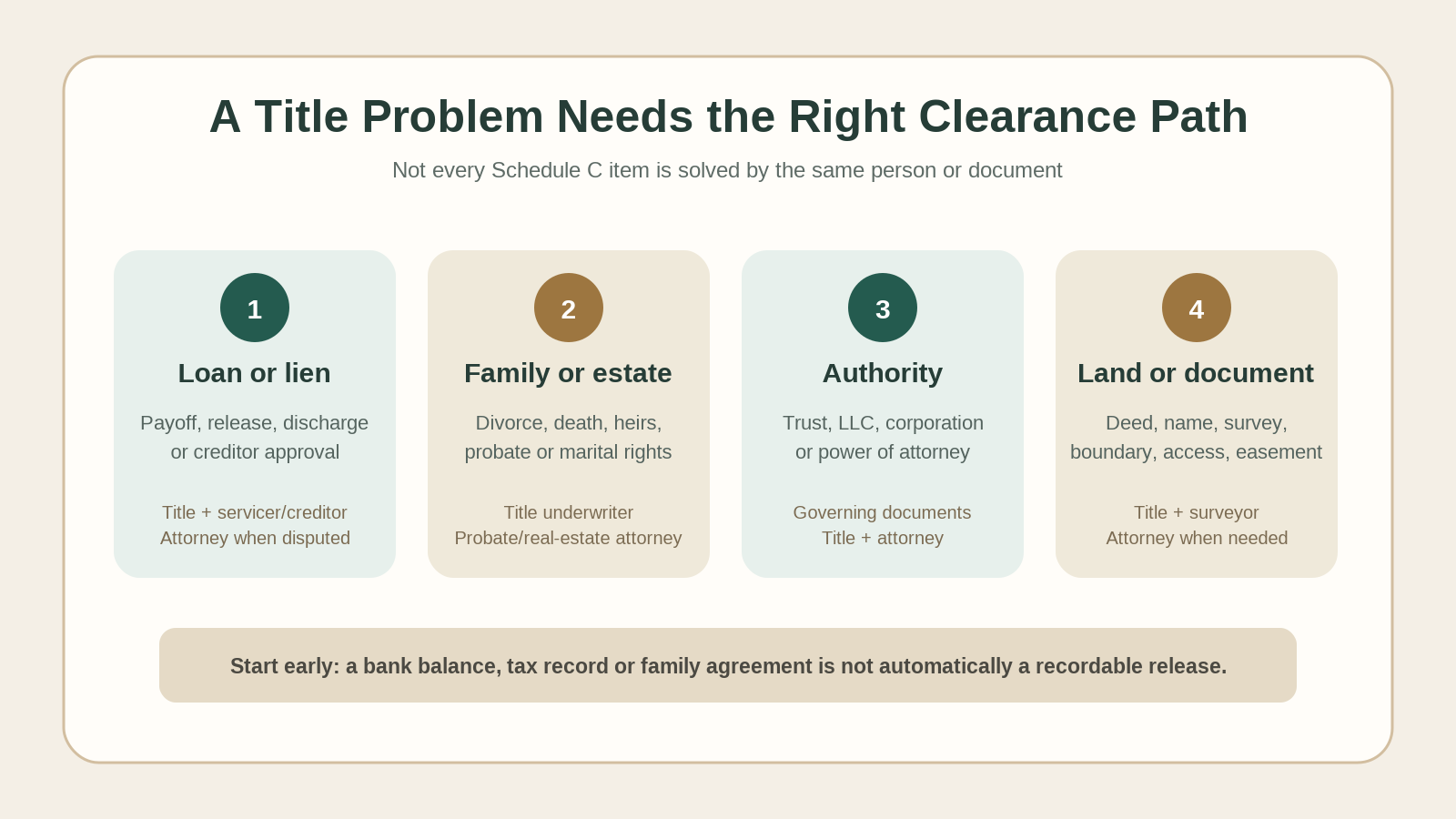
1. A paid mortgage or HELOC was never released
A zero balance does not prove that the deed of trust was released in county records. The original lender may have merged, servicing may have transferred, a HELOC may have been paid but never formally closed, or a signed release may have been recorded incorrectly. The title company generally needs an acceptable payoff, release or other clearance evidence.
The CFPB notes that a lien release can lag behind mortgage payoff. Contact the former servicer and check the county real-property records rather than relying on a screenshot from an app. Review theCFPB guidance on checking a lien release after payoff.
2. Tax, judgment, government or other creditor liens
Public records can reveal property-tax liens, federal tax liens, judgments, child-support liens or other claims. They are not all cleared the same way, and the balance is not the only question. The underwriter may require a payoff, release, discharge, court record or proof that the lien belongs to someone else with a similar name.
For a federal tax lien, equity may allow the lien to be paid from closing proceeds. When the sale will not satisfy the lien, an application to discharge the specific property may be required well before closing. See theIRS guidance for a federal tax lien on a home.
3. HOA, contractor, solar or equipment-financing claims
Unpaid HOA amounts, special assessments, mechanic’s or materialman’s liens, solar financing, equipment financing or UCC records can affect title or buyer financing. After a recent roof, pool, addition, solar installation or major repair, the title company may request contracts, invoices, proof of payment, lien waivers or affidavits.
Do not wire money to an unfamiliar clearance department. Verify payoff and release instructions through the title company, a known creditor number or counsel. A disputed contractor balance belongs with an attorney early—not in a closing-table argument.
4. Divorce, marital status and Texas homestead rights
One name on the deed does not always mean no other person may have to participate. How and when the property was acquired, homestead use, the divorce decree, the property division and any later recorded deed can affect title requirements.
Do not assume an ex-spouse never needs to sign or that a divorce decree alone is always enough. Give the title company the marital timeline, deed, decree and later conveyance documents early. When rights are disputed or records are incomplete, use a Texas real-estate attorney.
5. A prior owner died and the estate or heirship is incomplete
When title remains in a deceased owner’s name, the proper seller and required signers depend on the will, estate, family history and underwriter requirements. Probate, a muniment of title, an affidavit of heirship or another process may be considered, but family agreement alone does not complete the chain of title.
Texas Law Help notes that an affidavit of heirship does not itself transfer title and that acceptance should be confirmed with the title company. See itsguidance on transferring a deceased person’s propertyand involve probate counsel and title early.
6. A trust, LLC, corporation or power of attorney lacks clear authority
When the owner is a trust, LLC, corporation or another entity, title must determine who can sign the listing, contract, deed and closing documents. The file may need a trust certification or excerpt, operating agreement, resolution, certificate, status evidence or legal opinion, depending on the entity and underwriter.
A power of attorney is not automatically acceptable. Its terms, validity, execution, recordability and authority for the specific real-estate transaction need advance review. Do not wait until signing to learn that the authorized person is overseas or that the document does not grant the needed power.
7. A name, deed, notary or recording-chain error
Misspellings, former names, married names, same-name judgments, legal-description errors, defective signatures, notary problems, indexing mistakes or an error in a prior deed can become requirements. A missing letter may still need an affidavit, correction instrument, identity evidence or a new signature.
Do not download a deed template and correct it yourself. A correction can affect title, an existing loan and future liability. Let the title company or Texas counsel determine what must be signed, by whom and how it will be recorded.
8. Survey, boundary, easement, access or encroachment problems
Title is not only about who owns the property; it is also about the land being conveyed and the rights affecting it. A survey may show a fence over the line, a driveway crossing neighboring land, a pool or addition inside an easement, a legal-description mismatch or no clear legal access.
Some matters may be handled through a new survey, affidavit, easement, boundary agreement, neighbor document or title endorsement. Others can affect financing, coverage or the transaction itself. “The fence has been there for years” is not a clearance plan. Surveyors address measurement; title underwriters address coverage; attorneys address legal rights.
How should a seller get ahead of title problems?
Open the title order before listing or immediately after contract, not during the final closing week
Gather the current deed, old mortgages and HELOCs, marital or estate records, trust or LLC documents, solar papers and recent construction records
Track every Schedule C item by owner, required document, outside approval and estimated timing
Verify every payoff, wire and release instruction through a known number and the title company
Use Texas counsel early for disputed ownership, inheritance, divorce, boundaries or liens
Require title-underwriter acceptance of the solution rather than relying on an oral promise
Use the10-part Texas seller document checklistbefore listing, and theTexas seller contract-to-closing timelineafter the offer is signed.
Frequently asked questions
My appraisal record and tax bill show my name. Isn’t that enough?
Not always. Those records provide clues, but title still reviews deeds, liens, marital or estate rights, the legal description and signing authority before deciding whether the commitment requirements are satisfied.
The old loan was paid off. Can title just ignore it?
A recorded deed of trust generally cannot be ignored based only on a zero balance. The underwriter will require an acceptable release, payoff or another approved clearance method.
Will the title company fix every title problem for me?
Title can identify requirements, coordinate payoffs and explain what the underwriter needs. It does not replace the seller’s lawyer for disputed ownership, probate, divorce interpretation, litigation or complex document drafting.
Can we close now and fix the problem later?
That depends on the issue and whether the underwriter accepts an escrow, indemnity or another arrangement. A seller cannot unilaterally postpone a requirement involving a valid conveyance, lien, authority or buyer financing.
Joyce's Featured Listings

AI-generated illustration: a Greater Houston housing scene, not a real or currently available listing.
After understanding title clearance, sellers planning another home or investment can browse Joyce's Featured Listings to see current Greater Houston property types and options.
View Joyce's Featured Listings →
Planning to sell and unsure whether title will clear?
Send me the property address, current deed, mortgage or HELOC history, marital or estate facts, trust or LLC documents, and recent construction, solar or HOA information. I can organize the transaction materials for title review; the title company or Texas counsel must confirm legal conclusions, disputed rights and recordable documents.
About Joyce Tang

Joyce Tang is a Greater Houston real estate agent and investor, co-founder of the North American Real Estate Association, founder of JoyHome and JoyNest, and co-leader of the Dr. Wang Real Estate Team.
She has helped more than 200 families buy or sell homes and has participated in more than 40 renovation projects. Her approach examines not only price, but also location, carrying cost, cash flow, risk and future exit options.
Disclaimer
This article is based on Texas Department of Insurance, CFPB, IRS and Texas Law Help materials available through November 1, 2026. It provides general information about title clearance in a Texas home sale, not legal, title, tax, lending, estate or surveying advice. Schedule C requirements, lien clearance, marital and homestead rights, probate, signing authority, surveys and underwriting decisions depend on the actual records, contract and institutional standards. Consult the title company, a Texas real-estate or probate attorney, servicer, taxing authority and surveyor as appropriate.