

Yes. The papers that delay a sale are rarely ordinary receipts. Delays happen when a title name does not match the seller, a mortgage or HELOC cannot be identified for payoff, an existing survey is missing, HOA documents take time to order, or a solar loan, estate or trust issue appears only after the contract clock starts.
That does not mean every document should be uploaded before the listing goes live. The practical approach is to organize what may apply, identify gaps, and let the listing agent, title company and an attorney when needed determine who should receive each item, when and through what secure channel.
A common delay scenario
The seller accepts a strong offer and the option period begins. During title review, the title company finds that ownership is still shown in a former trust. The seller remembers that something was changed but cannot locate the paperwork. The roof also had an insurance claim, and the repair invoice is missing.
The sale is not automatically lost. The problem is that a title question and a condition question now compete with inspection, financing and every other contract deadline. The later the records appear, the less time the parties have to evaluate and resolve them.
Start with four folders before listing
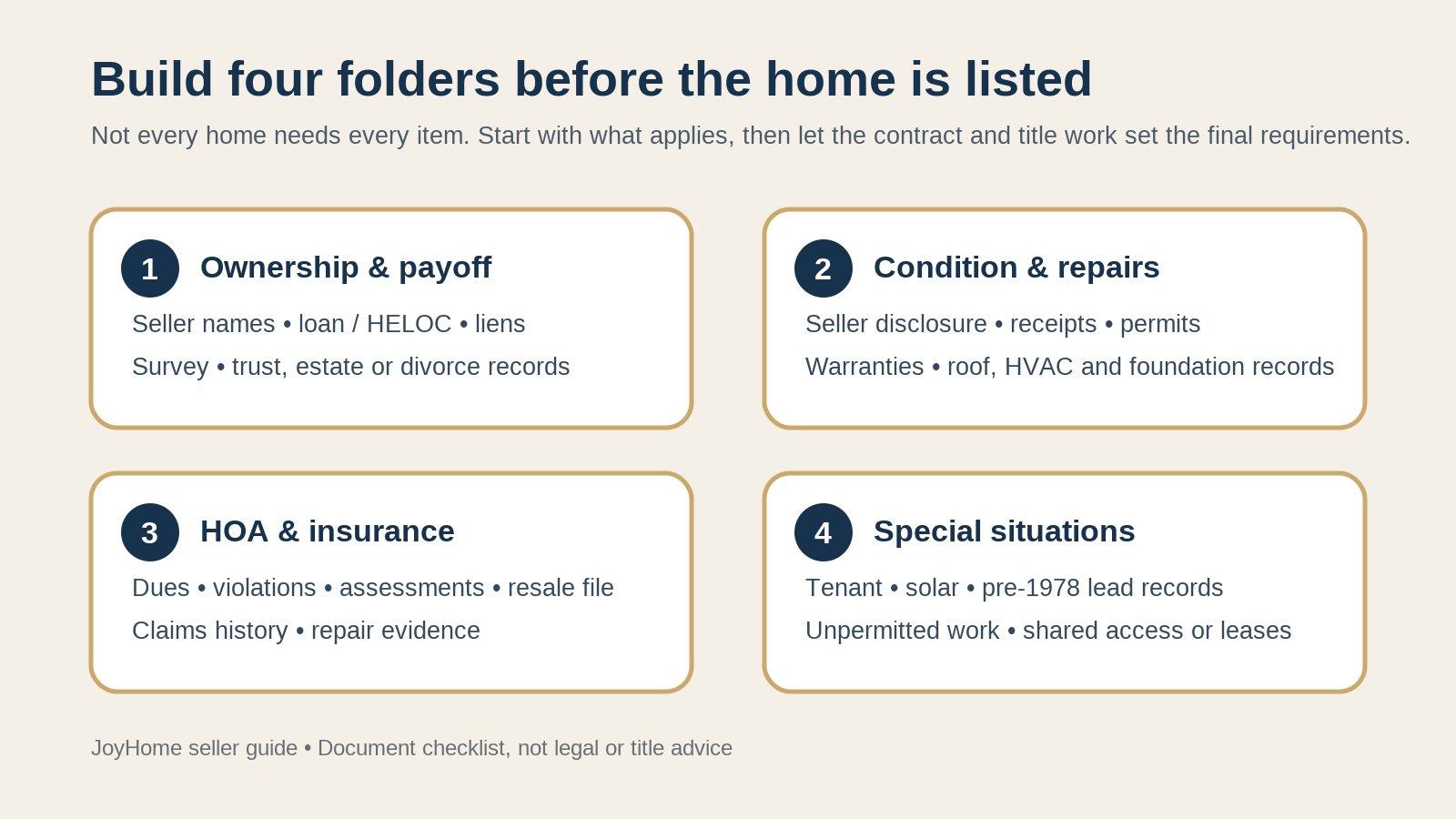
This is not a list of documents every seller must deliver. It is a screening tool. Use the following ten groups to identify what applies to the property.
1. Ownership names and seller authority
Compare the owner names in the property record with the people or entity expected to sign. Individual ownership, marital interests, a trust, LLC, estate, inheritance, divorce order or power of attorney can require different support.
Do not place identification, Social Security numbers or complete private records in a public folder. Tell the listing agent and title company about the structure early and ask what must be delivered securely. Trust, probate, divorce and title disputes may require legal advice.
2. Mortgage, HELOC, lien and payoff leads
Gather current statements or account details for the first mortgage, second lien, HELOC, solar financing, improvement financing, judgments or anything else that could affect payoff. A recent statement can help the title company locate the servicer and account, but the title company should obtain the official payoff through its secure process.
A loan paid long ago can still require work if the lien release is missing from the county record. Servicer changes and bank mergers can also take time. These payoffs belong in the seller’s net-proceeds estimate; see the complete Houston home selling guide for the larger cost picture.
3. Existing survey and records of boundary changes
Locate any existing survey and confirm that it is readable and reflects the current property. A pool, garage, patio cover, fence, driveway or addition completed later may make an older survey incomplete for the present transaction.
The current TREC resale contract lets the parties select how a survey will be provided and who bears the cost. Use of an existing survey may also involve a T-47 Affidavit or T-47.1 Declaration. Do not promise that an old survey will be accepted; the contract, title company and buyer’s lender control that decision. The title commitment, survey and title insurance guide explains the document roles.
4. Seller’s Disclosure and known-condition records
Many sales of previously occupied Texas single-family homes involve a Seller’s Disclosure Notice, although exemptions exist and should be evaluated for the transaction. The seller answers from actual knowledge. “I am not sure” should not automatically become “No.”
The current TREC Seller’s Disclosure Notice page identifies the form used for property-condition and material-fact disclosures under Texas Property Code Section 5.008. Before completing it, organize known information about water intrusion, flooding, foundation, roof, HVAC, termites, fire, claims and other conditions.
5. Repair, renovation, permit, warranty and inspection records
Organize major work as problem, response and result: what occurred, who performed the work, when it happened, whether a permit or final inspection applied, and where the invoice and warranty are. Roof, foundation, drainage, plumbing, electrical, HVAC, pool and structural work deserve particular attention.
The records do not prove that a component will never fail again. They make the disclosure and repair history clearer. Read whether repaired conditions still belong in a Texas seller disclosure for that distinction.
6. Insurance claims and matching repair evidence
List prior roof, hail, water, fire or other property claims by date and pair the coverage record with the actual repair record. An insurance payment page does not by itself prove that the full condition was repaired.
The Texas Department of Insurance CLUE report guidance says a CLUE report generally shows claims on a property for the past seven years. An owner can request one free copy each year and dispute incorrect information. Reviewing it before listing gives the seller time to address an error before the buyer shops for insurance.
7. HOA, condominium or community-association records
Identify the association and manager, account number, regular dues, unpaid balance, violations, special assessments and current notices. A resale certificate or subdivision package often has a specific order process and timing; an old package is not a substitute for a current one.
Texas Property Code Chapter 207 addresses access to certain residential POA records and resale certificates. Condominium requirements differ. The signed contract and title process determine who requests the package, who pays and when delivery is due.
8. Solar, security, water-treatment and equipment contracts
Separate equipment that is owned outright from equipment financed, leased, covered by a power purchase agreement or tied to a monthly service. Gather the contract, balance, transfer terms, cancellation cost and provider contact. Equipment attached to the home does not mean the debt automatically transfers with it.
Apply the same review to monitored security, leased water treatment, propane tanks, generators, internet equipment and other long-term services. Early ownership review makes the listing description and offer terms more accurate.
9. Tenant, lease and deposit records
For a tenant-occupied home, gather the full lease, renewals and amendments, rent ledger, security and pet deposits, repair requests, notices and property-management agreement. A screenshot of the monthly rent is not enough.
The seller also needs to know whether the buyer expects vacant possession or will assume the lease. Lease obligations, deposit transfer, showing notice and delivery date must work together. Disputed rights need legal review.
10. Documents triggered by a special property situation
Pre-1978 housing: known lead-based-paint information, reports and the required federal disclosure material
Additions or garage conversions: plans, permits, final inspections, contractor records and support for stated area
Well, septic, propane or rural property: maintenance, inspection, lease and service information
Flood claims, drainage work or major casualty: claim, repair, photograph, testing and permit records
Shared driveway, access, mineral, easement or natural-resource lease: existing agreements and title leads
Estate, trust, LLC, divorce or power of attorney: authority documents requested by title and legal counsel
The EPA Lead-Based Paint Disclosure Rule applies to most pre-1978 housing and requires known lead information and specified material before a buyer is obligated under a contract. Special property issues should be raised before the buyer or title company discovers them late.
When should the seller organize, and when should the seller deliver?
Before listing: locate records and flag gaps
Build a secure index of what exists, what is missing and what a third party must issue. The goal is discovery, not public distribution of sensitive documents.
Around the offer: follow the contract deadlines
The current TREC One to Four Family Residential Contract page lists Form 20-19 as effective July 1, 2026. Survey, title, disclosure and other delivery duties depend on the signed contract and addenda. A timeline from an older transaction should not be copied without review.
Before closing: complete payoff, title and authority requests
The title company may request additional items after issuing the title commitment and reviewing payoff and signing authority. Respond promptly, but never send bank, Social Security or wire information to an unverified contact through ordinary email. Independently verify wiring instructions using a known telephone number.
Seven common seller mistakes
Assuming the title company still has every paper from the seller’s purchase
Treating the Seller’s Disclosure as an inspection report or asking the agent to answer knowledge questions for the seller
Assuming an old survey works even after a pool, fence or addition changed the site
Saving the insurance payment but not the repair scope and invoice
Waiting until after contract to address HOA debt, violations or a special assessment
Advertising solar or security equipment as paid and included without checking the contract
Putting identification, account numbers and wiring information in an open sharing link
Frequently asked questions
Can I sell if I cannot find my original deed?
Do not assume the sale is impossible because the paper deed is missing. The title company will review public records. A name mismatch, trust, estate, divorce or earlier transfer may still require supporting documents or legal work.
If the old survey is missing, must the seller pay for a new one?
Not automatically. Survey delivery, use of an existing survey, acceptability and cost depend on the contract selection, property changes, title company and lender requirements. Avoid promising the outcome before the offer terms are known.
Can the home be listed if a repair invoice is missing?
Possibly, but the seller should not claim that an undocumented project was fully resolved by a particular licensed professional. Gather payment records, permits, warranties, photographs and contractor information that still exist, and consider a current evaluation when appropriate.
Should the buyer receive every document?
No. The recipient, timing and version depend on law, contract and transaction need. Identification, loan accounts, Social Security numbers, banking and wire information belong only in secure channels with the designated professional.
Joyce's Featured Listings

AI-generated illustration: a Greater Houston housing scene, not a real or currently available listing.
While organizing a future sale, browse Joyce's Featured Listings to see how current Greater Houston homes present condition and key property information.
View Joyce's Featured Listings →
Planning to sell but unsure what is missing?
Send me the property address, ownership type, whether there is a mortgage or HELOC, HOA, solar agreement, tenant and intended listing date. I can organize a property-specific starting checklist, then route title, legal, insurance and tax questions to the appropriate professionals.
About Joyce Tang

Joyce Tang is a Greater Houston real estate agent and investor, co-founder of the North American Real Estate Association, founder of JoyHome and JoyNest, and co-leader of the Dr. Wang Real Estate Team.
She has helped more than 200 families buy or sell homes and has participated in more than 40 renovation projects. Her approach examines not only price, but also location, carrying cost, cash flow, risk and future exit options.
Disclaimer
This article is based on public TREC, Texas Department of Insurance, Texas Property Code and EPA materials reviewed through October 30, 2026. It provides general home-sale document preparation information, not legal, title, tax, insurance, lending, engineering or cybersecurity advice. Requirements vary by property, ownership structure, contract version and transaction participant. Confirm the specific documents, disclosures, deadlines and secure delivery method with the title company, attorney, insurance professional, tax adviser and appropriate technical professionals.