

Once a Texas home goes under contract, the seller does not simply wait for closing. The job is to track the dates in the signed contract, provide access and documents, respond to inspection issues, support title and appraisal work, complete written repair obligations, and hand over possession only when the contract says to do so.
The problems are often small but expensive: missing a title-company email, treating a verbal promise as a contract change, removing an item that should stay, stopping utilities too early, or handing over keys after signing but before funding.
A common post-contract scramble
A seller accepts an offer Friday evening, sees the listing move to Pending and starts planning the move. On Monday the buyer schedules an inspection while the title company asks for a survey, payoff information and marital-status documents. A few days later, a repair request arrives.
That overlap is normal. The seller needs one calendar tied to the effective date, a complete set of addenda and a clear distinction between contract duties, negotiable requests and changes that count only after both sides sign a written amendment.
First question: when did the contract become effective?
The effective date is not necessarily the date the seller first signed or the date of the last email. It generally reflects final acceptance and is entered in the contract by the broker. TREC explains that Day 1 begins the day after the effective date and contract periods generally count calendar days; whether a particular deadline moves for a weekend or legal holiday depends on the wording of that provision.
As of this article’s review date, the TREC contracts page lists the One to Four Family Residential Contract (Resale) 20-19 as effective July 1, 2026. Different properties, addenda and specialized transactions may use different forms. The seller should follow the contract actually signed.
Six stages from accepted contract to closing
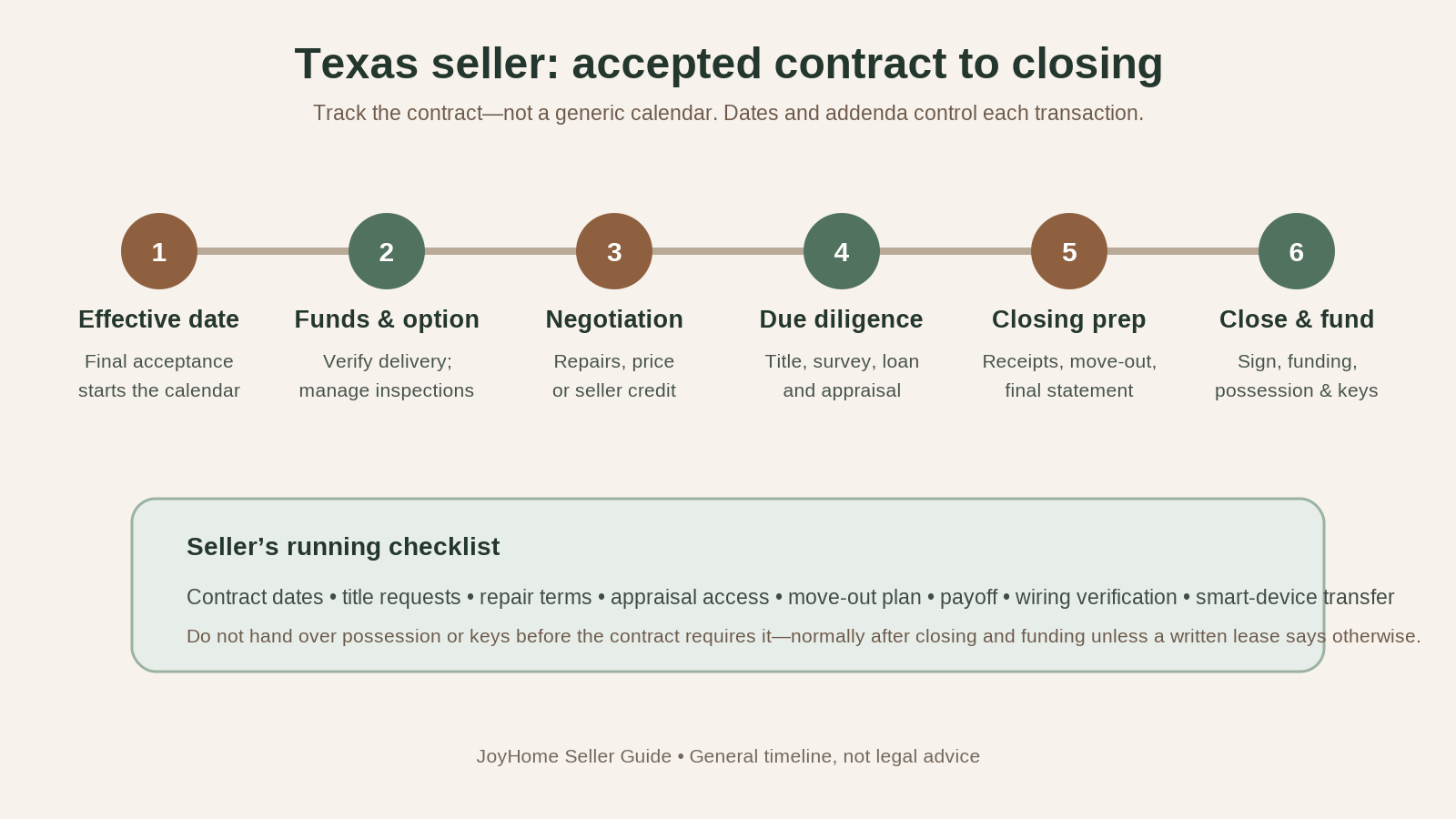
The sequence explains the workflow, not the deadlines in your file. Option, survey, financing and closing terms vary with the blanks and addenda in the contract.
Stage 1: build the contract calendar
Mark the effective date, option deadline, financing and appraisal dates, survey or document deadlines, and closing date
Keep the title company, buyer’s agent, lender contact and repair vendors in one place
List every addendum separately instead of relying on the first page of the main contract
Change a date or dollar amount only after the parties sign the appropriate written amendment
The closing date matters, but reaching that date does not automatically make the file ready. Title issues, financing conditions, written repairs and closing documents still have to reach the point where the transaction can sign and fund.
Stage 2: verify earnest money, option fee and the option period
The current TREC 20-19 resale contract generally requires the buyer to deliver the earnest money and option fee to the escrow agent within three days after the effective date. Its payment provision extends a last day that falls on a defined weekend or legal holiday. The option amount and length are negotiated entries in the contract.
The seller does not collect the money directly but should have the agent confirm receipt with the title company. If payment is late or missing, do not declare the contract void or assume who receives the earnest money based on a text message. Review the notice, remedy and legal issues in the actual contract.
During the option period, the buyer may inspect and investigate. Provide reasonable access, but do not assume every test is authorized. The contract specifically requires separate written seller authorization for certain testing, including hydrostatic testing.
Stage 3: respond to inspection negotiations in writing
A buyer may ask for repairs, a price change, a seller credit or nothing at all. Sort the report into safety and function, lender or insurer concerns, maintenance and buyer preference. Then weigh cost, scope, timing and closing risk.
The seller should act only on the final written agreement. “I’ll take care of that” on a phone call is not a reliable repair standard. For a deeper decision framework, read How Houston sellers should handle inspection repair, price and credit requests.
When the seller agrees to repair, define the item, completion date, any license requirement, and the receipts or reports that must be delivered. Avoid leaving “repair as needed” to two different interpretations.
Stage 4: title, survey, HOA, appraisal and financing move together
What might the title company need from the seller?
An existing survey and the related affidavit or declaration required by the contract
Payoff information for mortgages, home-equity loans, solar obligations or other liens
Marital-status, divorce, probate, trust, entity or signing-authority documents
HOA, lease, fixture-lease and other records that affect title or delivery
Identification, signing arrangements and verified proceeds instructions
TREC 20-19 states a contract period for delivery of the title commitment, but survey responsibility and timing, title objections and special notices depend on the selections and blanks in the agreement. Early delivery of seller documents gives the title company more time to identify an unreleased lien, name mismatch, probate issue or signing problem.
What can the seller do for appraisal and financing?
Keep the home accessible and provide accurate, supportable information about the property, improvements and repairs. Let the appraiser inspect without the seller following along or pushing a target value.
A low appraisal does not automatically require a price reduction. Review the financing and appraisal addenda, the buyer’s cash capacity and the negotiation choices before responding. See What Houston sellers can do when the appraisal is below the contract price.
Can the property still be marketed under contract?
Continued showings and backup offers depend on listing status, MLS rules, the first contract and the addendum being used. A backup contract is not an informal waiting list; it carries its own effective terms, money, option rights and process for moving into primary position.
After the effective date, the current TREC resale contract also restricts a seller from creating a new lease, changing an existing lease or conveying another interest in the property without the buyer’s written consent.
Stage 5: the seller’s nine-item closing-week checklist
Complete written repair obligations and retain invoices, photographs, warranties and permits
Confirm which appliances, curtains, mounts, controls and other items must remain
Remove personal belongings, trash and excluded items without removing included fixtures or accessories
Maintain the home, yard, pool and systems, and keep utilities on through the required point
Deliver payoff, identity and signing documents to the title company and address name or title issues early
Review the seller settlement statement for price, payoff, prorations, HOA charges, credits, agreed fees and estimated net proceeds
Verify proceeds instructions with the title company through a known phone number; treat last-minute bank-detail emails as a fraud warning
Organize keys, remotes, gate access, warranties and smart-device transfer information
Confirm signing, closing, funding and possession timing instead of assuming they happen together
The final walkthrough is not a new full inspection. It checks condition, repairs and agreed items near closing. If a problem appears, read What happens when a Texas final walkthrough finds a problem.
Stage 6: signing is not the same as funding and possession
After the seller signs, the title company still confirms buyer funds, lender funds, documents and disbursement conditions. Texas insurance guidance describes closing the transaction as work that includes proper execution of documents, passage and disbursement of funds, final title review and necessary recording.
The TREC resale contract generally delivers buyer possession upon closing and funding unless a written temporary lease provides otherwise. Do not hand over keys merely because the seller finished signing, and do not cancel insurance or surrender control before funding and possession are confirmed.
At possession, the current form also requires the seller to provide the access codes, usernames, passwords and applications needed for included smart devices, and to remove the seller’s own access from personal phones and computers.
Eight mistakes that cause delay or conflict
Tracking only the closing date and ignoring option, title, financing and document deadlines
Treating a verbal promise as an executed contract change
Allowing potentially damaging testing without required written authorization
Finishing repairs without receipts, photographs or a clear completion standard
Removing an included fixture, remote or smart-home component during the move
Stopping utilities or insurance early or allowing condition to decline before closing
Responding to an email that changes banking instructions without independent verification
Handing over keys after signing but before the title company confirms funding and possession
Frequently asked questions
Can a seller change their mind after signing?
A change of heart is not an automatic termination right. Seller rights depend on the contract and facts, and refusing to perform may create default exposure. Ask the broker and a qualified attorney to review the documents promptly.
The buyer is not clear to close. Does the seller have to wait?
Review the financing addendum, approval dates, closing date and any proposed written extension. The seller may decide whether to sign an amendment, but a lender saying “almost done” does not itself change the contract.
When does the seller receive the money?
Signing and funding are separate. The title company disburses net proceeds after required funds and documents are satisfied. Timing also depends on the closing, lender, bank and the seller’s verified proceeds method.
Is a verbal agreement enough to extend closing?
Do not rely only on a call or text. A new date, added cost, repair, possession arrangement or other exchange should be documented in the appropriate written agreement. Disputed or complex situations need legal advice.
Joyce's Featured Listings

AI-generated illustration: a Greater Houston housing scene, not a real or currently available listing.
After learning what happens between contract and closing, browse Joyce's Featured Listings to see how current Greater Houston homes present key property and transaction information.
View Joyce's Featured Listings →
Already under contract and unsure what comes next?
Send me the property address, effective date, option deadline, closing date and the inspection, title, appraisal or financing issue currently in front of you. I can help organize the seller timeline and action list, then direct legal questions to a qualified attorney.
About Joyce Tang

Joyce Tang is a Greater Houston real estate agent and investor, co-founder of the North American Real Estate Association, founder of JoyHome and JoyNest, and co-leader of the Dr. Wang Real Estate Team.
She has helped more than 200 families buy or sell homes and has participated in more than 40 renovation projects. Her approach examines not only price, but also location, carrying cost, cash flow, risk and future exit options.
Disclaimer
This article is based on the general Texas residential resale process and public TREC materials reviewed through October 2026. It is general information, not legal, tax, lending, title or insurance advice. Actual deadlines, termination rights, earnest-money entitlement, repair duties, default remedies, closing and possession depend on the signed contract, addenda, title-company requirements and applicable law. Consult a qualified Texas attorney when legal rights must be interpreted or changed.