

You can shop after a homeowners insurance renewal increase, but do not compare annual premium alone. Coverage, settlement method, limits, deductibles and exclusions must line up; otherwise, a quote that saves a few hundred dollars can create thousands more in out-of-pocket cost after a claim.
Put the old declarations page, renewal and new quote side by side. If any of the seven items below differs, the prices are not for the same product.
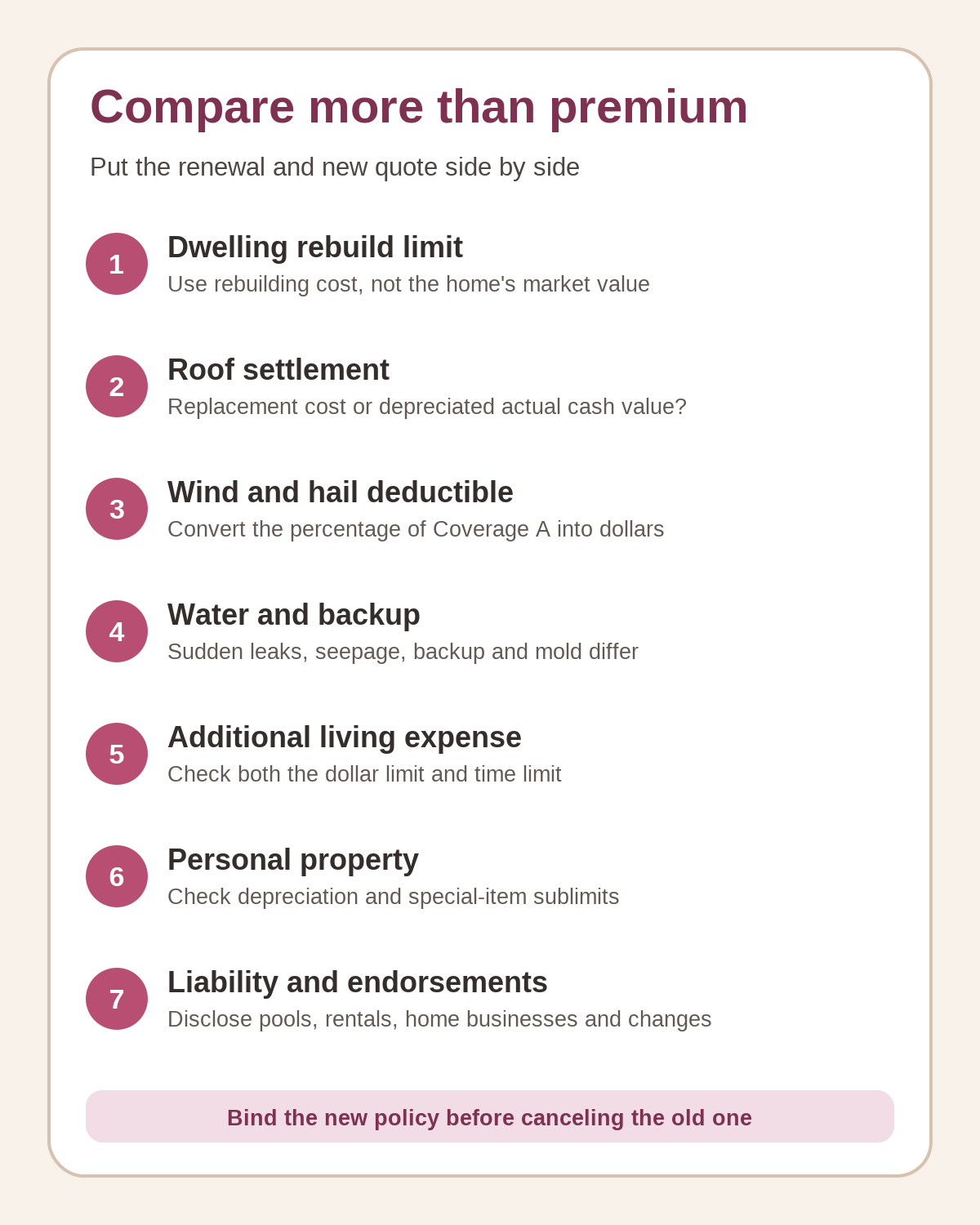
1. Dwelling coverage should reflect rebuilding cost—not market value
Coverage A is mainly intended to repair or rebuild the structure. It is not the sale price or county appraisal, and land value is not the cost of rebuilding the house. Verify square footage, construction year, exterior, roof type and renovations, then ask how the replacement-cost estimate was developed.
A lower dwelling limit is not automatically a benefit because the premium fell. A large increase also deserves an explanation. The goal is a reasonable estimate based on accurate property information.
2. A roof can change from replacement cost to actual cash value
The Texas Department of Insurance warns that some carriers move an aging roof from replacement-cost coverage to actual cash value at renewal. Actual cash value subtracts depreciation for age and condition, so an older roof can produce a much smaller payment.
Do not ask only whether the roof is covered. Ask whether wind or hail damage is settled at replacement cost or actual cash value, whether an age schedule applies, and whether the policy has cosmetic-damage, material or roof exclusions. Request the specific endorsement or schedule.
3. Convert wind and hail deductibles into dollars
Greater Houston policies often separate wind, hail and other-peril deductibles. A percentage deductible is commonly based on the dwelling limit, not on the amount of a particular loss.
For illustration, a 2% wind-and-hail deductible on $500,000 of dwelling coverage is $10,000. At 1%, it is $5,000. Convert every percentage before comparing quotes and decide whether that cash would be available after a storm.
4. Break water damage into separate questions
A sudden pipe break, long-term seepage, sewer or drain backup, surface flooding, mold remediation, and foundation or slab damage may be handled under entirely different provisions. TDI’s own comparison worksheet lists several of these separately.
Ask how the policy treats sudden accidental discharge, repeated seepage, water backup, mold, and foundation or slab-related water damage. Most homeowners policies do not cover surface flooding, so flood insurance needs a separate review.
5. Check both dollars and time for additional living expense
When covered damage makes a home uninhabitable, additional living expense coverage may reimburse reasonable extra costs such as a hotel, temporary rental and added meal expense, subject to policy terms and limits. TDI notes that many policies set this as a percentage of dwelling coverage and may also impose a time limit.
Ask two questions: What is the maximum dollar amount, and how long can payments continue? After a widespread Houston storm, repair schedules can stretch out.
6. Check how personal property is settled
Furniture, appliances and electronics may be covered at replacement cost or depreciated actual cash value. Jewelry, art, collectibles, firearms and high-value electronics can also have category or per-item sublimits.
A practical inventory does not require pricing every spoon. Record a room-by-room video, photograph higher-value items and serial numbers, and keep receipts in cloud storage.
7. Update liability and endorsements when the property changes
Pools, trampolines, rentals, short-term rentals, home businesses, solar equipment, extended vacancy and major renovations can affect underwriting or require disclosure. Do not wait for a claim to discover that the insurer still has years-old property information.
Review personal liability and medical-payments limits as well. Liability coverage is different from repairing your home; it addresses situations in which you are legally responsible for injury or property damage to someone else.
A 15-minute side-by-side comparison
Gather the old declarations page, renewal, new quote and every endorsement list.
Confirm the address, square footage, home age, roof year, mortgage company and occupancy match.
Write the dwelling, other structures, personal property, loss of use, liability and medical-payments limits side by side.
Convert wind, hail, hurricane and other-peril deductibles into dollars.
Mark roof, water, mold, backup, foundation or slab, and flood as covered, limited or excluded.
Identify lost discounts, new proof requirements, and whether the price is annual or installment-based.
Ask the agent or carrier to document every difference and provide the form or endorsement number.
Eight questions to send the agent or carrier
How was the dwelling limit calculated, and are the square footage, roof year and construction records correct?
Is the roof settled at replacement cost or actual cash value? Is there an age schedule or exclusion?
What are the wind-and-hail and other-peril deductibles in dollars?
How are sudden leaks, seepage, water backup, mold, and foundation or slab-related water damage handled?
What are the dollar and time limits for additional living expense?
Is personal property replacement cost or actual cash value, and what special-item sublimits apply?
Do a pool, rental, home business, solar equipment or vacancy require an endorsement?
Please list every coverage reduced, removed or added compared with the existing policy.
When is it safe to switch?
Shop before renewal, but do not cancel the old policy while waiting for the new one. TDI recommends keeping the current policy until the new policy or written proof of coverage is in hand.
If the home has a mortgage, give the new insurance information to the servicer and confirm how escrow will pay the new premium and whether the old carrier will issue a refund. Avoid a coverage gap and do not assume every notice happens automatically.
Frequently asked questions
A renewal jumped. Does that mean I should switch carriers?
Not automatically. Identify whether the change comes from the dwelling limit, deductible, roof settlement, discounts or corrected property information, then compare quotes using matching terms.
The carrier will cover an older roof only at actual cash value. What can I do?
Ask for the age schedule, inspection requirements and whether replacing the roof can restore replacement-cost coverage, then compare other carriers. Do not misstate the roof age or condition to obtain a quote.
Does homeowners insurance include flood?
Most homeowners policies do not cover surface flooding. Flood coverage requires a separate review, and being outside a mapped high-risk zone does not eliminate the need to evaluate the property and policy.
Escrow pays my premium. Do I still need to review the renewal?
Yes. The mortgage servicer pays the bill; it does not decide whether the limits are adequate, the roof settlement changed, or an endorsement disappeared.
Related guides
If you are buying, continue with why insurance should be checked before closing, what a roof inspection should answer and how to evaluate supply-pipe and repiping risk.
Sources and image note
Primary sources: the Texas Department of Insurance shopping checklist, declarations-page guide, roof coverage and renewal guidance, replacement cost versus actual cash value guide, additional living expense guide and homeowners comparison worksheet. Flood guidance was checked against the National Flood Insurance Program. Sources checked November 3, 2026.
The cover is a real at-home document-review scene photographed by Nataliya Vaitkevich from the Pexels source page under the Pexels License. It was cropped, resized and compressed. The seven-item graphic is an original JoyHome infographic based on the official sources above and contains no generative imagery.
Joyce's Featured Listings

Insurance is part of the long-term cost of owning a home. Browse Joyce's Featured Listings, then request address-specific quotes using the home's age, roof and intended use before relying on the mortgage payment alone.
View Joyce's Featured Listings
Have a renewal and unsure whether the cheaper quote is truly comparable?
Share the area, construction year, roof year, dwelling limit, deductible and roof settlement method from each quote. Redact policy numbers and personal information. I can help organize the property and carrying-cost questions to take back to a licensed insurance professional.
About Joyce Tang

Joyce Tang is a Greater Houston real estate agent and investor, co-founder of the North American Real Estate Association, founder of JoyHome and JoyNest, and co-leader of the Dr. Wang Real Estate Team.
She has helped more than 200 families buy or sell homes and has participated in more than 40 renovation projects. Her approach examines not only price, but also location, carrying cost, cash flow, risk and future exit options.
Important notice
This article provides general Texas homeowners insurance renewal information. It is not insurance, legal or claim advice, and Joyce is not presented as a licensed insurance agent. Coverage, settlement method, deductibles, exclusions and endorsements are governed by the issued policy, declarations and written carrier records. Consult a licensed insurance professional before buying, canceling or replacing coverage, and confirm that the new policy is in force first.