
A toilet that flushes once is not necessarily secure, leak-free or draining correctly. During a home purchase, the useful question is whether the symptom points to an inexpensive tank part—or to a failed seal, drainage problem or moisture-damaged floor.
There is no need to remove the toilet or operate an old shutoff valve during a showing. A gentle stability check, one flush, careful listening and a dry-surface check can identify what deserves professional follow-up.
What does a standard Texas inspection cover?
Current Texas Real Estate Commission minimum standards require inspectors to report visible active leaks, fixture drain performance, and deficiencies in commodes and other plumbing fixtures. The inspection uses normal controls and accessible observations; it does not require removing the toilet to see the seal, flange or concealed floor.
A report that says the toilet flushed normally therefore does not prove that the area under the base is dry or that the main drain line is clear. It describes performance within the visible, accessible scope at the time of inspection.
1. Check stability gently—never rock it hard
Hold the seat area or bowl and apply light side-to-side pressure. The fixture should not move noticeably. Do not push the tank or use force; porcelain can crack, and movement can worsen an already weak seal.
Movement may come from loose bolts, but it can also indicate a damaged flange, improper installation height or a moisture-softened subfloor. Simply tightening the bolts is not always the right repair, and overtightening can crack the fixture.
2. Look for new moisture after flushing
Confirm the floor is dry, then flush once or twice. After the tank finishes refilling, touch dry tissue around the base. Fresh moisture is easier to detect this way than by sight alone.
A wet base often raises concern about the toilet seal, but water can also travel down from tank bolts, the supply hose or shutoff valve. Trace the highest wet point before assuming that a new wax ring is the entire repair.
3. Separate the tank, supply hose and shutoff
Look at the tank bolts, both ends of the supply connector, the wall shutoff and the tank exterior for droplets, corrosion, mineral deposits and old stains. Use tissue on visible connections if needed, but do not operate an unfamiliar valve during a showing.
In humid weather, condensation can form on the tank. Condensation is different from a leaking connection, but repeated dripping can still damage the baseboard and floor. Follow the starting point and timing of the water.
4. Listen until the toilet actually becomes quiet
A normal cycle should flush, refill and stop. Continuous running, an unusually long refill, or periodic “phantom” refilling often points to a flapper, fill valve, chain or water-level issue. These are commonly easier than floor repairs, but they waste water and can distract from other leaks.
After ownership—or with explicit permission—the EPA dye test can reveal a silent tank leak: place a few drops of food coloring in the tank, wait 10 minutes without flushing, and check whether color enters the bowl. Flush immediately afterward to avoid staining. Do not add dye during a showing without permission.
5. Slow flow, gurgling and bubbles can extend beyond the toilet
Watch the strength of the flush, recovery of the bowl water level, slow drainage, gurgling and bubbles in a nearby sink. If several fixtures are slow or react when the toilet flushes, the problem may not be inside the toilet.
Possibilities include a local obstruction, vent problem, branch drain or main sewer line. A standard inspection observes fixture performance, but that is not the same as a sewer-camera inspection. An older home, mature trees or symptoms at several drains can justify a separate scope.
6. The floor can cost more than the toilet
Look for staining, swelling, cracked grout, old patches, odor or softness around the base and wall. A small seal leak may dry at the surface while the subfloor stays wet over time.
If the floor is soft, do not estimate the issue as “reset toilet” only. The flange, seal, subfloor, finish material and removal/reinstallation may need separate evaluation. In an upstairs bathroom, look at the ceiling directly below for stains or fresh paint.
A two-minute showing check
Look for existing moisture, patches, floor discoloration and baseboard damage.
Press the bowl or seat area gently for movement; never push the tank.
Flush once and watch bowl level, flow and drain speed.
During refill, inspect tank bolts, connector, shutoff and floor for fresh moisture.
After refill stops, listen for running or a later phantom refill.
Photograph and record symptoms for the inspector; do not disassemble or operate old valves.
Small repair or a reason to investigate further?
Often smaller: isolated running, an aging flapper, chain or fill-valve adjustment, with a stable base and dry floor.
Plumber follow-up: movement, moisture after flushing, corroded shutoff or connector, or cracked porcelain.
Expanded evaluation: a soft or musty floor, ceiling stain below, or several fixtures that drain slowly or gurgle.
Consider a sewer scope: older piping, mature-root conditions, repeated clogs, or connected symptoms at multiple drains.
During the option period, do not write only “repair toilet”
A vague request can result in one inexpensive part being replaced while base movement, floor damage or drainage symptoms remain. Separate the observations: where and when water appears, whether the base moves, whether the floor is affected, and whether drainage is abnormal.
After repair, review the invoice for the actual work and recheck stability, dry connections, flush/refill behavior and drainage. If the floor was affected, confirm the extent rather than relying on a new bead of caulk.
Frequently asked questions
Does caulk around the base prove the toilet cannot leak?
No. Caulk can finish the edge, but it does not replace the internal seal and may make a small leak harder to notice. Use stability, post-flush moisture and floor condition together.
Is occasional phantom refilling serious?
It commonly indicates a slow tank leak and is often a modest repair. If it appears with a wet base, damaged flooring or a leaking supply connection, replacing the flapper alone is not enough.
Will a new toilet fix a slow flush?
Not necessarily. The restriction may be in the fixture, branch drain, vent or farther down the sewer line. Multiple affected fixtures are a reason to evaluate drainage before replacing the toilet.
The seller just installed a new toilet. Does it still need inspection?
Yes. A new fixture can be loose, poorly sealed or leaking at the supply, and it does not prove that old floor or drain problems were corrected.
Related guides
Toilet findings often overlap with supply, drainage and bathroom moisture. Continue with when a sewer scope is worth adding, how to evaluate supply-pipe and repiping risk and whether the bathroom fan actually removes moisture.
Sources and image note
Primary sources: the Texas Real Estate Commission inspection standards, TREC explanation of visible plumbing and fixture inspection, EPA WaterSense home-maintenance guide and WaterSense leak-detection guidance. Sources checked November 3, 2026.
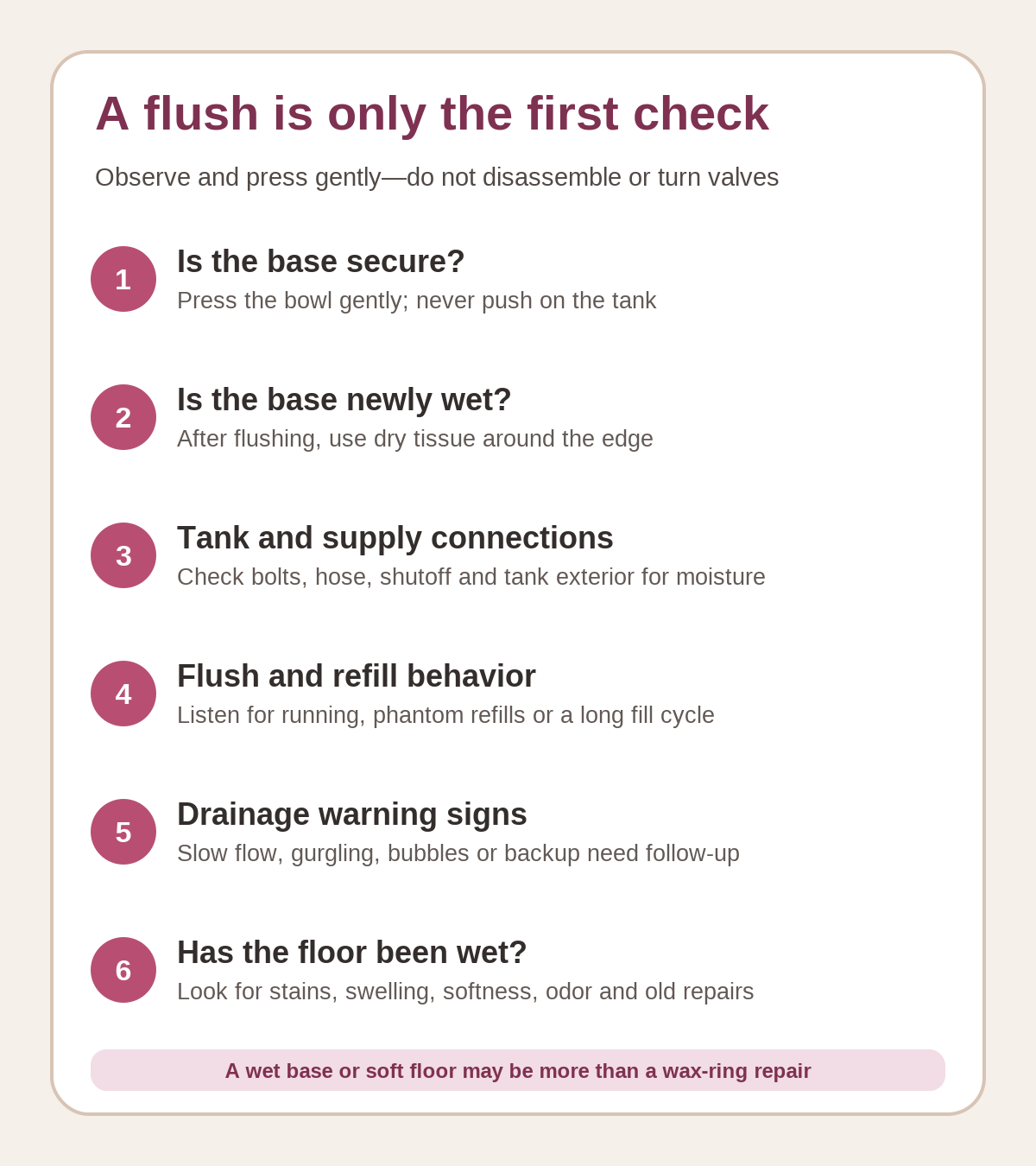
The cover is a real residential bathroom photographed by Max Vakhtbovych from the Pexels source page under the Pexels License. It was cropped, resized and compressed. The six-item graphic is an original JoyHome infographic based on the official sources above and contains no generative imagery.
Joyce's Featured Listings

A renovated bathroom does not prove that the toilet base, supply connection and surrounding floor were handled correctly. Browse Joyce's Featured Listings, then use this checklist on the homes you are considering.
View Joyce's Featured Listings
The inspection report lists a toilet issue—what should the request actually address?
Share the property address, clear photos of the base and surrounding floor, and the relevant inspection pages, with personal information redacted. I can help separate a tank component, base seal, moisture-damaged floor and drainage-system question before the option period ends.
About Joyce Tang

Joyce Tang is a Greater Houston real estate agent and investor, co-founder of the North American Real Estate Association, founder of JoyHome and JoyNest, and co-leader of the Dr. Wang Real Estate Team.
She has helped more than 200 families buy or sell homes and has participated in more than 40 renovation projects. Her approach examines not only price, but also location, carrying cost, cash flow, risk and future exit options.
Important notice
This article provides general home-buying and plumbing-fixture inspection information. It is not inspection, plumbing, construction, mold-remediation or legal advice and does not replace evaluation by a Texas-licensed inspector or qualified plumber. Do not remove a toilet, force the fixture or operate an unfamiliar valve during a showing. Stop use and obtain professional help for sewage backup, a soft floor or an active leak.