

If a Houston seller offers $10,000, the best use is not automatically a $10,000 price cut. A buyer short on closing cash may benefit more from eligible closing-cost help; a buyer keeping the mortgage for years may benefit more from a permanent rate buydown; and a buyer expecting income to rise may consider temporary payment relief. The right answer depends on the actual loan quote, expected holding period and cash remaining after closing.
My practical rule is simple: negotiate the result you need, not just the largest-looking concession. Ask the lender to price the same transaction four ways on the same day, then compare cash to close, full monthly payment and break-even time.
Why this question matters in Houston now
Houston’s September 2026 single-family median price was essentially flat at $325,000, but inventory reached 5.5 months and pending sales fell 11.6%. Buyers have more choices, while sellers are competing for a smaller pool of payment-qualified buyers. Source: HAR September 2026 Housing Market Update.
At the same time, Freddie Mac reported a 7.40% national average for a 30-year fixed mortgage on October 15. That survey is not an individual Houston quote, but it explains why a concession that changes monthly payment can matter more than a small change in headline price. Source: Freddie Mac mortgage rates and affordability.
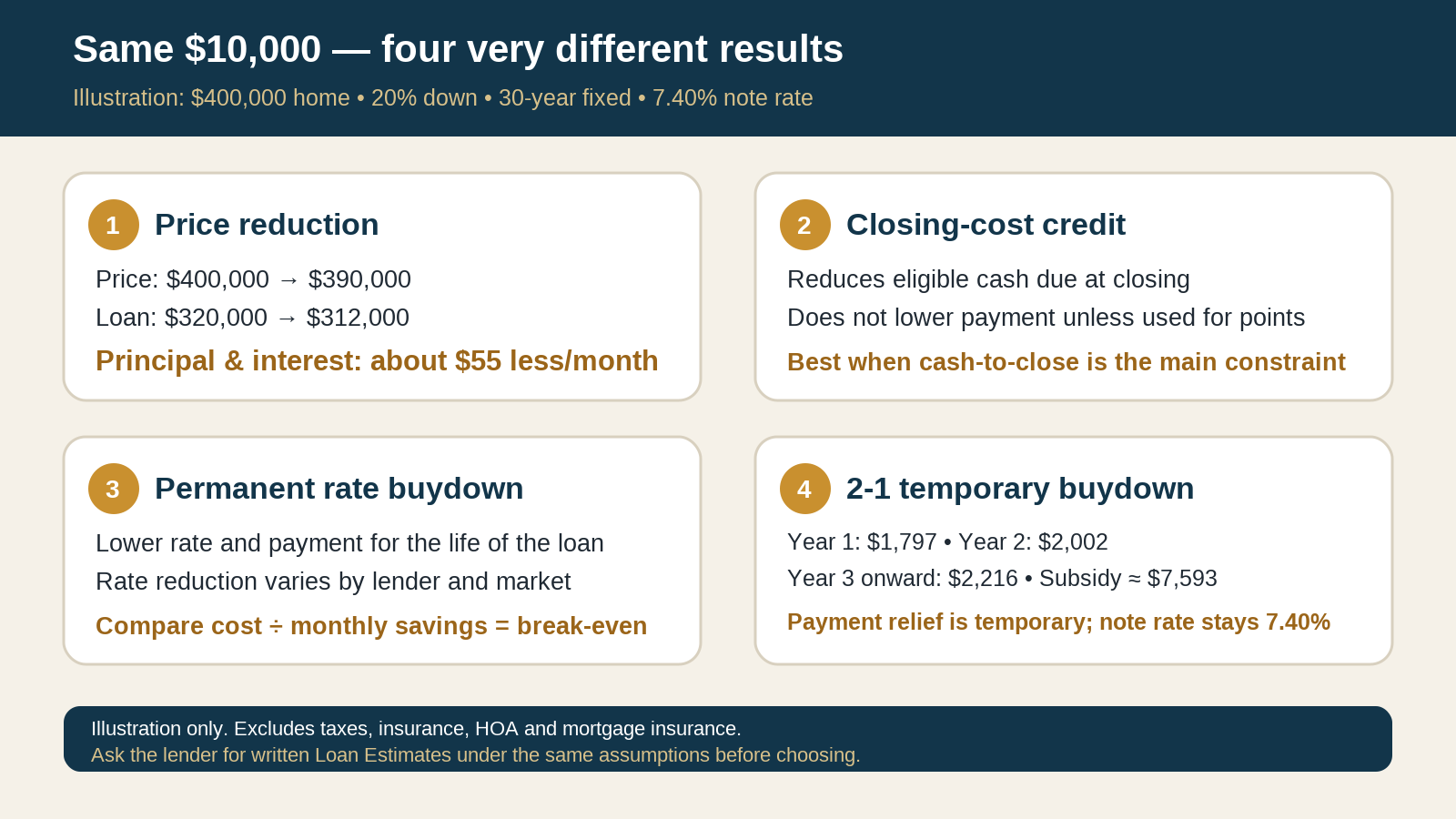
A $400,000 example: what does the same $10,000 actually do?
Assume a $400,000 home, 20% down, a $320,000 30-year fixed loan and a 7.40% note rate. The payment examples below include principal and interest only. Property tax, insurance, HOA dues and mortgage insurance, if any, are separate.
1. Reduce the price by $10,000
If the price falls from $400,000 to $390,000 and the buyer still puts 20% down, the loan falls from $320,000 to $312,000. At 7.40%, monthly principal and interest falls from about $2,216 to $2,160—roughly $55 per month.
A price reduction improves the purchase basis and saves interest over time, but it may not solve a buyer’s immediate cash problem. With 20% down, a $10,000 price cut reduces the down payment by $2,000, not $10,000.
2. Use the $10,000 for eligible closing costs
A closing-cost contribution can reduce the buyer’s cash due for eligible costs and prepaids. It normally does not lower the monthly payment unless part of it is used for discount points. This can be the strongest choice for a buyer who qualifies for the payment but wants to preserve reserves for moving, repairs or an insurance deductible.
The full amount may not be usable. The buyer must have enough eligible costs, and the contribution must fit the loan program, down payment, appraisal and lender rules. Fannie Mae states that financing concessions cannot exceed the borrower’s closing costs and calculates maximum limits using the lower of the sales price or appraised value. Source: Fannie Mae interested-party contribution rules.
3. Use it for a permanent rate buydown
Discount points are upfront charges tied to a lower interest rate. One point equals 1% of the loan amount, but one point does not always reduce the rate by the same amount. Pricing changes by lender, loan type and market conditions. The CFPB recommends comparing offers with and without points over several possible time horizons. Source: CFPB guide to points and lender credits.
The useful calculation is: cost of the permanent buydown divided by monthly savings equals the break-even period. If a buydown costs $8,000 and saves $140 per month, the simple break-even is about 57 months. If the buyer sells or refinances before then, the paid points may not be recovered. This is only a method—not a quote—and the lender must supply the real pricing.
4. Use a 2-1 temporary buydown
A 2-1 buydown applies a subsidy to payments for the first two years while the mortgage note keeps its full rate. In this example, payments calculated at 5.40% in year one are about $1,797; at 6.40% in year two, about $2,002; and at the 7.40% note rate from year three onward, about $2,216. The approximate two-year subsidy is $7,593.
This can help with the transition into a new payment, but it is not a substitute for affordability. Fannie Mae’s temporary buydown rules require the mortgage documents to show the permanent terms, and the borrower is not relieved of the note payment obligation if subsidy funds are unavailable. Seller-funded buydowns also count toward applicable interested-party contribution limits. Source: Fannie Mae temporary buydown requirements.
Which choice fits which buyer?
- Cash to close is the main problem: prioritize a usable closing-cost contribution, while keeping adequate post-closing reserves.
- Monthly payment is the main problem and the loan may be kept for years: compare permanent buydown pricing and calculate break-even.
- Income is expected to rise, but the first two years are tight: a temporary buydown may help, provided the full payment is already affordable.
- The home is overpriced or future resale flexibility matters: a price reduction may be more valuable than financing relief.
- The home needs near-term work: do not spend every concession on the rate while leaving no cash or contractual solution for material repairs.
What I would ask the lender before changing the offer
- Provide four written scenarios on the same day: no concession, price reduction, permanent buydown and temporary buydown.
- Keep the loan type, down payment, lock period and estimated closing date the same in every comparison.
- Show the note rate, APR, points, principal-and-interest payment, total monthly payment and estimated cash to close.
- Confirm the maximum usable seller contribution for this buyer and whether any amount would go unused.
- Explain what happens to unused temporary buydown funds if the loan is refinanced or paid off early.
For a broader budget, read the Houston homebuying costs guide. When writing the offer, also compare the non-price terms in the Houston offer strategy guide. If the competing option is a builder’s advertised rate, use the builder incentive comparison guide to bring the promotion back to total cost.
Frequently asked questions
Can the buyer receive unused seller credit as cash?
Usually no. The contribution must be applied to lender-approved, documented eligible costs, and the loan program may cap it. Ask the lender and title company to confirm the exact usable amount before the contract is amended.
Does a 2-1 buydown change the mortgage note rate?
No. It temporarily subsidizes payments; the note retains the permanent rate. The buyer should budget and qualify based on the full payment required under the applicable loan rules.
Is a seller credit always better than a price reduction?
No. A credit may solve cash-to-close or payment pressure, while a price reduction may be better when the home is overpriced, the buyer expects to refinance soon or long-term basis matters more. Compare the actual numbers for the specific property and loan.
Browse Joyce's Featured Listings

If you want to see how these choices fit real asking prices and monthly budgets, browse Joyce's Featured Listings. This is the current listings hub; individual prices and availability may change.
View Joyce's Featured Listings
Want to compare the options for a specific home?
Send me the property address, expected price, down payment, loan type and how long you may keep the home. If you already have a Loan Estimate, include the rate, points and cash-to-close page. I can help organize the real-estate side of the comparison so you know which questions to take back to your licensed lender.
About Joyce Tang

Joyce Tang is a Greater Houston real estate agent and investor, co-founder of the North American Real Estate Association, founder of JoyHome and JoyNest, and co-leader of the Dr. Wang Real Estate Team.
She has helped more than 200 families buy or sell homes and has participated in more than 40 renovation projects. Her approach examines not only price, but also location, carrying cost, cash flow, risk and future exit options.
Mortgage and calculation disclosure
Market and mortgage figures are based on the cited sources and dates and may change. Calculations are illustrations, not loan quotes, and exclude property tax, insurance, HOA dues and mortgage insurance. Seller contributions, points and buydowns depend on the contract, appraisal, lender, loan program and borrower qualifications. Joyce Tang is not acting as a mortgage, tax or legal professional; confirm financing with a licensed lender and obtain appropriate tax or legal advice.