

A fixed mortgage rate does not guarantee that the total payment on a new Houston home will stay flat. Principal and interest may remain unchanged while the escrow portion rises to cover a completed-home tax bill, a higher insurance premium and repayment of an earlier escrow shortage. Buyers should stress-test the payment using the completed home—not the first low tax or escrow number they see.
If the first-year payment only works because taxes were estimated from an incomplete property, it is not the real long-term housing payment.
First separate the mortgage payment into its parts
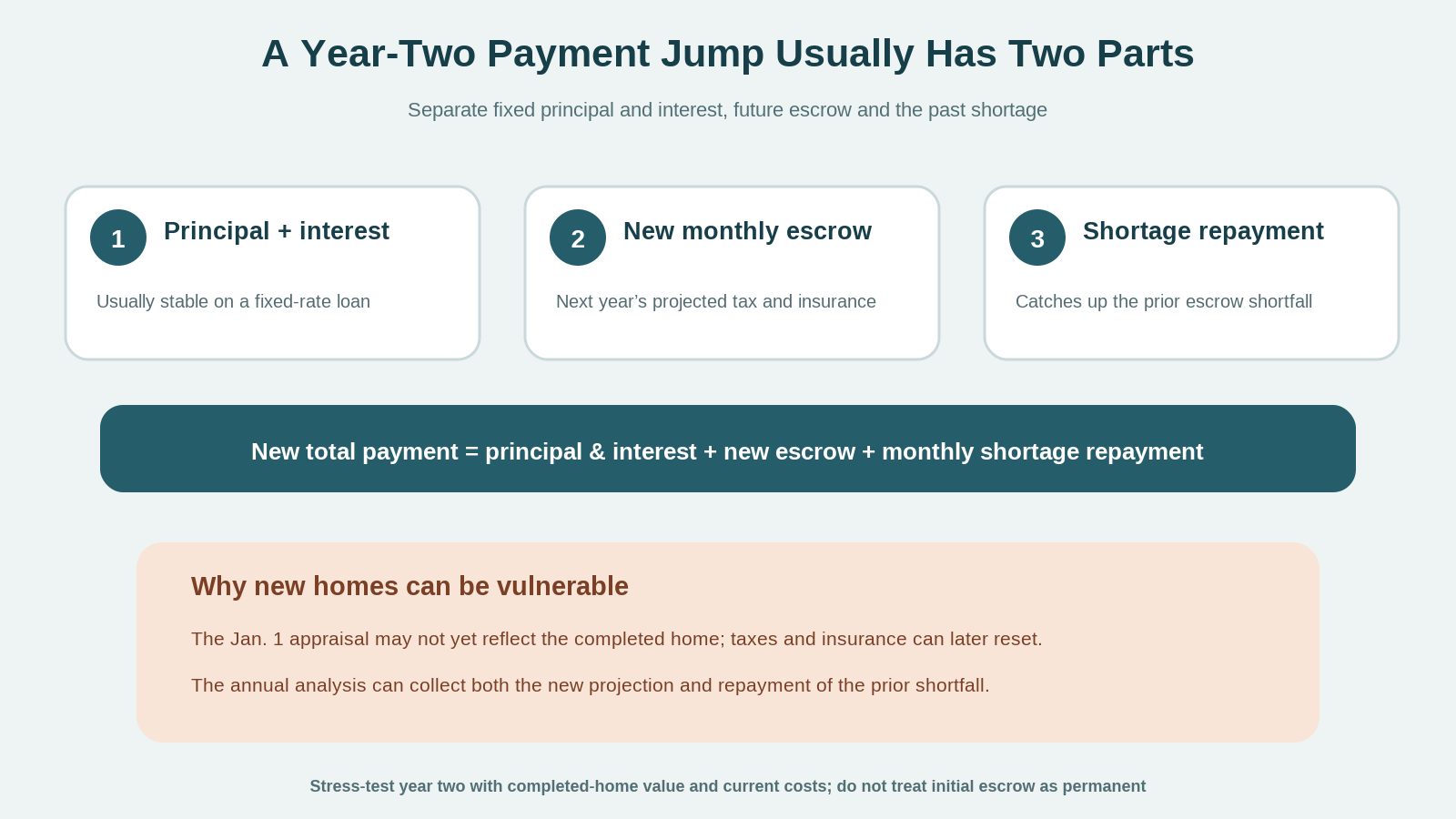
The CFPB explains the total payment as principal and interest, mortgage insurance when applicable, and escrow for items such as property taxes and homeowners insurance. With a fixed-rate loan, principal and interest are generally stable, but escrow can change when the underlying bills change. HOA dues, PID installments or other costs may be paid separately, so the lender’s monthly total is not always the full carrying cost.
An escrow account does not freeze taxes or insurance. The servicer collects money, holds it and pays covered bills. It periodically analyzes whether the account is collecting enough for the next year and whether the prior year ended with a surplus, shortage or deficiency.
Why the surprise often appears after buying new construction
1. Texas property value is measured as of January 1
Texas appraisal districts generally appraise taxable property at market value as of January 1. If a home was vacant land or only partly constructed on that date, that year’s appraisal may not reflect the later completed house. Harris Central Appraisal District says it updates property characteristics for new construction and appraises based on the property’s January 1 status. A later tax year can therefore show a much larger value once the completed improvement is included.
This does not mean every new home receives a land-only bill or that the next value will equal the purchase price. The result depends on construction status on the appraisal date, county records, market evidence, exemptions and applicable law. The useful question is: what completed-home taxable value and current taxing-unit rates should be used for a conservative estimate?
2. The initial escrow estimate may follow an incomplete tax picture
The Loan Estimate and Closing Disclosure show estimated taxes, insurance and assessments, but they are still estimates. Ask the lender which taxable value, tax rates, exemptions and insurance premium were used. A number copied from the prior tax bill may be technically real for that bill and still be a poor estimate of the completed home’s next full tax year.
Check page 1 of the Loan Estimate for the projected payment and the items included in escrow. Also identify costs marked as not escrowed. The CFPB warns that non-escrowed property costs still need to be paid directly, often in larger installments.
3. An escrow analysis can add the future increase and the past shortage
A servicer generally collects one-twelfth of the annual escrow payments it reasonably anticipates. At the annual analysis, it projects the next computation year and determines whether the prior account has a surplus, shortage or deficiency. If the servicer paid a tax or insurance bill larger than the amount collected, the new payment can contain two increases at once:
- A higher ongoing escrow deposit for the newly projected tax and insurance bills; and
- A temporary monthly amount to repay the shortage from the prior cycle.
That is why paying an allowed shortage amount may reduce the temporary catch-up portion but does not erase the higher ongoing tax or insurance estimate. Read the actual annual escrow statement and servicer options before sending extra money.
4. Insurance can move independently of property tax
The first premium is not a permanent quote. Renewal price, dwelling coverage, roof information, deductibles, wind or hail terms and carrier eligibility can change. A tax increase and an insurance renewal can land in the same escrow analysis, making the change look like one event. Ask for the tax and insurance components separately.
How to stress-test the second-year payment before signing
Step 1: estimate taxes using the completed home and every taxing unit
Start with the exact lot or address. Identify the county, school district, city when applicable, MUD or other special district, and any separate PID obligation. Apply current adopted rates to a reasonable completed-home taxable value, then model only the exemptions the buyer is likely to qualify for. Do not use the seller’s or developer’s current net bill as the final answer.
The related guide MUD, PID and HOA: Why Two Houston Homes With the Same Price Can Have Different Monthly Costs explains which obligations can overlap and which may sit outside lender escrow.
Step 2: verify homestead timing instead of assuming an automatic cap
A qualifying owner must apply with the county appraisal district. Texas allows certain buyers who acquire and occupy a residence after January 1 to receive the general residence homestead exemption for the applicable part of that year when statutory conditions are met. Eligibility and approval belong to the appraisal district.
A homestead exemption can reduce taxable value, but it does not make the first low new-construction bill permanent. The residence-homestead appraisal limitation applies only when the property qualifies, takes effect under statutory timing rules, and its formula adds the market value of new improvements. Do not assume a “10% cap” prevents a completed structure from entering the value.
Step 3: use the actual insurance quote and one renewal scenario
Use the bindable premium for the home—not a community average—and confirm whether wind or flood coverage is separate. Then test a higher renewal amount that your insurance professional considers reasonable. This is a planning scenario, not a prediction or promise of future premium.
Step 4: calculate the steady payment and the temporary catch-up separately
A useful planning framework is:
- Steady total payment = principal and interest + mortgage insurance, if any + projected completed-home taxes ÷ 12 + projected insurance ÷ 12 + other escrowed charges.
- Temporary payment during shortage recovery = steady total payment + the servicer’s monthly shortage repayment.
- Full carrying cost = lender payment + HOA/PID or other non-escrowed charges + utilities, maintenance and reserves.
The servicer’s exact escrow calculation follows the loan and federal rules; this formula is a buyer-side affordability check. The broader budget framework is in How to Build a Houston Homebuying Budget Beyond the Mortgage Payment.
What to ask the lender before closing
- Which appraised or taxable value did you use for the property-tax estimate?
- Does that value represent vacant land, construction in progress or the completed home?
- Which taxing units and rates are included, and is any PID amount separate?
- Which exemption, if any, did the estimate assume?
- Which insurance policies and premiums are escrowed, and which are paid separately?
- When will the first escrow analysis occur, and how will a shortage be shown?
- What would the total payment be using my completed-home tax estimate and current insurance quote?
For a new-build transaction, keep this calculation beside the contract review in Ready to Sign for a New Houston Home? Check These Eight Builder-Contract Terms First. The contract, loan and long-term carrying cost are three different checks.
If the payment already increased, read these five lines first
- Old versus new projected annual property tax;
- Old versus new homeowners insurance premium;
- The prior escrow account balance and actual disbursements;
- The stated shortage or deficiency and its repayment schedule; and
- The effective date and new total monthly payment.
Then compare the servicer statement with the actual county tax bill, appraisal-district record and insurance renewal. A value or exemption concern belongs with the appraisal district; a tax-payment question belongs with the tax office; an insurance premium or coverage issue belongs with the insurance professional; and an escrow collection or disbursement concern belongs with the loan servicer. Preserve statements, bills and dates.
Frequently asked questions
Does a fixed-rate mortgage mean my monthly payment cannot change?
No. The principal-and-interest portion is generally fixed, but escrowed taxes and insurance, mortgage insurance and other applicable components can change the total payment.
Will paying the escrow shortage in one amount restore the old payment?
Not necessarily. It may remove or reduce the temporary shortage-repayment portion if the servicer accepts it, but the ongoing escrow deposit can remain higher because future taxes or insurance are higher. Ask the servicer for the resulting payment in writing.
Will a homestead exemption stop a new home’s taxable value from rising?
It can reduce taxable value when approved, but it does not freeze the value or exclude newly completed improvements. Eligibility, timing, local exemptions and the statutory appraisal-limit calculation must be verified with the county appraisal district.
Is it safer to waive escrow?
Not automatically, and not every loan permits it. Without escrow, the owner must save for and pay taxes and insurance directly. The annual cost still exists even when it is no longer part of the mortgage-company payment.
Joyce's Featured Listings

AI-generated illustration: a Greater Houston housing scene, not a real or currently available listing.
Once you know how to test the completed-home tax and escrow payment, browse Joyce’s Featured Listings to see current home types and price ranges. For any new construction, recalculate the second-year payment using that lot’s taxing units, insurance and lender assumptions.
View Joyce's Featured Listings →
Comparing new Houston homes and want the second-year payment tested before you choose?
Send me the community or address, price, estimated completion date, lender payment worksheet, available tax information and insurance quote. I can help organize the real-estate cost comparison and identify which numbers should be confirmed with the lender, appraisal district, tax office or insurance professional.
About Joyce Tang

Joyce Tang is a Greater Houston real estate agent and investor, co-founder of the North American Real Estate Association, founder of JoyHome and JoyNest, and co-leader of the Dr. Wang Real Estate Team.
She has helped more than 200 families buy or sell homes and has participated in more than 40 renovation projects. Her approach examines not only price, but also location, carrying cost, cash flow, risk and future exit options.
Sources and disclaimer
Sources checked October 21, 2026: CFPB explanations of escrow accounts, principal-and-interest versus total payment, annual escrow analysis, shortages and deficiencies and the Loan Estimate; Texas Comptroller guidance on property valuation, property-tax basics and exemptions; and HCAD information about new-construction field appraisal.
This article provides general real-estate education, not lending, servicing, tax, legal, appraisal or insurance advice. Appraised values, exemptions, tax rates, construction status, escrow treatment, premiums and loan terms vary by property and borrower. Obtain written figures from the lender or servicer, county appraisal district, tax office and insurance professional; consult qualified tax or legal professionals for advice within their licenses.
Cover photograph by RDNE Stock project via Pexels under the Pexels License. Cropped and resized to 1600×900. The photograph is an illustrative home-finance scene and does not show an actual tax bill, loan file, client or listing.