
A Houston-area home can have a MUD tax, a PID assessment and HOA dues at the same time—and each pays for something different. Do not compare two homes by price and mortgage payment alone. Identify every district and association tied to the exact parcel, convert each obligation to an annual and monthly cost, and then check which numbers can change.
My rule is simple: if a cost is attached to the address, it belongs in the budget even when it does not appear in the listing’s “HOA” field.
The short version: MUD, PID and HOA are not interchangeable
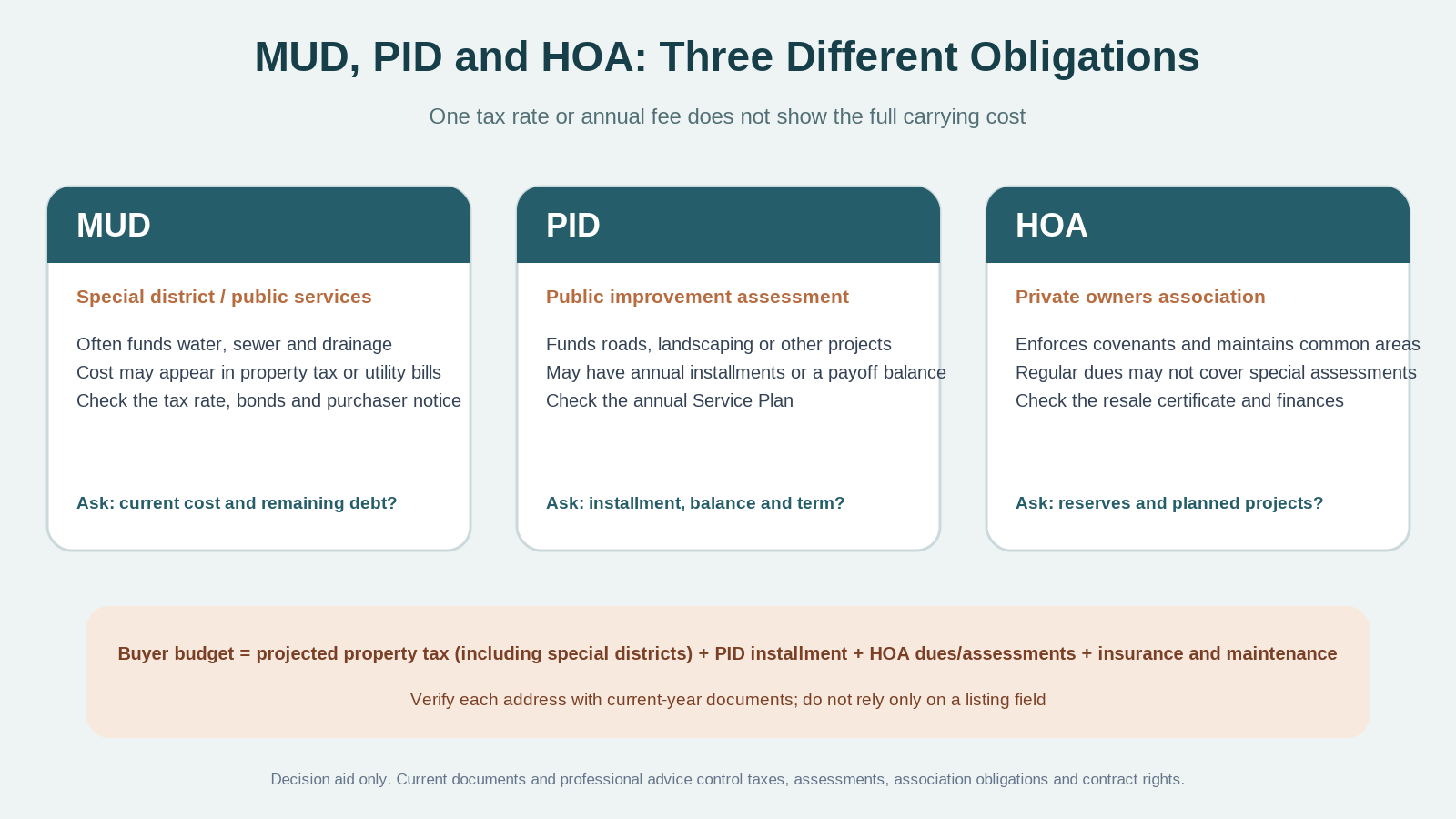
A property may have one, several or none of these layers. A subdivision name, mailing city or ZIP code does not establish the answer. Boundaries can split streets and sections, so the review must be address-specific.
MUD: a governmental district that can tax and provide services
A Municipal Utility District is a political subdivision created to provide services in a defined area. In Greater Houston, that often includes water, wastewater and drainage infrastructure, although powers and services vary by district. A MUD is not an HOA, and its tax is not a membership fee.
The cost can appear in more than one place. A district may levy property tax, charge utility rates and fees, or use other authorized revenue. The current property-tax rate is only one piece of the picture. Texas Water Code purchaser notices can include the district name, current or projected tax or assessment rate, voter-authorized bonds, tax-backed bonds already issued and other required information.
For a specific address, I would check:
- The current Notice to Purchaser issued or posted by the district—not an old builder handout.
- The district’s adopted tax rate, separating maintenance and operations from debt service when the records provide it.
- Authorized, issued and outstanding bonds, understanding that these figures add context but do not predict a future rate by themselves.
- The latest property-tax bill and appraisal-district taxing-unit list for the exact parcel.
- Current water and sewer rate schedules, connection fees or other district charges relevant to ownership and occupancy.
The TCEQ Water Districts Map Viewer is a useful starting point and links to district information, but TCEQ states that the map is informational, approximate and not a legal or on-the-ground survey. Use it to identify questions, then verify with the district, county records, title company and current transaction documents.
PID: a special assessment for public improvements or services
A Public Improvement District is generally created by a city or county to finance improvements or services within a defined area. Depending on the project, that may include streets, sidewalks, drainage, parks, landscaping or other authorized work. A residential property can carry a PID assessment even when the listing’s HOA field is blank.
The important number is not only whether a PID exists. Buyers should locate the current annual Service and Assessment Plan or service plan, the parcel-specific annual installment, the remaining assessment balance, the payment schedule and any payoff procedure. An assessment may be payable in annual installments and may be paid in full under the applicable documents; “paid through escrow” does not mean the obligation disappeared.
Texas law requires a prescribed PID notice in covered transactions before a binding contract is executed. If the notice arrives late or seems incomplete, do not improvise a legal conclusion. Preserve the document and dates, review the contract and ask a Texas real-estate attorney about rights and deadlines. As of January 1, 2026, Chapter 372 also requires the applicable city or county to post approved or updated service plans on the Internet site used for property-tax transparency.
HOA: a private association with dues, rules and shared obligations
A homeowners or property owners association is a private association governed by recorded covenants, bylaws and rules. Regular dues may support common landscaping, amenities, private roads, gates, management or other community responsibilities. The HOA is separate from a MUD or PID even when residents experience all three as one monthly housing cost.
Do not stop at the annual dues. For a Texas residential subdivision covered by Property Code Chapter 207, a current resale certificate can disclose the frequency and amount of regular assessments, approved special assessments due later, unpaid amounts tied to the property, approved capital expenditures, reserves, the current operating budget and balance sheet, judgments, lawsuits, common-area insurance and transfer-related fees. Condominium resales follow separate Chapter 82 rules, so a condo document review should not be treated as identical to a subdivision HOA review.
What I look for in the documents:
- Are regular dues current, and does the certificate show any balance tied to this property?
- Has a special assessment already been approved, and who pays it under the contract?
- Are reserves reasonable in relation to roofs, roads, gates, drainage, pools, elevators or other assets the association must maintain?
- Are large capital projects discussed in budgets, meeting records or notices even if no assessment has been formally approved?
- Do restrictions affect leasing, parking, exterior changes, short-term rentals or another planned use of the home?
- What transfer, resale-certificate, capital-contribution or other closing fees appear in the current documents?
How to calculate the real carrying cost before you make an offer
1. Build an address-specific obligation list
Start with the exact legal parcel, not the subdivision marketing name. Pull the county appraisal-district account and latest tax bill; identify every taxing unit; check the TCEQ district viewer; read the title commitment and recorded exceptions; locate the city or county PID plan; and obtain the HOA or condo resale package. The title commitment and survey serve different purposes, so use the checklist in Title Commitment, Survey or Title Insurance? What Houston Buyers Need to Check Before Closing when organizing the documents.
2. Put every cost on the same timeline
Convert the available figures to annual and monthly equivalents:
- Projected property tax: use an expected taxable value and the applicable current tax rates, then model exemptions only if the buyer is likely to qualify. Do not copy the seller’s net bill as the buyer’s forecast.
- PID: add the parcel’s current annual installment when it is separate from the reported tax total; also record the remaining balance and scheduled term.
- HOA or condo association: add regular dues, approved special assessments and known transfer or capital-contribution costs in the correct year.
- MUD or other district service charges: add current utility rates and recurring fees that are not already captured in property tax.
For the rest of the ownership budget—insurance, maintenance, utilities and cash reserves—continue with How to Build a Houston Homebuying Budget Beyond the Mortgage Payment.
3. Stress-test changes instead of assuming today’s bill is permanent
The current year is a snapshot. Property values and tax rates can change. A MUD can have outstanding or authorized debt. A PID plan is reviewed and updated over time. HOA dues can rise under governing documents, and major projects can lead to special assessments. I would run a base case using current verified figures and a higher-cost case that the buyer can still afford without relying on a promised future reduction.
A falling MUD tax rate can be encouraging, but it is not a guarantee of the next year’s bill. A growing tax base, new bond issuance, maintenance needs and property value changes can all affect the result. The same caution applies to a low HOA fee: a low fee with weak reserves can create more risk than a higher fee backed by an adequate maintenance plan.
4. Compare what the money buys—and what remains your responsibility
Higher carrying cost is not automatically bad. The district or association may be funding infrastructure and amenities the buyer values. But buyers should know which entity maintains drainage, detention, roads, landscaping, gates, parks, pools, fences and other shared assets—and which items still fall on the homeowner. Paying three bills does not mean three entities cover the same repair.
A practical five-document checklist
- Current county tax record and the parcel’s complete taxing-unit list.
- Current special-district Notice to Purchaser plus the district’s tax, bond and utility-rate information.
- Current PID Service and Assessment Plan, parcel installment schedule and payoff information.
- Current HOA or condo resale certificate, governing documents, budget, balance sheet, insurance certificate and relevant notices.
- Title commitment, survey and contract addenda showing recorded restrictions, easements, liens, districts and notice obligations.
Builders and sellers may summarize some of these figures, but the controlling question is what the current official and transaction documents say for this parcel. This is especially important when comparing a new home with a resale; incentives can change the first-year payment without changing the long-term district or association obligations. See Why Can a Houston New Home Cost Less Than a Resale Right Now? for the broader comparison.
Frequently asked questions
Can a home have MUD, PID and HOA charges at the same time?
Yes. They are separate entities or obligations and can overlap on the same parcel. Verify each layer independently.
Does a MUD tax eventually disappear?
Do not assume it will. Debt service may change as bonds are paid or issued, while the district may continue to levy taxes or charge for operations and services as authorized. Review current district records and budget conservatively.
Is a PID included in the property-tax rate shown on a listing?
Not necessarily. A PID assessment may appear on a tax bill or be collected in another documented way, but a listing field may omit it or describe it inconsistently. Use the parcel-specific assessment plan, tax records and title documents.
Is a low HOA fee always better?
No. Compare the fee with the association’s responsibilities, reserves, insurance, deferred maintenance and planned projects. A low fee can be appropriate, but it can also leave little cushion for major repairs.
Joyce's Featured Listings

AI-generated illustration: a Greater Houston housing scene, not a real or currently available listing.
Once you know how to separate MUD taxes, PID assessments and HOA obligations, browse Joyce’s Featured Listings to see current home types and price ranges. Every address still needs its own district, tax and association review.
View Joyce's Featured Listings →
Comparing two Houston homes and want the full monthly cost side by side?
Send me the exact addresses, expected use, purchase timing and any tax, PID, district or HOA documents you already have. I can help organize the real-estate due diligence and cost comparison, then identify which questions belong with the title company, district, association, lender, tax professional or Texas attorney.
About Joyce Tang

Joyce Tang is a Greater Houston real estate agent and investor, co-founder of the North American Real Estate Association, founder of JoyHome and JoyNest, and co-leader of the Dr. Wang Real Estate Team.
She has helped more than 200 families buy or sell homes and has participated in more than 40 renovation projects. Her approach examines not only price, but also location, carrying cost, cash flow, risk and future exit options.
Sources and disclaimer
Sources checked October 21, 2026: TCEQ guidance on Municipal Utility Districts and its Water Districts Map Viewer; Texas Water Code Section 49.4521 and the current TREC special taxing or assessment district notice; Texas Property Code Sections 5.014 and 207.003; Local Government Code Section 372.013; and Texas Comptroller and Texas.gov guidance on property-tax basics, local property-tax information and property-tax transparency.
This article provides general real-estate education, not legal, tax, accounting, engineering, lending, title or association-governance advice. District boundaries, tax rates, assessed values, exemptions, bonds, PID installments, HOA dues, reserves, restrictions and notices can change. Verify the exact parcel and current documents with the relevant appraisal district, tax office, district, city or county, association, title company and lender. Consult a qualified tax professional for tax treatment and a licensed Texas attorney for contracts, notices, restrictions, remedies or legal deadlines.
Cover photograph: a September 12, 2025 aerial view of developing land and neighborhoods in northeastern Harris County, photographed by Famartin and used under CC BY-SA 4.0 via Wikimedia Commons. Cropped and resized to 1600×900. The image does not establish that any visible property is in a MUD, PID or HOA and does not depict a listing. The adapted image is shared under the same license.