
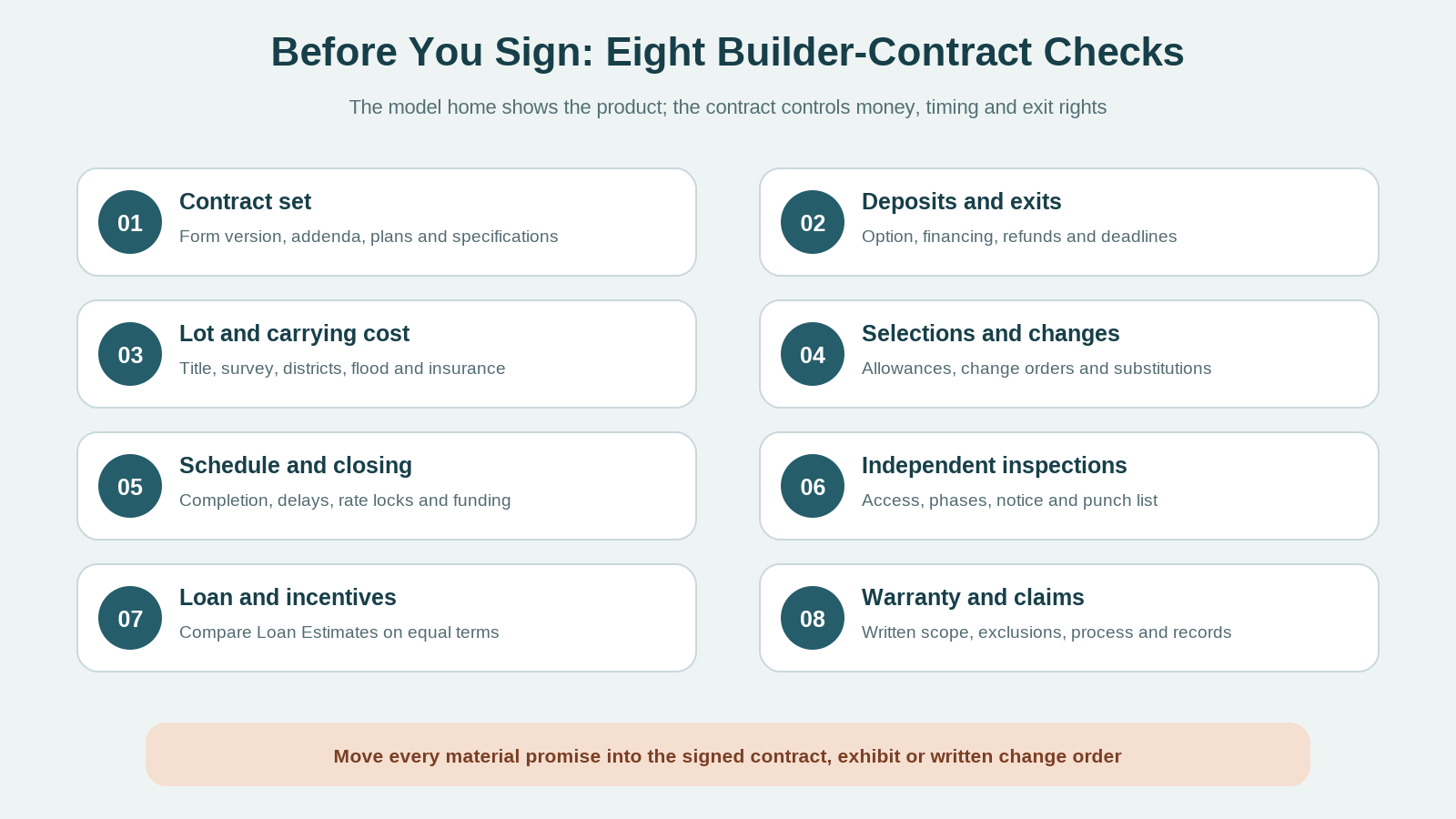
A new home is not ready to buy just because the model, price and incentive look right. Before signing, identify the exact contract and every document it incorporates, then check deposits, termination rights, construction specifications, delays, inspections, financing, closing and warranty procedures. A sales-office promise that never reaches the signed paperwork is hard to budget or enforce.
My practical rule: the model home shows what is possible; the signed contract says what this buyer is actually purchasing and when the buyer may walk away.
Start with the actual contract—not assumptions from a resale deal
Texas currently publishes separate TREC forms for completed and incomplete new construction. The current versions listed by TREC are Form 24-20 and Form 23-20, effective July 1, 2026. A transaction may instead involve builder- or attorney-drafted paperwork. Do not assume every new-home agreement has the same option, financing, repair or completion rights as a familiar resale contract. Read the document being offered, including every addendum and exhibit; ask a licensed Texas attorney to interpret or negotiate legal language when needed.
1. Confirm the complete contract set
Before signing, create one document list. It should identify the contract form and version, legal description or lot, price, addenda, community disclosures, construction plans, specifications, finish schedule, allowance sheet, design selections, warranty documents and any incentive or lender terms. If one document is “coming later,” decide whether signing before receiving it is acceptable.
In TREC Form 23-20, construction documents—including plans, specifications, finish schedules, change orders and allowances—can be incorporated into the contract. That is why the words “same as the model” are not a substitute for a written specification. Record room dimensions, structural options, appliance models, flooring areas, exterior materials, landscaping, fencing, irrigation and smart-home items only when they matter and can be stated accurately.
2. Trace every deposit, deadline and exit right
Write down each payment separately: earnest money, option fee, builder deposit, design-center deposit and change-order payment. For each one, identify the recipient, due date, whether it is credited at closing, the exact refund conditions and what happens after a buyer default. Do not describe a payment as refundable unless the signed agreement says so.
The current TREC incomplete-construction form provides spaces for earnest money and an option fee due within three days after the effective date, and an option termination right only when the paragraph is completed and the fee is timely delivered. Other contracts can work differently. Financing approval, appraisal, sale-of-existing-home and construction-delay issues also do not automatically create a right to cancel; each must be supported by the contract and applicable addenda. Put every deadline on a calendar with the required delivery method and local cutoff time.
3. Review the lot and the costs that survive closing
New construction does not remove land, title or carrying-cost questions. Verify the legal lot, easements, building lines, drainage and detention features, survey, title exceptions, flood information, homeowners insurance availability, property-tax assumptions, MUD or other district taxes, PID assessments and HOA obligations. A builder incentive may reduce cash at closing without changing these long-term costs.
For an address-by-address cost review, use MUD, PID and HOA: Why Two Houston Homes With the Same Price Can Have Different Monthly Costs. If a lot premium is charged, ask what physical or recorded feature supports it and whether the view, open land or adjacent use is guaranteed.
4. Control selections, allowances and change orders in writing
An allowance is a budget placeholder, not a promise that every selection fits that amount. Ask what labor, tax, delivery and installation it includes; how overages and unused balances are handled; and when selections become final. Check design-center deadlines and whether missing one lets the builder choose.
In the current TREC incomplete-construction form, change orders are to be written, and buyer selections follow stated deadlines. The form also addresses material substitutions of comparable quality in specified circumstances. A different builder contract may allocate much broader discretion. For every change, require the description, price adjustment, schedule effect and signatures before work proceeds. Keep one updated total rather than relying on scattered emails.
5. Define completion, closing and delay risk
A sales estimate such as “ready in December” may not be the contractual closing date. Find the definition of substantial completion, who certifies it, allowed delay events, notice requirements, the outside date—if any—and remedies if construction runs long. TREC Form 23-20 connects substantial completion to required final inspection or approval by applicable governmental authorities and the lender, while also addressing certain delays. Your actual contract controls.
Match that schedule against lease expiration, home-sale plans, moving arrangements, loan approval and rate-lock length. Ask the lender what an extension costs and who pays it; do not assume the builder covers it. Possession should follow the signed closing and funding terms, not the day furniture happens to arrive.
6. Preserve access for independent inspections and a documented punch list
Municipal inspections and a builder quality-control process are not the buyer’s independent inspection. The current TREC form allows buyer access at reasonable times and inspections by a TREC-licensed or otherwise permitted inspector, but the site schedule, safety rules, required notice and actual contract still matter. Confirm access before signing.
Depending on construction stage and contract, buyers commonly discuss foundation or pre-pour, framing or pre-drywall, final and warranty-period inspections. Not every phase is available on every home. Coordinate the inspector and builder early, deliver reports exactly as required, and separate life-safety or functional concerns from cosmetic punch-list items. A completed inspection does not force a repair unless the contract, warranty or applicable law creates that obligation.
7. Compare the preferred-lender incentive with the full loan
Builders often advertise money toward closing costs, a rate buydown or upgrades when the buyer uses an affiliated or preferred lender. The CFPB notes that buyers do not have to use a builder-associated lender and may shop. Compare written Loan Estimates on the same loan amount, down payment, lock period and points—not a rate quoted at different assumptions.
Review interest rate, monthly principal and interest, mortgage insurance, origination charges, points, lender credits, cash to close and the CFPB five-year cost comparison. An incentive can be valuable, but the net result depends on the price, loan terms, title or settlement charges, required upgrades and how long the buyer expects to keep the loan. For the broader math, read Builder Incentives Aren’t Free Money: How Houston Buyers Should Compare the Real Cost.
8. Read the warranty before the first claim
Collect the builder warranty, manufacturer warranties, claim instructions, emergency contacts, maintenance obligations, exclusions, response timelines and transfer rules before closing. TREC Form 23-20 states that, except as provided in the contract, a separate writing or law, the seller makes no other express warranties, and it addresses transfer of assignable manufacturer warranties. Never assume a verbal “one-year warranty” answers what is covered.
Document the final walkthrough and punch list with dates and photographs, keep closing and construction records, and report problems using the required written procedure. Texas Property Code Chapter 27 may impose notice and an opportunity to inspect and offer repair before certain residential-construction defect actions. That is a legal process, not a do-it-yourself checklist; consult a Texas attorney promptly when a serious defect, missed deadline or unresolved claim appears.
A practical signing-day checklist
- I received the contract, every addendum and every incorporated exhibit before signing.
- I can state which payments are refundable, under what clause and until what exact deadline.
- The plans, specifications, selections, allowances and incentives I rely on are in writing.
- I understand the builder’s substitution, change-order, delay and closing rights.
- I verified the lot, title, districts, HOA, flood and insurance questions for this address.
- The inspection access and notice process works with the current construction stage.
- I compared lender offers on matching assumptions and tested a delayed closing.
- I received the warranty and know the punch-list and post-closing claim procedures.
Frequently asked questions
Can I use my own agent when buying from a builder?
Often yes, but builder registration and representation policies can be time-sensitive. Contact your agent before the first visit or online registration and review what the builder requires. The sales representative at the model home represents the seller, not the buyer.
Does a new home still need an independent inspection?
An independent inspection can identify visible safety, installation and performance concerns even in a new home. The useful phases depend on construction status, site access and the contract, so arrange them early rather than assuming access later.
Can I cancel if the appraisal is low or my loan is denied?
Only if the signed contract and applicable addenda provide that right and the buyer follows their deadlines and notice requirements. Do not rely on a resale-contract assumption or a verbal assurance.
Should I hire a lawyer before signing?
A real-estate agent can explain transaction process and help organize due diligence, but cannot give legal advice. A Texas real-estate attorney is appropriate when the contract is builder-drafted, terms are unclear, deposits are substantial, custom construction is involved or the buyer wants legal language negotiated.
Joyce's Featured Listings

AI-generated illustration: a Greater Houston housing scene, not a real or currently available listing.
After you know which builder-contract terms and long-term costs to compare, browse Joyce’s Featured Listings to see the home types and price ranges currently available. Each new-construction opportunity still requires its own contract, lot, incentive and inspection review.
View Joyce's Featured Listings →
Considering a Houston new-build and want a second set of eyes on the real-estate process?
Send me the community, lot or address, price sheet, expected completion date, deposit schedule and the builder documents you have received. I can help organize the transaction questions, compare the home and carrying costs, and identify which contract issues should go to your lender, inspector, title company, insurance agent or Texas attorney.
About Joyce Tang

Joyce Tang is a Greater Houston real estate agent and investor, co-founder of the North American Real Estate Association, founder of JoyHome and JoyNest, and co-leader of the Dr. Wang Real Estate Team.
She has helped more than 200 families buy or sell homes and has participated in more than 40 renovation projects. Her approach examines not only price, but also location, carrying cost, cash flow, risk and future exit options.
Sources and disclaimer
Sources checked October 21, 2026: the Texas Real Estate Commission’s current contract forms page, New Home Contract (Incomplete Construction), Form 23-20 and its current PDF; CFPB guidance on builder deposits and affiliated lenders and comparing Loan Estimates; and Texas Property Code Chapter 27.
This article provides general real-estate education, not legal, lending, appraisal, engineering, inspection, insurance, tax, title or warranty advice. Contract forms, builder terms, incentives, construction schedules, district costs, insurance availability and warranties change. The signed agreement and current transaction documents control. Use licensed professionals for their fields, and consult a licensed Texas attorney about contract language, default, termination, delay, warranty rights, construction claims or legal deadlines.
Cover photograph: new-home construction at Easton Park in Austin, Texas, photographed by Straley on July 11, 2016 and used via Wikimedia Commons under CC BY-SA 4.0. Cropped and resized to 1600×900. It is a representative Texas construction scene, not a Houston listing or an endorsement of any builder; the adapted image is shared under the same license.