
A dryer that runs—and clothes that eventually dry—does not prove the exhaust system is safe or working well. Buyers need to confirm that heat and lint reach the exterior, the visible duct is not crushed or disconnected, the outside damper opens, and any concealed run does not need a more specialized evaluation.
Dryer-vent problems are easy to overlook because they rarely announce themselves with a puddle on inspection day. Restricted airflow may instead show up as longer drying times, a hot or humid laundry room, extra strain on the appliance and lint collecting where it should not.
What does a standard Texas inspection cover—and what can it miss?
Under the current Texas Real Estate Commission minimum standards, an inspector must report a missing dryer exhaust where dryer provisions exist, a duct that does not terminate outdoors, a screened termination, and visible ductwork that is not metal with a smooth interior finish.
The same standards say an inspector is not required to determine vent-system adequacy, proper routing or duct length, or operate and determine the condition of the clothes dryer itself. A general inspection can identify visible defects without proving that every concealed section inside a wall, floor or attic is correct.
The seven areas I separate during a purchase
1. Is there an exhaust connection at the laundry area?
Do not stop at an electrical receptacle or gas connection. A dedicated exhaust should be present and should ultimately terminate outdoors—not in the attic, garage or a wall cavity. This deserves extra attention after a laundry-room remodel or when the seller has already removed the appliances.
2. Is the transition duct crushed behind the dryer?
Pushing a dryer tight against the wall can flatten or sharply kink the connector. The appliance may still run while airflow is restricted. Look for crushed sections, holes, disconnections, excessive tape and tight bends caused by the appliance itself.
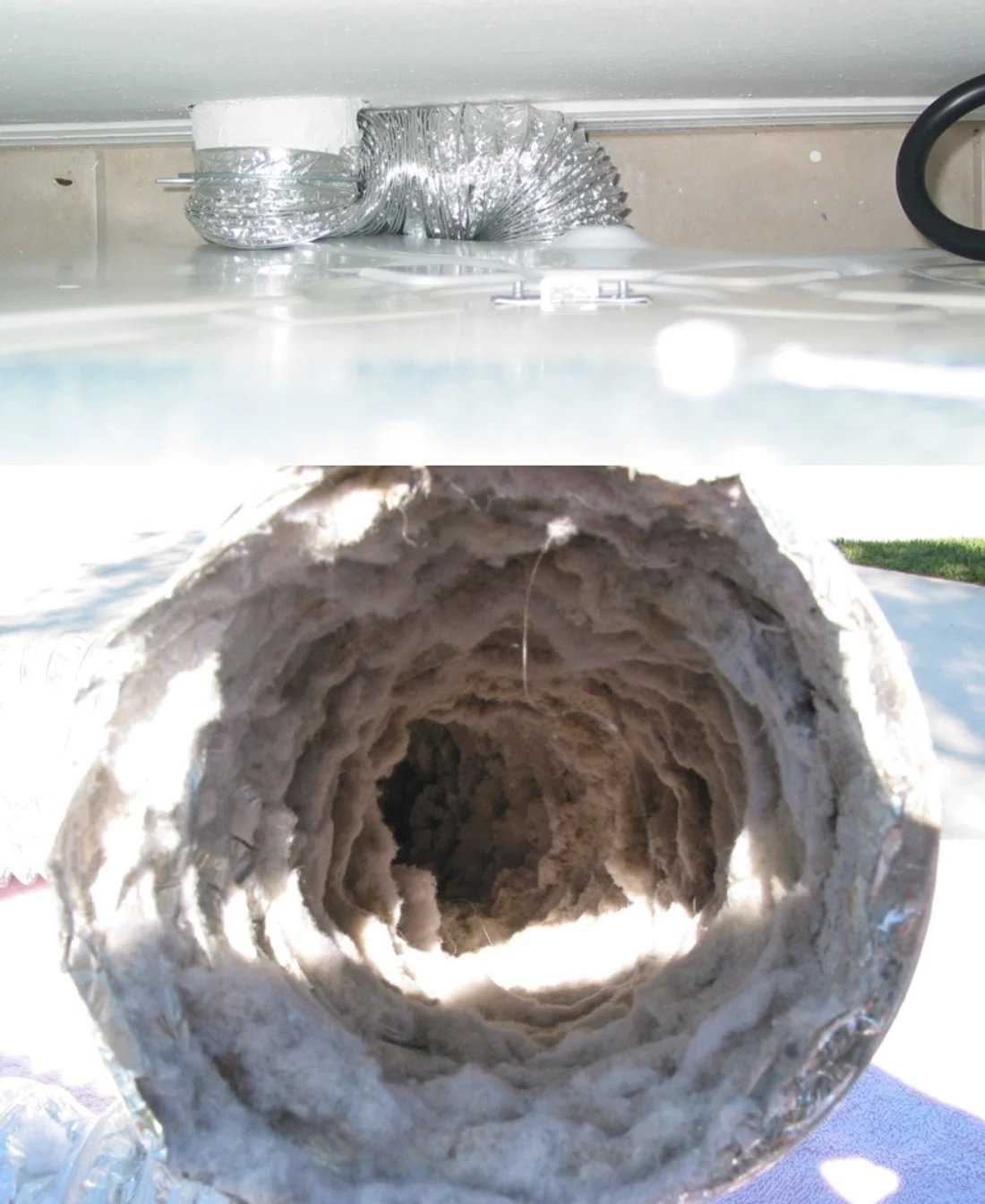
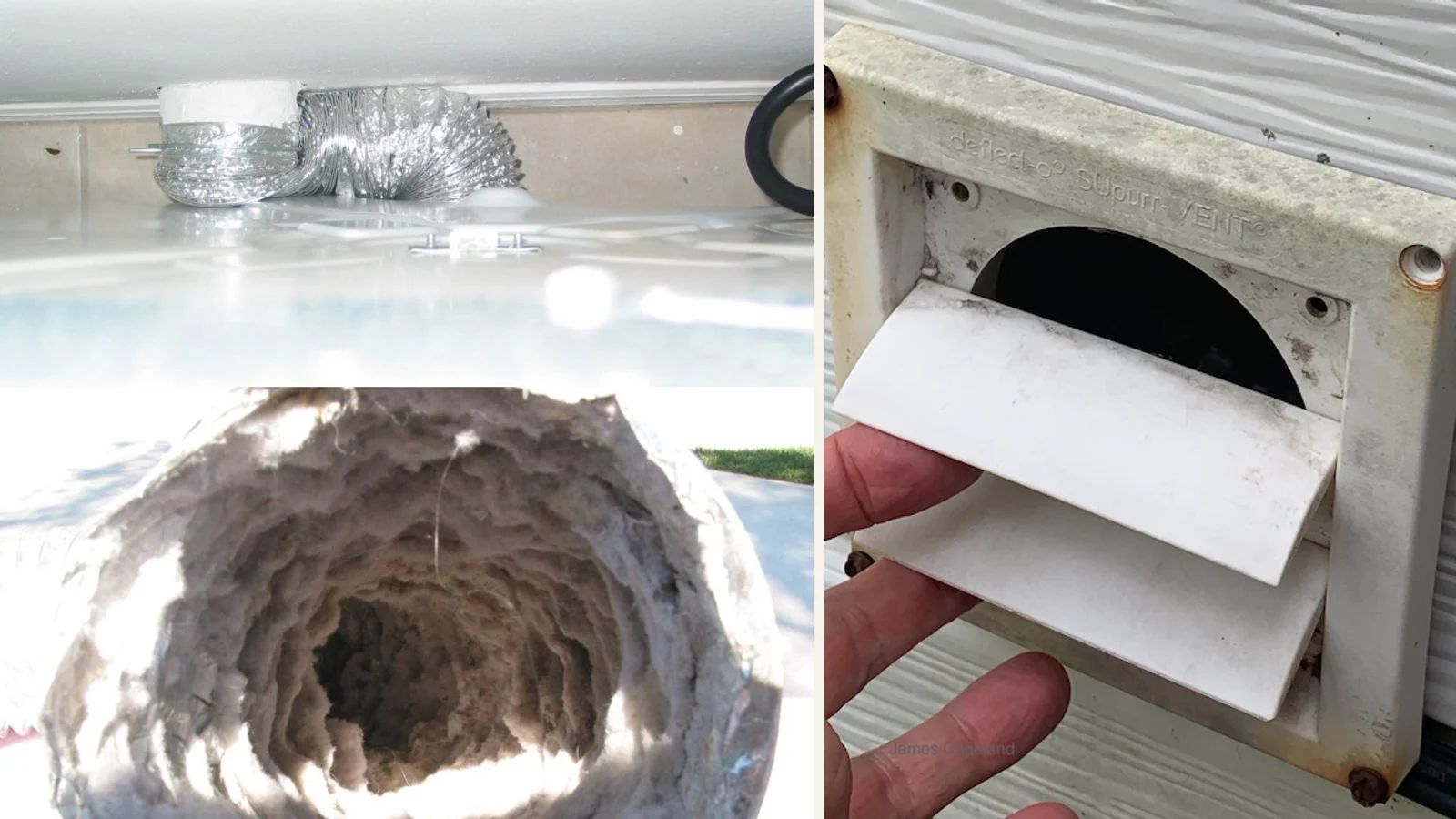
This real photo shows a severely kinked transition duct above and lint buildup inside the duct below. It is a useful reminder that “the dryer works” and “the vent is clear” are different findings.
3. What material is visible?
Texas inspection standards flag visible ductwork that is not metal with a smooth interior finish. Corrugated or easily crushed material can hold lint. Ask the inspector which portions were actually visible and which disappeared behind cabinetry, drywall or the appliance.
4. Does the route appear unusually long or complicated?
When the laundry is centered on the second floor, far from an exterior wall or vented through the roof, ask where the termination is, how many turns are likely and how the run can be cleaned. A general inspector is not required to verify the complete route or length, so silence in the report is not proof that the concealed design is adequate.
5. Does the exterior damper open—and is it free of a screen?
The U.S. Fire Administration recommends confirming that the outdoor vent cover opens while the dryer operates. Texas standards also flag screened terminations because screens can catch lint. Vegetation, nests, paint and accumulated debris can obstruct the outlet as well.
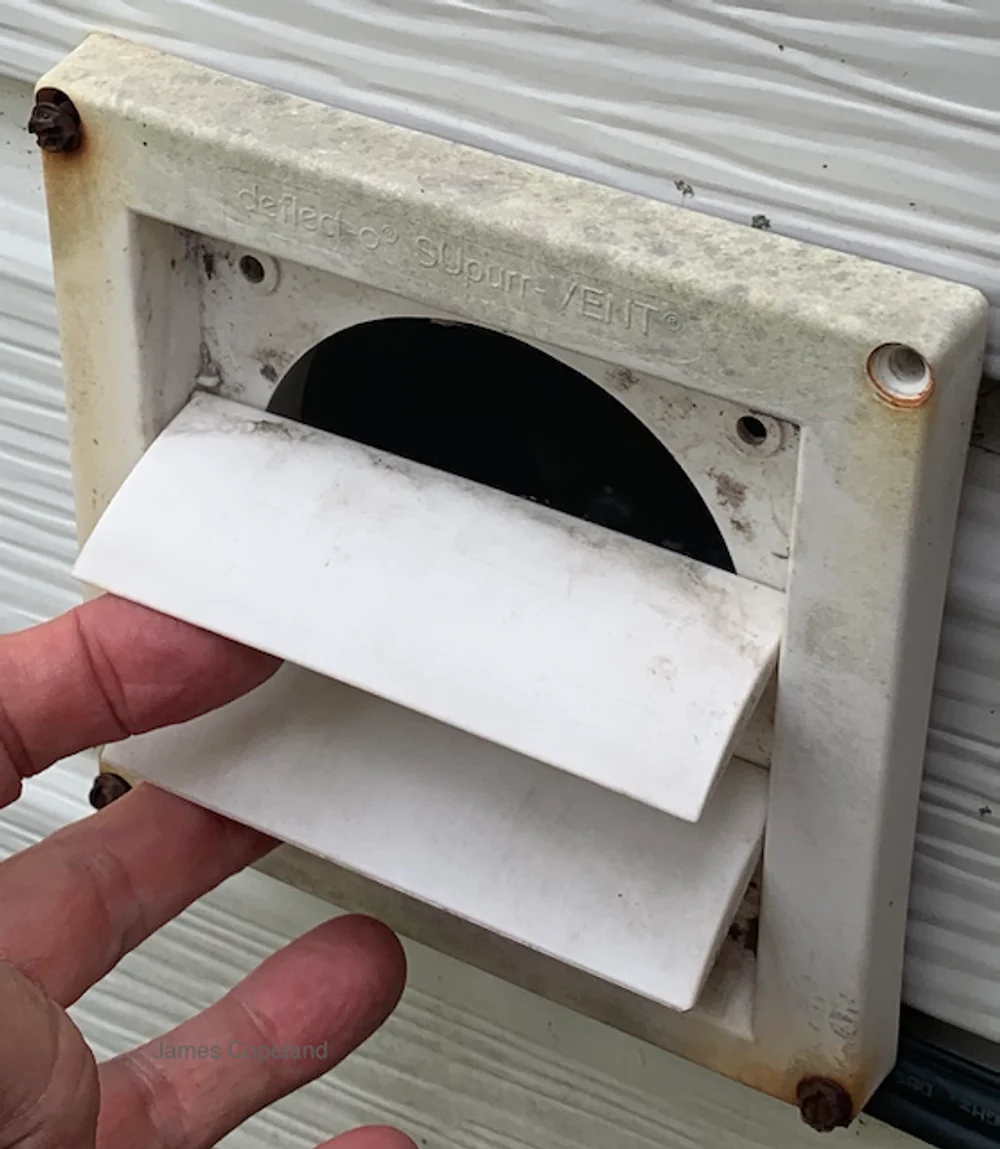
This is a real exterior dryer-vent termination. Finding a cover is only the first step: confirm that it serves the laundry, moves freely and has no obvious lint buildup or damage.
6. Are there signs that air is not getting out?
- Loads regularly require a second cycle or take noticeably longer to dry.
- The laundry room becomes much hotter or more humid than adjacent rooms.
- Lint appears behind the dryer, near baseboards, in the attic or around the exterior outlet.
- There is a burning odor, overheating evidence or repeated dryer shutdowns.
None of these clues alone locates a concealed defect, but they justify further evaluation instead of treating the issue as a minor appliance quirk.
7. Is this a cleaning problem or an installation problem?
Cleaning can remove lint, but it cannot correct a crushed duct, unsuitable material, a disconnected concealed joint, an excessive route or the wrong termination. Before negotiating a repair or credit, separate cleaning, connector replacement and rerouting—the scope can be very different.
How to handle this during the option period
- Ask the inspector to identify the visible starting point, material and exterior termination; note it when the outlet cannot be located.
- Confirm whether the dryer is excluded, conveyed with the home or already removed; do not confuse appliance condition with the house exhaust system.
- For a long run, roof termination, visible moisture or lint, consider a dryer-vent specialist for a closer evaluation using appropriate camera, airflow or access methods.
- Ask estimates to separate cleaning, connector replacement, concealed-duct repair and rerouting so the negotiation addresses the real scope.
- If the run cannot be fully evaluated before closing, place cleaning and reinspection on the move-in list before regular use.
Why this small system deserves attention
The U.S. Fire Administration reports that failure to clean was the leading factor contributing to ignition in 31% of home clothes-dryer fires from 2018 through 2020. It also advises checking the vent behind the dryer for damage, crushing or restriction and confirming that the outdoor cover opens during operation.
I would not reject a home because I saw an old connector. I would, however, determine whether the defect stops at the visible connection or extends into a concealed wall or roof run before calling it a cheap fix.
FAQ
Does a normal home inspection include the dryer vent?
Partly. Texas minimum standards cover visible components, outdoor termination, a screen at the termination and visible duct material. They do not require the inspector to operate the dryer or verify the complete route, length or airflow capacity.
The report only says “recommend cleaning.” Is cleaning enough?
Not always. Ask whether the recommendation came from visible lint, weak airflow, a kink or an abnormal termination. Cleaning will not correct a disconnected or damaged duct, unsuitable material or a poor concealed route.
Is a roof termination automatically a defect?
Location alone is not enough to make that conclusion, but a roof termination is usually harder to observe and maintain. Confirm the cap, airflow, lint condition, route and practical cleaning access with the appropriate local and professional guidance.
How often should a dryer vent be cleaned?
There is no single interval for every house. Usage, run length, elbows, termination location and fabrics all affect accumulation. Longer drying times, overheating, a damper that does not open and visible lint are reasons to act before a calendar deadline; follow the appliance instructions and findings from a qualified inspection.
Related inspection guides
If you are prioritizing a full inspection report during the option period, start with how to evaluate the big-ticket systems in an older Houston home. Continue with the garage-door safety inspection checklist and, when the laundry route may pass through an upper floor or attic, the attic insulation and ventilation guide.
Sources and image note
Primary sources: Texas Real Estate Commission Standards of Practice §535.232, U.S. Fire Administration appliance and electrical fire data, and the USFA clothes-dryer fire safety flyer. Sources checked October 23, 2026.
The kinked-duct and lint photo is by Rick Harpenau from the Wikimedia Commons source page under CC BY 3.0. The exterior-vent photo is by Vick648 from the Wikimedia Commons source page under CC BY-SA 4.0. Images were only cropped, resized, compressed and combined for the cover; no generative edits were made. The cover collage is shared under CC BY-SA 4.0.
Joyce's Featured Listings

Checking these easy-to-miss systems makes it easier to compare the true move-in cost of two homes. Browse Joyce's Featured Listings, then build a property-specific inspection list for the homes that fit your plan.
View Joyce's Featured Listings
In the option period and unsure whether this needs a specialist?
Send me the home’s age, laundry-room location, the relevant inspection-report pages and a photo of the exterior termination. I can help sort the issue into items that are straightforward, need an estimate or need more evidence before you decide whether to negotiate or handle it after closing.
About Joyce Tang

Joyce Tang is a Greater Houston real estate agent and investor, co-founder of the North American Real Estate Association, founder of JoyHome and JoyNest, and co-leader of the Dr. Wang Real Estate Team.
She has helped more than 200 families buy or sell homes and has participated in more than 40 renovation projects. Her approach examines not only price, but also location, carrying cost, cash flow, risk and future exit options.
Important notice
This article provides general home-purchase and maintenance information. It does not replace an on-site opinion from a licensed inspector, fire-safety professional, dryer-vent contractor or local code authority. Construction age, appliance instructions, concealed routing and locally adopted codes vary; repair scope should be based on the specific property and written professional estimates.