
A garbage disposal that spins has passed only one small part of the check. Before buying, listen to its operation, review mounting, inspect the sink flange and drain connections for leaks, and identify the switch, power connection and dishwasher drain hose.
The bigger cost is often not the disposer itself. A slow leak can damage the cabinet base, while a recurring drain problem may remain after a new unit is installed.
What does a standard Texas inspection cover?
Current Texas Real Estate Commission minimum standards require inspectors to report an inoperative food-waste disposer, performance or mounting deficiencies, missing or damaged components, and visible active water leaks. Inspectors operate installed appliances with ordinary controls, but the standard does not require appliance disassembly.
“Operated normally” describes observable condition at the inspection. It does not mean every internal part is new or guarantee that the unit will not jam later.
Separate the disposer into six checks
1. Listen instead of checking only whether it spins
With cold water running, the sound should be reasonably steady. Repeated metallic impact, heavy grinding, humming without rotation, or an immediate shutdown can point to a foreign object, jam, loose installation or electrical issue. Do not keep cycling the switch just to retest it; have the inspector document the behavior.
2. Check the mounting at the sink
From below, observe whether the disposer is firmly attached at the sink flange. Noticeable movement during operation is more than a noise issue; vibration can also loosen drain fittings over time.
3. Inspect four common leak locations
Look at the sink flange, disposer body seams, discharge connection and dishwasher drain-hose connection. Run the unit and drain the sink, then watch for fresh droplets. Swelling, darkening, peeled finish, odor or old stains on the cabinet base can reveal a longer history.
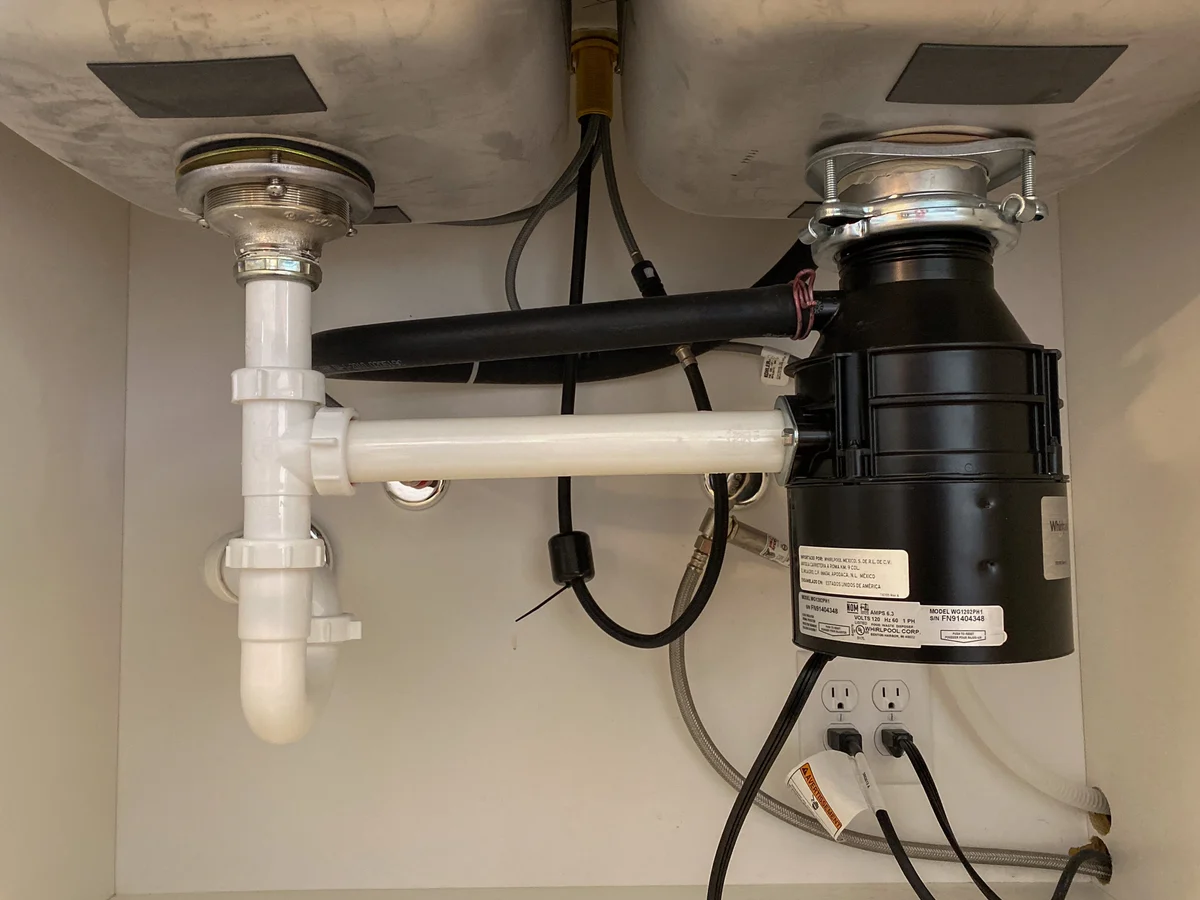
This real photograph shows a disposer, drain piping and power connections below a sink. It identifies useful inspection locations; it is not presented as a compliant installation or a Houston property. Requirements vary by model and property.
4. Confirm that the sink drains well
A loud, spinning motor does not solve a slow drain. Watch for sluggish flow, water rising in the second basin or backup after shutdown. With a double sink, test drainage from both bowls rather than only the disposer side.
5. Review the splash guard, controls and visible components
A missing or damaged splash guard can let debris and water escape. The wall switch, air switch or other normal control should be clear, secure and operable. A visible reset button is not proof of a repair; repeated overload trips still need a cause.
6. Separate power from the dishwasher drain connection
The sink cabinet combines water, electricity and drainage. Look for visible cord damage, scorching, strain or a power connection near a leak. When the dishwasher drains into the disposer, inspect that hose connection at the same time. Use the appropriate qualified electrician or plumber when the issue crosses trades.
Use this option-period sequence
Clear access to the cabinet and photograph the model, mounting, drain pipes, power and dishwasher hose connection.
Have the inspector use normal controls and document noise, vibration, drainage and visible leakage.
Use a dry paper towel on visible joints and the cabinet base; never put a hand into the grinding chamber.
Price object removal, remounting, fitting or hose repair, drain work and full replacement separately.
If the cabinet or flooring shows moisture damage, define that scope instead of negotiating only the appliance price.
Stop repeated testing when the unit hums, trips, smells burned or has questionable wiring; request the appropriate specialist.
Which findings can become the larger repair?
A worn splash guard, loose small part or isolated fitting leak is usually easier to define. Body leakage, corroded mounting, recurring drain blockage, cross-basin backup, cabinet moisture damage and repeated electrical trips deserve more attention.
I separate the finding into three layers: the appliance, the drain installation and moisture damage. Repairing only one layer can leave the buyer with the same problem after closing.
Can you simply press the reset button on a jammed disposer?
At your own home, follow the exact model instructions and disconnect power before deciding whether a reset or manufacturer-specified wrench is appropriate. Whirlpool guidance calls for turning off the wall switch and unplugging the unit or switching off the circuit breaker; never reach into the grinding chamber while power is connected. During a showing or inspection, do not perform your own repair—document the condition and use the seller or an appropriate professional.
Frequently asked questions
Does odor mean the disposer is failing?
Not necessarily. Food buildup, slow drainage and deferred cleaning can all cause odor. Separate maintenance from drain trouble and body leakage, and do not experiment with caustic drain cleaner.
Can I keep trying a disposer that hums but does not spin?
No. It may be jammed, and repeated power can trip the overload protector or worsen the problem. Disconnect power, then follow the model instructions or call an appropriate professional.
Will a seller-installed new disposer solve everything?
Not automatically. Existing leakage, drain blockage, dishwasher-hose issues and cabinet damage need separate review. A new appliance does not repair old plumbing or damaged woodwork.
Is a garbage disposal required in a home?
No. The decision is about the condition of the equipment that exists and whether it fits your needs. Adding one later may require review of the sink, drainage, power and cabinet space.
Related inspection guides
Under-sink findings often overlap. Continue with the dishwasher inspection guide, water-supply pipe guide and electrical panel and wiring checklist.
Sources and image note
Primary sources: current Texas Real Estate Commission inspection rules, TREC consumer FAQs and Whirlpool disposer reset and safety guidance. Sources checked October 31, 2026.
The cover is a real kitchen-sink photograph by Karolina Grabowska from Pexels, used under the Pexels License. The inline photograph is by Tony Webster from Wikimedia Commons, used under CC BY 2.0. Images were cropped, resized and compressed only; no generative edits were used.
Joyce's Featured Listings

A clean kitchen sink does not prove the disposer, drainage and power connections below it are right. Browse Joyce's Featured Listings, then use this checklist on the homes that fit your plans.
View Joyce's Featured Listings
Not sure how to negotiate a disposer finding?
Send me the property address, model number, cabinet photos and the relevant inspection pages. I can help separate appliance repair, drain work, electrical review and moisture-damage scope before you decide how to respond during the option period.
About Joyce Tang

Joyce Tang is a Greater Houston real estate agent and investor, co-founder of the North American Real Estate Association, founder of JoyHome and JoyNest, and co-leader of the Dr. Wang Real Estate Team.
She has helped more than 200 families buy or sell homes and has participated in more than 40 renovation projects. Her approach examines not only price, but also location, carrying cost, cash flow, risk and future exit options.
Important notice
This article provides general home-purchase and residential-appliance information. It is not inspection, plumbing, electrical, construction, mold-remediation or legal advice and does not replace a property-specific opinion from a licensed inspector or appropriate qualified professional. Never put hands or tools into an energized disposer or operate unfamiliar wiring or valves.