

A home having power does not prove that its electrical system is problem-free. When buying an older Houston home, the real questions are whether the panel and wiring have safety concerns, whether the available capacity fits your plans, and whether the condition could affect insurance, repair cost, or the closing decision.
A light turning on proves that a circuit has power at that moment. It does not prove that a breaker will trip when required or that concealed wiring is sound.
What does a standard Texas home inspection cover?
TREC minimum standards require inspectors to examine accessible service entrances, panels, grounding, compatibility of conductors and overcurrent devices, panel covers, branch circuits, and visible protection devices such as GFCI and AFCI where applicable. Observable deficiencies are reported.
It is still a limited visual inspection. An inspector is not required to perform a whole-home load calculation, verify the effectiveness of every breaker, or open walls to inspect concealed wiring. A panel cover may remain closed when removal would be unsafe. “Further evaluation by a licensed electrician” usually means the question is beyond what a general inspection can confirm.
Seven signs that deserve a closer electrical review
1. The panel brand, model, or breaker compatibility is unclear
Do not rely on a blanket internet claim that every panel of a certain brand is dangerous, and do not assume that a panel is fine because it has not tripped. Photograph the nameplate, model, and breakers. A licensed electrician can determine compatibility, replacement-part availability, and whether the practical fix is limited work or a panel replacement.
Federal Pacific Stab-Lok is a good example of why precision matters. When the U.S. Consumer Product Safety Commission closed its investigation, it did not make a final determination that the breakers were safe or unsafe. A buyer should identify the equipment, obtain a professional evaluation, and ask the insurer about underwriting requirements.
2. Two conductors share a breaker—or conductor size and protection may not match
Some terminals are listed for a specific multi-conductor use and others are not, so a photo alone does not settle every case. The manufacturer listing, wire size, breaker rating, and termination method need to match. A report noting a double tap or incompatible overcurrent protection calls for an electrician to define the repair.
3. An older home has aluminum branch-circuit wiring
Large aluminum conductors serving an air conditioner, range, or service entrance are not the same issue as the smaller aluminum branch-circuit wiring commonly installed in the late 1960s and early 1970s. CPSC guidance focuses on overheating risks at connections in the latter system.
Do not remove receptacles yourself and do not accept “it was pigtailed” without documentation. An electrician experienced with aluminum-wiring remediation should confirm conductor type, connection method, materials, and the extent of completed work.
4. The cabinet shows rust, water, scorching, odor, or missing covers
Rust and moisture require a source: an exterior enclosure leak, condensation, or water entering from the building. Scorching, melting, burning odor, or abnormal heat is more urgent. Missing covers, open knockouts, and exposed energized parts are safety concerns, not cosmetic details.
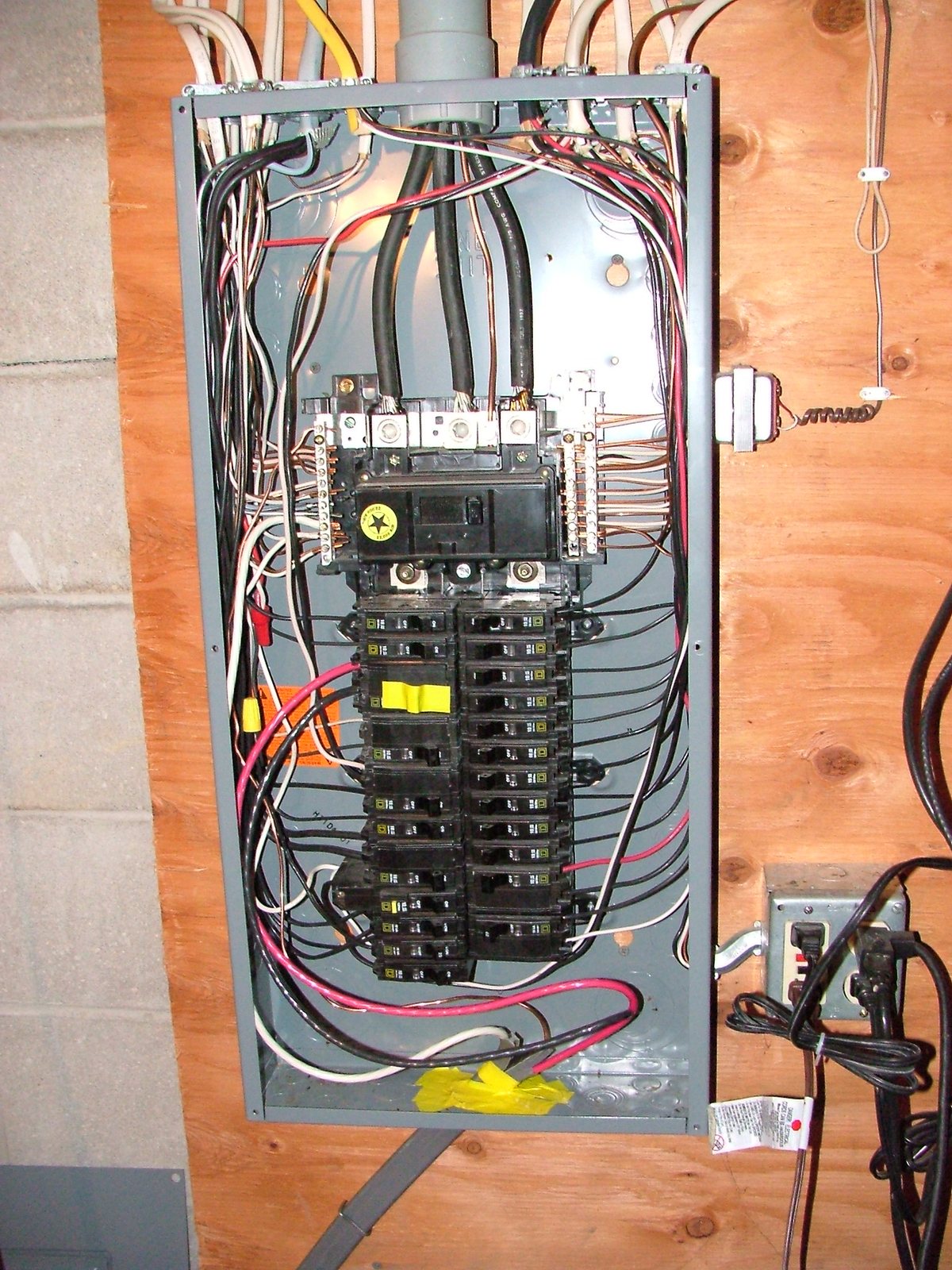
Real U.S. residential breaker-panel photo. Breakers, conductors, terminations, and cabinet condition must be evaluated with the equipment labeling and site testing; buyers should not remove an energized panel cover. Photo: davef3138 / Wikimedia Commons, CC BY 2.0, resized and compressed.
5. Kitchen, bathroom, garage, or exterior protection is incomplete
GFCI and AFCI requirements depend on the installation and renovation history as well as applicable local rules. An older home without later-generation protection is not automatically an illegal home, but it can represent a sensible safety upgrade. Ask the inspector to identify missing or failed protection and the electrician to define the scope.
6. The renovation looks new, but the electrical history does not connect
A new kitchen, addition, garage conversion, pool, generator connection, EV charger, or second air-conditioning system can add circuits and load. When finishes look new but panel labels are confusing, wiring appears improvised, and permits or invoices are unavailable, ask what changed, who performed the work, and whether the service capacity is adequate.
7. Insurance or future power needs create an additional requirement
Electrical conditions can influence an insurer’s underwriting, but the rules vary by company and property. A real estate agent or inspector cannot promise coverage. If you plan an EV charger, pool equipment, induction range, or another major load, today’s system being adequate for current use does not prove it fits the future plan. A licensed electrician should perform the load calculation.
A practical option-period sequence
- Obtain the complete inspection report and panel photos instead of reading only the red-item summary.
- Record the panel nameplate, breaker types, stated service capacity, and inspection limitations.
- When the report shows questionable equipment, aluminum branch wiring, heat or water damage, mismatched components, or extensive remodeling, schedule a licensed electrician promptly.
- Ask the estimate to separate immediate safety work, ordinary repair, and future upgrades instead of giving one unexplained total.
- Give the address and inspection findings to an insurance professional during the option period and ask whether they affect the quote or eligibility.
- Compare the existing capacity with your own future electrical plans.
- Use the contract, written estimate, and professional findings to decide whether to negotiate repair, credit, price, further investigation, or termination.
For the full inspection picture, start with Five Big-Ticket Problems Houston Buyers Should Watch During a Home Inspection. Connect property condition to coverage in Houston Home Insurance Before Closing. Before presenting requests to the seller, use What Should a Buyer Ask the Seller to Fix? to set priorities.
When should safety come before negotiation?
- a burning smell, smoke, arcing, or visible melting;
- switch or receptacle covers that are unusually hot;
- a breaker that repeatedly trips and is repeatedly reset without diagnosis;
- water in the panel, exposed energized parts, or an attempt at do-it-yourself panel repair.
These are electrical-safety issues, not ordinary negotiation items. Stop do-it-yourself work and contact a qualified electrician. When there is an immediate hazard, contact the utility or emergency services as the situation requires.
Frequently asked questions
Does an older panel always need full replacement?
No. The answer depends on the exact equipment, physical condition, component compatibility, service capacity, repair feasibility, and insurer requirements. A licensed electrician should determine whether targeted work is sufficient.
If the general inspection passed, do I still need an electrician?
Not necessarily when there are no concerns. A focused electrical inspection becomes more useful when the report recommends it, access was limited, the home is older, remodeling is extensive, or you plan significant new loads.
Is it enough for the seller to say the electrical item was repaired?
Ask who performed the work, what was changed, and whether invoices and applicable permit or inspection records are available. A written scope and pre-closing verification are more useful than “fixed.”
How much does panel replacement cost?
A single online average is not a reliable budget. Service size, feeders, grounding, panel location, circuit corrections, permits, and wall repair can change the scope. Obtain a property-specific written estimate before negotiating.
Joyce's Featured Listings

AI-generated illustration: a Greater Houston housing scene, not a real or currently available listing.
When touring homes, place the panel, roof, HVAC, and insurance in the same budget—not just the kitchen and flooring. Browse Joyce’s Featured Listings, then tailor inspections to the specific address.
View Joyce's Featured Listings →
Considering an older home with an unclear panel or wiring history?
Send me the address, electrical section of the inspection, panel photos, insurance feedback, and your future electrical plans. I can help organize what is still missing, who to call during the option period, and how to separate safety work from future upgrades. Electrical safety, load calculations, repairs, and underwriting must be confirmed by the appropriate licensed professionals.
About Joyce Tang

Joyce Tang is a Greater Houston real estate agent and investor, co-founder of the North American Real Estate Association, founder of JoyHome and JoyNest, and co-leader of the Dr. Wang Real Estate Team.
She has helped more than 200 families buy or sell homes and has participated in more than 40 renovation projects. Her approach examines not only price, but also location, carrying cost, cash flow, risk and future exit options.
Sources and disclaimer
Sources checked October 20, 2026: TREC inspection standards, the CPSC aluminum-wiring repair guide, the CPSC Federal Pacific Stab-Lok notice, and CPSC residential electrical inspection guidance.
This article is a general real-estate and inspection checklist. It is not electrical, engineering, insurance, legal, or contract advice and does not replace an on-site inspection, licensed electrician evaluation, or insurer underwriting decision. Do not open or repair an energized panel yourself. Confirm safety, code, permits, repairs, and transaction rights with the appropriate professionals.
Cover electrician photo from Pexels by ranjeet ., used under the Pexels License and cropped/compressed. U.S. residential panel photo from Wikimedia Commons by davef3138, used under CC BY 2.0 and resized/compressed. The images do not depict Joyce clients, a listing, an inspection result, or an electrician endorsement.