
A seller’s signature does not mean the sale has funded or the proceeds can be released immediately. The title company generally still must confirm buyer and lender funds, complete signing, title and payoff conditions, and then disburse according to the final settlement statement.
Many transactions finish the same day, but a morning signature followed by no afternoon deposit is not automatically a failure. The useful question is whether the file is waiting on signing, funding authorization, title clearance or disbursement—and which condition remains open.
A common closing-day scenario
The seller signs at 10 a.m. and has already moved out. The buyer signs by noon, but at 2 p.m. the title company is still waiting for final lender funding authorization. The seller sees no bank deposit and worries that the buyer backed out or the proceeds were calculated incorrectly.
The seller’s signing may be complete. The transaction simply has not reached the disbursement milestone. A financed purchase still needs buyer funds, lender funds, lender authorization and title review. Late signing, a final document request or a banking cutoff can move receipt later.
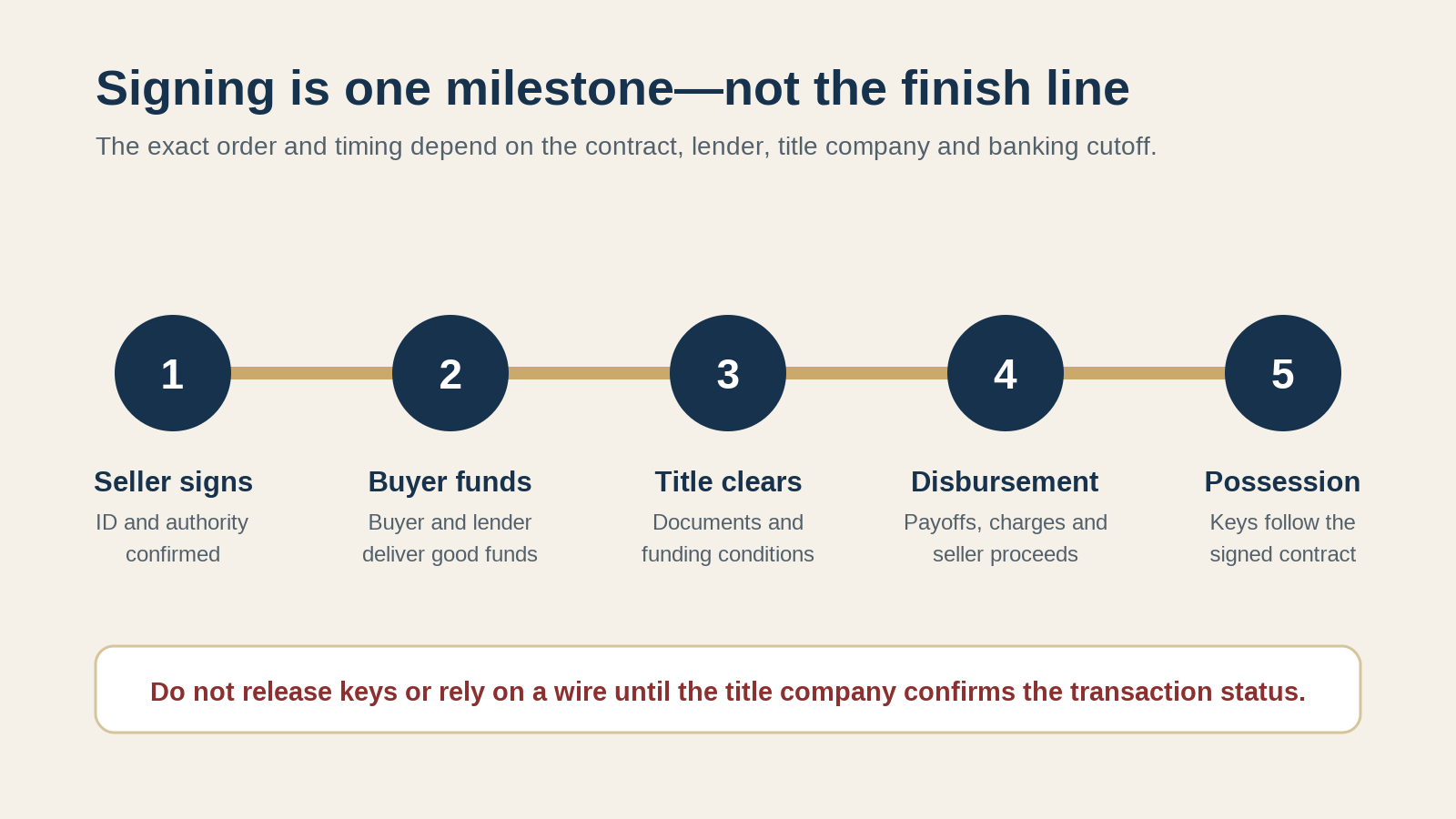
Five milestones: signing is not funding
1. Seller signing
The seller signs the deed, settlement statement, tax forms and title-company documents, and the closing team verifies identity and authority. Early or remote signing means the seller documents are ready; it does not mean the buyer’s loan has funded.
2. Buyer and lender funds
The buyer must provide acceptable cash to close and the lender sends loan proceeds after final conditions are satisfied. A cash transaction has no mortgage lender, but the title company still must verify buyer good funds and signed documents.
3. Title clearance
The title company reviews the deed, loan package, title requirements, payoffs, prorations and other closing conditions. The Texas Department of Insurance definition of closing the transaction includes proper execution and delivery of necessary documents, delinquent-tax and current-tax handling, movement and disbursement of consideration, a final title search and filing of necessary papers.
4. Disbursement
The title company pays existing loans, liens, taxes, HOA items, brokerage charges, contract credits and other listed amounts, then sends the seller the remaining net proceeds through the verified method. The contract price is not the seller’s deposit.
5. Possession
As reviewed for this article, the TREC One to Four Family Residential Contract (Resale) 20-19 is effective July 1, 2026. Its standard possession paragraph lets the parties select buyer possession upon closing and funding or under a written temporary residential lease or other written lease. A seller should not release keys merely because the seller signed, and should not remain after closing without the required written arrangement.
Eight items a seller should verify before closing
1. Sales price and earnest money on the settlement statement
Confirm the contract price, earnest money, option fee treatment and every written price amendment. Do not review only the final net line. If an upstream number is wrong, the net line will be wrong too.
2. Mortgage, HELOC, solar loan and lien payoffs
Check each account to be paid, the payoff amount, and possible wire, recording or prepayment charges. A recent mortgage payment does not necessarily update the payoff instantly. Payoff figures are date-specific and may include daily interest.
3. Property-tax, HOA, rent and other prorations
Texas property taxes may be prorated before the final annual bill exists. A seller tax credit is not necessarily the title company paying that tax bill for the buyer that day. The TREC contract also addresses later adjustment when the actual tax differs from the estimate. See the Texas property-tax proration guide for the mechanics.
4. Seller credits, repairs and buyer expenses
Compare the statement with the contract, amendments and repair agreement. Did the seller agree to a fixed credit, an actual invoice or an amount not to exceed a cap? Loan-program limits can also affect how buyer credits are used, so oral assumptions are not enough.
5. Title, escrow, brokerage and other closing charges
Texas title premiums are regulated, while escrow and other closing fees can vary. Ask to review the final or near-final seller statement before signing and question unfamiliar charges instead of seeing them for the first time at the table.
6. How the seller will receive net proceeds
Confirm whether proceeds will be wired, issued by cashier’s check or delivered another way the title company offers. Verify the payee name, bank limitations, cutoff and expected timing. A sent wire is not the same as a posted deposit, and a receiving bank may conduct additional review.
7. Keys, remotes, smart-home access and utilities
Key delivery follows the contract and funding confirmation. Gather garage remotes, access devices, mailbox keys, equipment instructions and smart-device access, then remove the home from personal devices. Do not cancel utilities, insurance or monitoring solely because documents were signed; coordinate timing with funding, possession and the appropriate insurer.
8. Final records and contact information
Keep the signed settlement statement, deed copy, payoff and release leads, repair and credit agreements, title-company contact and proof of receipt. A tax professional should determine how the sale, basis and eligible selling expenses affect the seller’s tax return.
Why can funding be delayed after the seller signs?
The buyer’s lender is still clearing a final income, insurance, employment or other loan condition
Buyer cash to close has not become good funds available to the title company
A signature, date, name, notary or remote-signing item must be corrected
A mortgage payoff, HELOC freeze or lien release needs confirmation
The final walkthrough found damage, unfinished repairs or a move-out issue requiring written resolution
The final title search found a new lien, judgment or document requirement
Late signing missed the lender, title-company or bank cutoff for same-day processing
When a delay happens, ask the title company to identify the missing item, responsible party, next update and any effect on the contractual closing date and possession. The Texas seller timeline from contract to closing provides the larger sequence.
Where seller-proceeds wire fraud happens
The risk is not limited to someone asking the seller to send money. Criminals may impersonate the seller and direct the title company to send net proceeds to a new account. Stop when an account change arrives late, an email demands urgency, or the sender refuses independent telephone verification.
The Texas Department of Insurance title-insurance guidance recommends saving contact details for the people in the transaction, verifying electronic-payment instructions with the title agent, questioning last-minute changes and confirming receipt immediately after an electronic payment. Do not use the phone number or link inside a suspicious email to verify that same email.
Safer practices
Save the escrow officer’s name and known title-company telephone number before closing day
Provide bank information only through the secure method specified by the title company
Verify every proceeds-account change through an independent known telephone number
Treat the actual bank posting and title-company confirmation—not a screenshot—as evidence
If instructions or a transfer look wrong, contact the bank, title company and law enforcement immediately; speed matters
How soon should proceeds arrive?
There is no reliable promise that every seller will receive funds within a fixed number of hours after signing. Cash versus financing, signing time, lender authorization, title process, bank cutoff, weekends or holidays, and wire versus check can all change timing.
The day before closing, confirm whether the seller must attend, when the final statement will be ready, what the title company considers funded, how proceeds will be delivered and what happens if the cutoff is missed. Use the Houston seller net-proceeds guide to reconcile the contract price with the expected deposit.
Seven common seller mistakes
Telling the buyer to take the keys after seller signing without funding confirmation
Reviewing an estimated net sheet but not the final settlement statement
Forgetting a HELOC, solar loan, lien or updated mortgage payoff
Trusting new wire instructions because the email uses the title company’s logo
Giving full bank and identity information to an unfamiliar caller to speed up payment
Canceling insurance, utilities or smart-home service too early
Deleting the closing file after proceeds arrive instead of retaining tax and title records
Frequently asked questions
The seller signed in the morning but has no afternoon deposit. Is that normal?
It can be. Confirm whether the buyer signed, lender funds arrived, the title company received funding authorization and the bank cutoff was met. Seller signing alone does not prove disbursement.
Does a cash offer guarantee immediate proceeds?
No. A cash purchase removes lender funding conditions, but the title company still verifies good funds, signing, title and payoff conditions before disbursement. Ask the escrow officer for the actual status.
Is a wire faster than a cashier’s check?
It depends on title-company options, the receiving bank, amount, cutoff and the seller’s needs. A wire may help a remote seller but requires careful account verification. A check still requires pickup and bank processing.
Can the seller release keys before the proceeds post?
Do not use the seller’s bank balance as the only test. Let the title company confirm closing and funding, then follow the signed possession paragraph. A seller remaining after closing needs the appropriate written lease and insurance plan.
Joyce's Featured Listings

AI-generated illustration: a Greater Houston housing scene, not a real or currently available listing.
After reviewing the seller closing and proceeds process, browse Joyce's Featured Listings to see how current Greater Houston homes present transaction details and property information.
View Joyce's Featured Listings →
Closing soon and unsure about proceeds, funding or possession?
Send me the property address, closing date, loan or lien information, agreed credits and the seller settlement statement from the title company. I can help reconcile the contract and charges, then direct title, legal, tax and banking questions to the appropriate professionals.
About Joyce Tang

Joyce Tang is a Greater Houston real estate agent and investor, co-founder of the North American Real Estate Association, founder of JoyHome and JoyNest, and co-leader of the Dr. Wang Real Estate Team.
She has helped more than 200 families buy or sell homes and has participated in more than 40 renovation projects. Her approach examines not only price, but also location, carrying cost, cash flow, risk and future exit options.
Disclaimer
This article is based on public TREC and Texas Department of Insurance materials reviewed through October 31, 2026. It provides general Texas home-sale closing information, not legal, title, tax, lending, insurance, banking or cybersecurity advice, and does not guarantee a specific funding, disbursement or bank-posting time. Rights, charges, payoffs, possession and delivery depend on the signed contract, title company, lender, bank and applicable law. Consult qualified legal, title, tax, insurance and financial professionals for the transaction.