
The short answer: when current-year property taxes have not been paid at closing, the seller usually bears the portion from January 1 through the closing date as a seller debit and buyer credit. The buyer then pays the full tax bill when it becomes due. That credit is not a gift toward closing costs; it allocates the tax cost for the period each party owns the home.
The confusing part is that the tax office does not split the annual bill. The Harris County Tax Office expressly says it does not prorate taxes—the bill must show the full amount due. The purchase contract and closing statement allocate that cost between seller and buyer.
Separate two questions: who pays the bill and who bears the cost
Texas property taxes follow the calendar year. Local taxing units commonly send bills in the fall, and most payments are due by January 31 of the following year. When a home sells midyear, the final bill may not exist yet even though the seller has owned the property for part of that tax year.
Paragraph 13 of the current TREC 20-19 resale contract prorates current-year taxes through the closing date. If the taxes are not paid at or before closing, the buyer pays the current-year taxes. The same paragraph also requires the parties to adjust if the final tax bill differs from the closing proration.
A simple example makes the direction clear
Assume estimated annual property taxes are $10,950, or $30 per day, and closing occurs August 31. The seller owns through closing—a total of 243 days—so the seller’s estimated share is $7,290. It commonly appears as a seller debit and buyer credit.
When the bill arrives later, the buyer pays the full $10,950. The buyer’s own 122-day share is $3,660; the other $7,290 was already credited at closing for the seller’s ownership period.
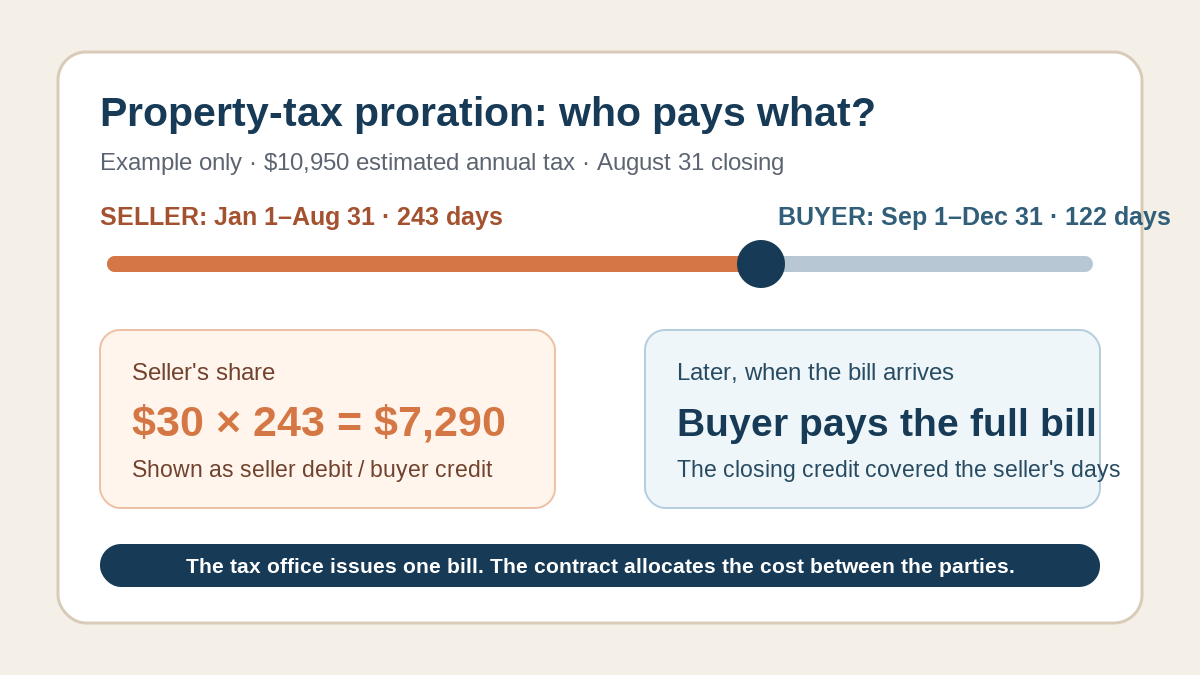
This is an illustration, not a universal closing calculation. The actual number depends on the closing date, leap-year treatment, title-company estimate, taxing units and the contract.
What if the seller already paid the current-year taxes?
The direction generally reverses. When the seller has paid the full bill, the closing statement usually charges the buyer for the buyer’s post-closing share—buyer debit and seller credit.
Whenever you see “Property Tax Proration,” read both the amount and the column. Confirm whether the line is a debit or credit and whether the annual bill has already been paid.
Why is the closing number often an estimate?
Many Houston transactions close before the final taxable value and adopted rates are fully reflected in a tax bill. The title company may use the prior-year bill, current appraisal information, known rates or another available basis. The final amount can change because:
- The seller’s homestead, over-65, disability or other exemption may not continue under the buyer, or the buyer may need to apply separately.
- The current appraised value, tax rate or protest result changes.
- A new or recently completed home was previously taxed mainly as land and is now assessed with the completed improvement.
- The property has several taxing units—county, city, school district, MUD, PID or others—and one component is not final.
- A supplemental or corrected bill arrives after the closing estimate was prepared.
The TREC contract permits the calculation to consider an exemption change affecting current-year taxes and calls for an adjustment when the final bill varies. Whether and how that post-closing adjustment is pursued depends on the complete contract and professional advice; do not assume the title company will automatically perform a second settlement.
Tax proration, the buyer’s loan escrow and the seller’s escrow refund are different money
Closing tax proration
This is the buyer-and-seller allocation for the current tax year. It appears on the Closing Disclosure or settlement statement.
The buyer’s lender escrow account
When the new loan requires escrow, the lender may collect several months of tax reserves at closing and a monthly amount afterward to pay future bills. That is between the buyer and the new lender. It does not replace the seller-to-buyer proration.
The seller’s old mortgage escrow balance
The seller’s existing loan servicer normally does not transfer its escrow balance to the buyer. After payoff, the servicer refunds any remaining balance to the seller under its own process. Money sitting in that old escrow account is not a reason to remove the tax proration from the closing statement.
Six checks before the buyer signs
- Confirm whether the current-year bill has been paid and whether prior-year taxes, penalties or liens remain.
- Identify the tax year, taxable value and taxing units used for the proration estimate.
- Check whether the closing date is included and whether debit and credit directions are correct.
- Identify seller exemptions that may change after ownership transfers.
- Compare the lender’s escrow collection and projected monthly payment with a realistic tax estimate.
- Preserve contact information and understand the contract adjustment obligation if the final bill is materially different.
Sellers should include the proration in net proceeds
Sellers often focus on loan payoff and brokerage expenses but miss the current-year tax debit. The closer the sale occurs to year-end, the more ownership days the seller has and the larger that debit will generally be.
Put the proration into the broader Houston seller net-proceeds calculation. Near closing, also review why signing does not always mean the keys are released immediately. New-construction buyers should continue with why the second-year payment can jump after an escrow shortage.
FAQ
If the seller gives a property-tax credit, does the buyer avoid paying taxes?
No. If the bill was not paid before closing, the buyer still pays the full current-year bill. The credit simply moves the seller’s estimated share to the buyer at closing.
Why does the buyer receive a bill covering months when the seller lived there?
The taxing authority issues one annual bill tied to the property rather than separate bills for each ownership period. The closing proration is how the parties divide the cost.
Is the amount on the closing statement always final?
Not necessarily. If the current bill is unavailable, the number is an estimate. Paragraph 13 of the TREC contract provides for an adjustment when the final taxes differ.
Will a buyer’s homestead exemption always reduce the tax bill?
Do not assume so. Eligibility, filing date, appraisal limits and each taxing unit matter. If the seller had an over-65 or another exemption the buyer does not qualify for, the buyer’s tax cost may be higher than the old bill suggests.
Sources and image note
Primary sources: the TREC Form 20-19 page and Paragraph 13 of TREC Form 20-19, the Texas Comptroller’s property-tax payment guidance and property-tax system basics, and the Harris County Tax Office FAQ. Sources checked October 23, 2026.
The cover is licensed stock photography by RDNE Stock project from the Pexels photo page under the Pexels License. It was cropped to 16:9, resized and compressed without generative alteration. The people shown are not Joyce or JoyHome clients.
Joyce's Featured Listings

Including the tax rate, exemption changes and closing proration produces a more realistic first-year cash estimate. Browse Joyce's Featured Listings, then verify the complete taxing units and tax history for any specific address.
View Joyce's Featured Listings
Buying or selling and want the tax numbers organized first?
Send me the address, expected closing date, prior-year tax bill and financing plan. I can organize the questions for the title company, lender and tax office so one credit line does not distort your cash-to-close or net-proceeds estimate.
About Joyce Tang

Joyce Tang is a Greater Houston real estate agent and investor, co-founder of the North American Real Estate Association, founder of JoyHome and JoyNest, and co-leader of the Dr. Wang Real Estate Team.
She has helped more than 200 families buy or sell homes and has participated in more than 40 renovation projects. Her approach examines not only price, but also location, carrying cost, cash flow, risk and future exit options.
Important notice
This article is an educational explanation of common Texas residential closing prorations. It is not legal, tax, accounting or lending advice. Joyce Tang is not an attorney, CPA or tax adviser. The exact proration, exemption change, tax-bill responsibility, lender escrow and post-closing adjustment must be confirmed from the complete contract, title-company settlement statement, loan documents, local taxing records and appropriate professional advice.