

Usually not because of regret alone. Once a Texas residential purchase contract is formed, the seller generally does not receive the buyer-style option period or an automatic three-day cooling-off right. The seller needs a written termination right in the contract or addendum, a buyer default that triggers a contractual remedy, or a negotiated written release.
The dangerous move is to announce “I am not selling” and search for a reason afterward. A termination notice does not create the right to terminate. If the asserted basis fails, the seller may turn a difficult situation into the seller’s own default.
A realistic scenario
After accepting an offer, the seller’s family decides not to move, the next-home purchase falls apart, or a higher backup offer appears. The seller now feels that the first contract was accepted too quickly or at too low a price.
Those concerns are real, but a changed family plan, a better later offer or simple reluctance usually does not create a contractual exit. The first step is contract review—not asking the agent to manufacture a termination reason.
Separate three points in time
The offer has not been accepted
If the seller has not signed and accepted, the seller can generally reject, counter or stop negotiating. Still confirm whether a signed document, electronic acceptance or delivery record already exists. A listing website status does not decide contract formation.
Both sides signed and the contract just became effective
The question now shifts from whether the seller wants to sell to what the contract requires and whether it contains a seller termination right. TREC notes that the buyer’s promise to buy and seller’s promise to sell can provide contract consideration; validity and termination are private legal questions. See the TREC Frequently Asked Questions.
The transaction is already in performance
Once title, inspection, financing, appraisal and closing work begins, a seller’s refusal to cooperate can affect several parties. The Texas seller under-contract-to-closing timeline explains the active obligations.
Five questions before a seller tries to terminate
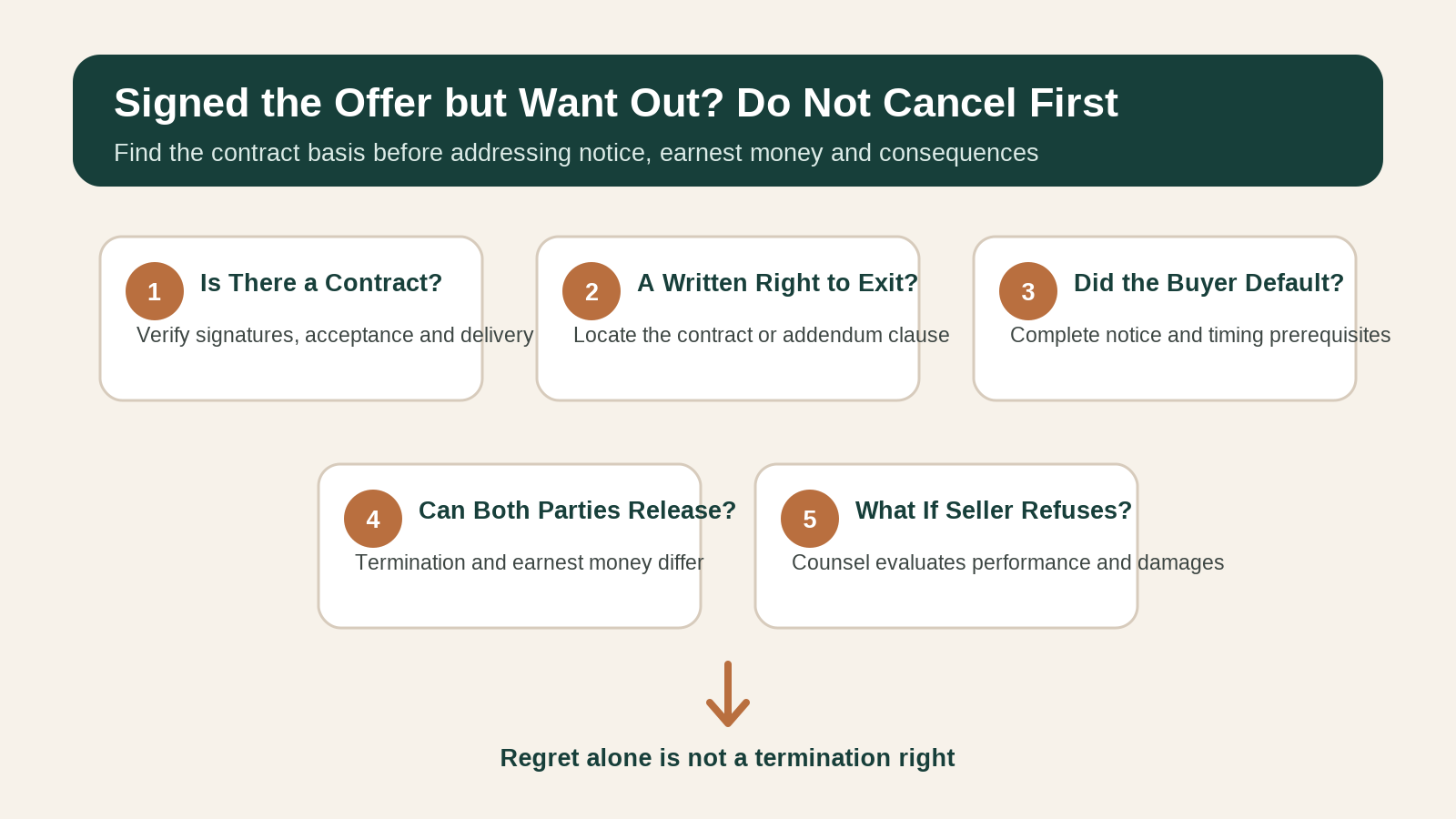
1. Is there an effective contract?
Collect the complete contract, every addendum, counteroffer, signature page, effective date and delivery record. Do not rely on one signature screenshot, and do not confuse the listing agreement with the purchase contract.
If formation or timing is disputed, a Texas real estate attorney should review the original records. The agent can organize the transaction history but should not give a legal conclusion.
2. Does a written term give the seller a termination right?
The buyer’s option period is not the seller’s option period. Review the actual contract and addenda for a seller contingency, an unmet condition that expressly permits termination or another written right.
The TREC One to Four Family Residential Contract (Form 20-19), effective July 1, 2026, is a common resale form, but condominiums, builder sales and farm-and-ranch transactions can use different contracts. Confirm the signed form on the current TREC resale-contract page.
3. Did the buyer default, and were the prerequisites completed?
Late earnest money, missing documents, financing trouble or a delayed closing does not let the seller cancel by instinct. Read how the contract defines the event, which remedy it provides and whether notice or another deadline must occur first.
TREC’s Seller’s Termination Notice gives one specific example: the buyer failed to deliver earnest money within the contract deadline and still had not delivered it before the seller sent the notice. The form also allows the seller to identify another contract or addendum paragraph. The form therefore expects an existing basis; it does not create one. See the TREC Notice of Seller’s Termination of Contract.
4. Can the parties negotiate a mutual release?
When the seller lacks a clear unilateral right, a written mutual release can be more controlled than default—but the buyer does not have to agree for free. The parties may discuss inspection, appraisal, loan, moving or other costs and should have counsel address the necessary language.
Contract termination and entitlement to earnest money are separate questions. The TREC seller notice says earnest-money release remains governed by the contract, and the escrow agent may require signed releases. See the TREC earnest-money FAQ. Do not promise an immediate refund or insist the seller automatically receives the funds without contract and legal review.
5. What could happen if the seller refuses to close?
The default paragraph in the current TREC residential contract may give the non-defaulting party several remedies, including a claim for specific performance or other legal relief. Specific performance can mean seeking an order requiring the sale—not merely paying a simple cancellation fee. Applicable remedies and likely outcomes require an attorney’s fact-specific analysis.
Review the listing agreement too. Even if the purchase contract ends, a seller default or refusal of a qualifying transaction may still affect brokerage compensation, marketing expenses or other obligations. Revisit the Texas seller listing-agreement checklist.
Common reasons that usually are not automatic exit rights
A later offer has a higher price or better terms
The seller believes the first offer was accepted too quickly or too cheaply
The seller did not find the next home or the next purchase failed
Family, work or moving plans changed
The appraisal is low but the signed contract gives the seller no resulting termination right
The buyer made inspection requests that make the transaction feel difficult
A title problem appeared but the contract may still require an effort to cure it
These facts may support a renegotiation or request for mutual release, but they do not replace a contract basis.
Seven steps when the seller truly wants out
Do not first announce by text, email or phone that the deal is cancelled
Collect the complete contract, addenda, counters, notices, payment and delivery records
Write down the real reason for wanting out; do not recast it as a default that did not occur
Ask the agent to organize deadlines, buyer performance and title progress—not to give legal advice
Have a Texas real estate attorney evaluate termination rights, notice and possible consequences promptly
Continue performing existing duties unless counsel advises a valid alternative
For a mutual release, document termination, earnest money, expenses, release scope and effective time
A notice sent to the wrong place can create another problem
The contract’s notice paragraph should be complete, and a termination or default notice must follow the permitted delivery method and address. A message sent only to a familiar mobile number may not be effective notice. TREC specifically emphasizes completing the notice information; see TREC’s notice-paragraph guidance. The agent and attorney should verify who sends the notice and when it becomes effective.
Frequently asked questions
Does a Texas seller have a three-day cooling-off period?
Texas residential sale contracts generally do not give the seller an automatic three-day right to cancel for no reason. A right to terminate must come from the contract, addendum, established default or written agreement.
If the buyer has not delivered earnest money, is the contract automatically void?
Do not assume so. Under the applicable contract, late earnest money may give the seller a termination right or another remedy, but timing, later delivery, notice and the signed form must be checked.
Does sending TREC Form 50-0 guarantee termination?
No. Form 50-0 is a notice tool and still requires a valid contract or addendum basis. The form itself tells the seller to consult an attorney before signing.
If the buyer agrees, is an earnest-money release enough?
Do not assume that an earnest-money release is a complete mutual release. The document should address contract status, earnest money, release scope, expenses and effective time. Counsel should confirm whether it is sufficient.
Joyce's Featured Listings

AI-generated illustration: a Greater Houston housing scene, not a real or currently available listing.
If the sale changed because the next-home plan failed, browse Joyce's Featured Listings and rebuild the timing and budget before trying to solve a planning problem through a contract default.
View Joyce's Featured Listings →
Did circumstances change after the contract was signed?
Send me the signed contract, addenda, effective date, buyer-payment and performance status, title progress and the actual reason the seller wants to stop. I can organize the transaction timeline and questions for counsel; termination rights, notice validity, earnest money and legal consequences require a Texas real estate attorney.
About Joyce Tang

Joyce Tang is a Greater Houston real estate agent and investor, co-founder of the North American Real Estate Association, founder of JoyHome and JoyNest, and co-leader of the Dr. Wang Real Estate Team.
She has helped more than 200 families buy or sell homes and has participated in more than 40 renovation projects. Her approach examines not only price, but also location, carrying cost, cash flow, risk and future exit options.
Disclaimer
This article is based on public Texas Real Estate Commission materials reviewed through November 3, 2026. It provides general information about the Texas residential sale-contract process. It is not legal advice and does not determine whether a particular contract is effective, breached or terminable. Contract forms, addenda, notices, performance facts and remedies vary. Have a Texas real estate attorney review the complete file before terminating, refusing to close, demanding earnest money or signing a release. Title, lending, tax and insurance questions require the appropriate professionals.