

No. Commission matters, but a listing agreement also decides which broker receives authority, how long the relationship lasts, what services are included, when compensation may be earned and what happens if the seller wants to pause, withdraw or change direction.
In Texas, a listing agreement is a private contract between a property owner and a real estate broker; it is not a seller-listing form promulgated by TREC. Brokerage forms and addenda can differ. Before signing, a seller should work through the ten questions below and put material promises in the appropriate writing. TREC also directs consumers to private counsel for interpretation of listing-agreement terms. See the TREC Frequently Asked Questions.
A common real-world scenario
A seller has a good conversation with an agent about price, photography and commission. Several weeks later, a work change makes the seller want to pause the sale. Only then does the seller learn that stopping showings, withdrawing the listing from the MLS and mutually terminating the listing agreement are not necessarily the same event. The contract term, expenses and a post-expiration protection clause may still matter.
That does not mean the agreement is unfair. It means the terms that seem unimportant during a smooth relationship become important when plans change. Ten extra minutes of questions before signing are usually easier than guessing later.
First: you are hiring a broker, not only an individual agent
TREC explains that listing agreements are generally between the property owner and the broker, not the individual sales agent. If the agent changes brokerages, the listing does not automatically follow the agent. Confirm the broker entity named in the agreement, the assigned agent, the supervisor and the escalation contact.
The Information About Brokerage Services notice explains brokerage roles and basic duties. It is not the listing agreement, and receiving it does not by itself create representation. TREC explains the current 2026 notice on its official IABS page.
Ten checks before signing
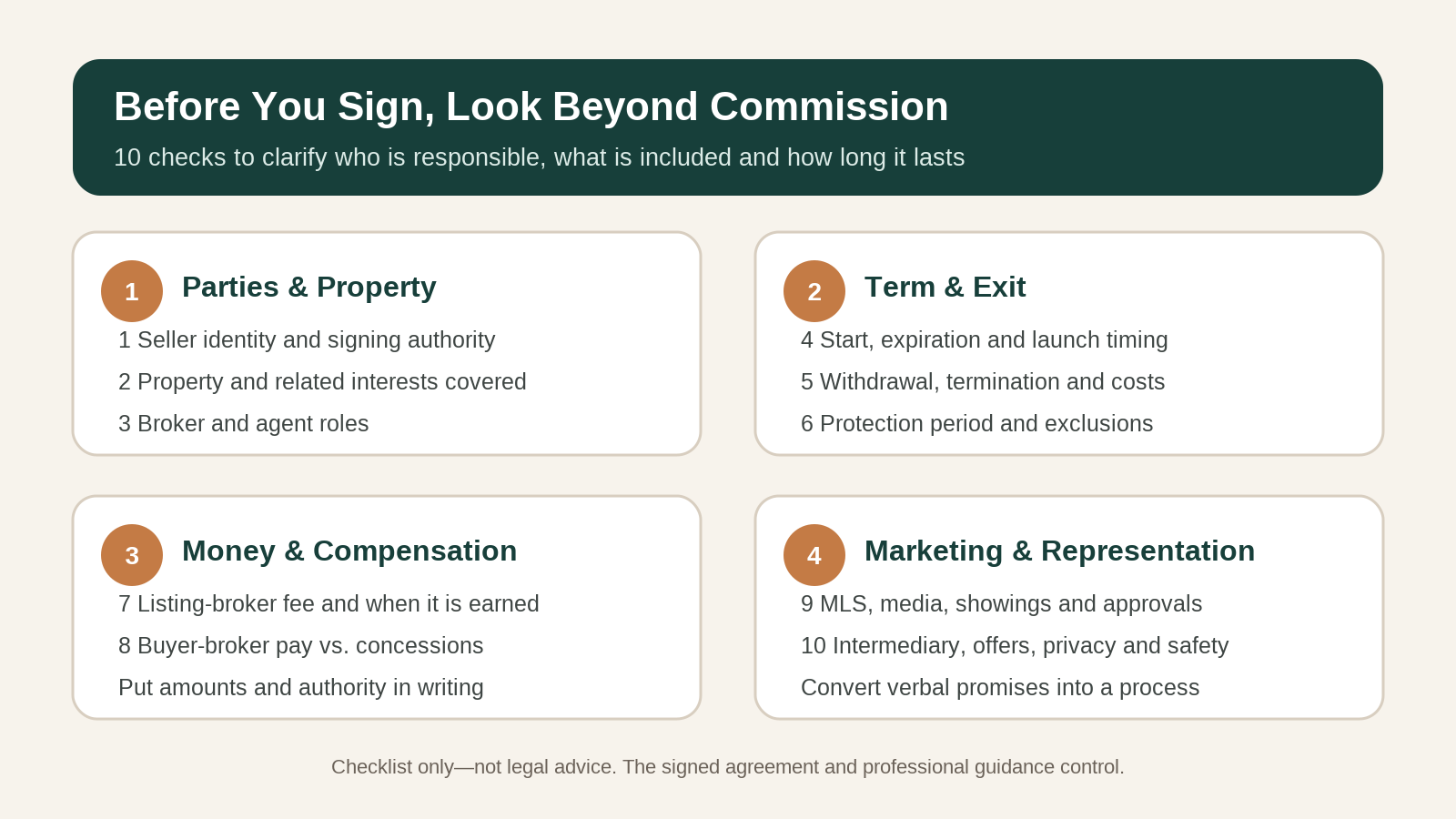
1. Who is the seller, and who has authority to sign?
Compare the expected seller names with the deed, marital status, trust, LLC, estate, power of attorney or divorce documents that may affect authority. The property-tax record alone may not answer every title question.
Raise an unusual ownership structure before an offer arrives. The title company can screen records; a Texas real estate or estate attorney should address disputed rights, inheritance, divorce or trust interpretation.
2. What property and related interests does the agreement cover?
Check the legal description, street address, land, parking or storage rights, additional parcels, leases, equipment and other interests connected to the sale. This matters especially for condominiums, rural property, adjoining lots and tenant-occupied homes.
3. Who sets or changes the listing price?
The list price is a seller-authorized marketing decision. Ask how the initial price was developed and whether price reductions, buyer concessions, repair credits or other changes require written seller approval. Confirm how approvals will be recorded.
If activity is weak, reevaluate showings, competing listings, pending pace and buyer feedback instead of relying on a vague statement that the home is “too high.” The complete Houston home selling guide explains the broader launch and adjustment process.
4. What are the start date, expiration date and actual launch schedule?
When does the agreement become effective? When will the MLS listing go live? Is there time for repairs, photography and preparation? Do not treat the signing date, a coming-soon date and the active-market date as the same date.
If moving, repairs or a tenant affect access, establish that schedule before signing. Use the Houston listing-photo preparation checklist to plan the visual launch.
5. Are withdrawal, termination and release the same thing?
Usually not. Removing a home from public marketing does not necessarily terminate the private listing agreement, and refusing showings does not automatically erase contractual duties. Ask who may terminate, what notice is required, whether incurred costs or compensation apply, whether the broker must agree to a release and which duties survive.
TREC cannot interpret the private contract for the parties or order a broker to release a seller. If the form offers a negotiable termination option, discuss it before a conflict exists.
6. How does the protection period work?
Many agreements address a period after expiration or termination in which compensation may still be claimed if the property is sold to a prospect introduced to or involved with the property during the listing term. Review the length, required prospect list, definition of a covered buyer and any exception when the seller signs with another broker.
If the seller already knows of a tenant, neighbor, relative or other potential buyer, ask before signing whether a written exclusion is appropriate. A verbal “that person does not count” is not a reliable substitute.
7. How is the listing broker compensated, and when may it be earned?
Broker compensation is negotiable; the law does not set a standard percentage. Read more than the amount. Identify what event makes compensation earned or payable, what happens if the seller rejects a type of offer, the transaction does not close, the seller defaults, or a sale or lease occurs later, and whether photography, staging or advertising costs are separate.
Place every possible seller-paid amount on a net sheet and compare proceeds under different prices and buyer requests. The Houston selling-cost and net-proceeds guide provides the larger framework.
8. Separate buyer-broker compensation from buyer concessions
A seller can decide whether to offer or negotiate buyer-broker compensation where permitted. That is different from agreeing to a buyer concession for closing costs, repairs or financing. Confirm what the seller authorizes, any amount or formula, when it can change and who may communicate it.
NAR practice changes effective August 17, 2024 prohibit displaying an offer of buyer-broker compensation in an MLS, while off-MLS communication remains possible; seller concessions may still be communicated subject to MLS rules. Listing-broker compensation remains negotiable. See NAR’s official seller explanation and Offers of Compensation consumer guide. Local MLS rules, brokerage policy, the contract and applicable law still control the transaction.
9. Marketing authority is more than “sell my home”
Ask what the service actually includes: MLS entry, syndication, professional photography or video, copywriting, open houses, showing feedback, reporting frequency and any minimum advertising commitment.
Then review what the seller authorizes: interior and personal-property photography, floor plans, drone use, public address display, lockbox and signs, access by other license holders, and reuse of media or transaction information after closing. For tenant-occupied or lived-in homes, establish rules for pets, cameras, medication, valuables, children and work-from-home information.
10. How will intermediary, offers and seller decisions be handled?
When the same Texas brokerage is involved with both seller and buyer, Texas uses the intermediary framework—not a casual assumption that one person can advocate fully for both sides. Intermediary requires written consent from both parties. Whether separate license holders are appointed and what advice each side can receive depend on the structure. TREC’s intermediary guidance also makes clear that IABS is not intermediary consent.
Set the offer process too: who receives offers, who must be copied, how quickly the seller expects delivery, whether the seller wants to review all written offers and how counters or rejections are documented. Accepting, rejecting or countering remains the seller’s decision; the broker conveys information, explains transaction effects and follows lawful instructions.
Eight questions to ask at the signing table
Which broker entity is the contract with, and what happens if my assigned agent leaves?
What services will be completed between signing and active launch, and on what schedule?
If I pause the sale, what are the separate consequences of withdrawal, termination and release?
How long is the protection period, which prospects are covered and how are exclusions documented?
What compensation, marketing cost or early-termination expense could I be responsible for?
Who approves and documents buyer-broker compensation and buyer concessions?
If the brokerage is also involved with the buyer, who can advise me and who cannot?
What are the standards for media, lockbox access, open houses, safety and offer reporting?
Frequently asked questions
Can I switch agents after signing a listing agreement?
Not necessarily on a unilateral, immediate basis. The agreement is generally with the broker, not the individual agent. Review termination and release provisions and raise the request with the broker in writing. Obtain legal advice when contract rights are disputed.
The agent said I can cancel anytime. Is a verbal promise enough?
Do not rely on the verbal statement alone. Put the termination option, notice method, cost and surviving obligations into the applicable agreement or obtain written confirmation from someone with authority.
Must a seller pay the buyer’s broker?
There is no uniform legal requirement that a seller do so. The seller can evaluate whether to offer or negotiate it as part of the marketing and offer strategy. Listing-broker compensation, buyer-broker compensation and buyer concessions are separate items and should be documented separately.
Does signing IABS mean I hired the broker?
No. IABS is a required brokerage-services notice. It is not the listing agreement and not intermediary consent. Representation and service authority come from the separate written agreement.
Joyce's Featured Listings

AI-generated illustration: a Greater Houston housing scene, not a real or currently available listing.
After reviewing the selling agreement, browse Joyce's Featured Listings to understand the types of Greater Houston homes currently represented in the market.
View Joyce's Featured Listings →
Preparing to sign but unsure about a few terms?
Send me the property address, expected launch date, ownership structure, tenant status and the questions you have about exit terms, marketing scope or cost. I can help organize the operational questions for the broker; a Texas attorney should interpret private contract rights and legal consequences.
About Joyce Tang

Joyce Tang is a Greater Houston real estate agent and investor, co-founder of the North American Real Estate Association, founder of JoyHome and JoyNest, and co-leader of the Dr. Wang Real Estate Team.
She has helped more than 200 families buy or sell homes and has participated in more than 40 renovation projects. Her approach examines not only price, but also location, carrying cost, cash flow, risk and future exit options.
Disclaimer
This article is based on public Texas Real Estate Commission and National Association of REALTORS® materials reviewed through November 1, 2026. It provides general information about Texas residential home selling and brokerage services. It is not legal advice and does not interpret any specific listing agreement. Form versions, brokerage addenda, local MLS rules and transaction facts vary. Ask the broker to explain services and implementation, and consult a Texas real estate attorney before signing, modifying or terminating an agreement or addressing disputed contract rights.