

The short answer: annual dues are only one small part of buying in a Houston HOA. The resale certificate and subdivision information can reveal unpaid amounts, property violations, special assessments, transfer fees, reserve levels, litigation and rules that directly affect how you plan to use the home.
The review clock may also be short. Under common elections in the 2026 TREC 36-11 addendum, the buyer may have three days after receipt—or until closing, whichever comes first—to terminate. That right is separate from the option period.
A resale certificate is not just an HOA dues statement
TREC 36-11 defines “Subdivision Information” as the current restrictions, bylaws and association rules plus a resale certificate described by Texas Property Code Chapter 207. The buyer is reviewing both money and use: what this property owes, what the association is dealing with and what the owner will be allowed or required to do.
TREC Form 37-5 is a voluntary resale-certificate form that organizes common disclosures, although an association or management company may use a different format. The layout matters less than the information behind it.
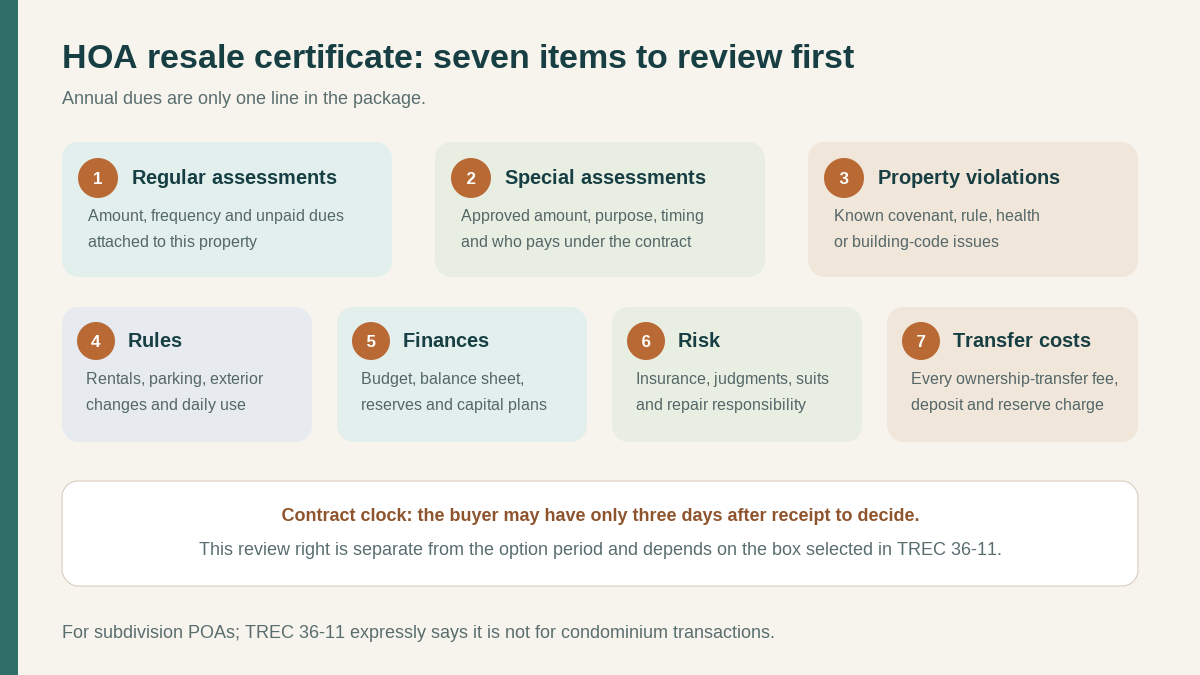
The seven items I check first
1. Regular assessments and unpaid amounts tied to the property
Confirm the amount and frequency—monthly, quarterly or annual—then look for unpaid dues, interest, fines or other balances under the seller’s account. Modest annual dues do not erase a delinquency that must be resolved before the title company can obtain a clean status.
2. Approved special assessments
A special assessment is not the same as ordinary dues. Review the amount, purpose and due dates, then read the contract allocation of payments due before and after closing. “None currently due” does not mean one can never occur, so compare approved capital work, reserves and the operating budget.
3. Known violations on this property
The certificate addresses whether the association has actual knowledge of covenant, bylaw or rule violations and whether governmental health or building-code notices have been received. Common issues can involve exterior color, fencing, sheds, parking, landscaping or unapproved alterations. Ask who will cure the issue, what it may cost and how closure will be documented.
4. Rules that affect your intended use
Test the documents against your actual plan: long-term leasing, short-term rentals, commercial vehicles, a pool, solar panels, exterior changes, a new fence or a home business. Do not assume an activity is permitted because a neighbor appears to be doing it; verify the current rule, approval process and the specific property.
5. Budget, balance sheet, reserves and capital projects
Chapter 207 requires disclosure of approved capital expenditures and capital reserves, while TREC 37-5 lists the current budget and balance sheet among the attachments. Reserve dollars only make sense next to the age and expected cost of association-maintained roofs, walls, roads, drainage, pools or clubhouses.
Low reserves do not prove a special assessment is imminent, and high reserves do not guarantee strong management. The useful question is whether planned obligations and available funds appear materially out of balance.
6. Insurance, judgments, lawsuits and repair responsibility
The package typically includes association insurance information and discloses unsatisfied judgments and pending litigation. Buyers need to separate what the association insures and repairs from what the homeowner must insure and maintain. TREC 36-11 specifically warns buyers to be satisfied with repairs that are solely the association’s responsibility before signing.
7. Transfer fees, deposits and reserve charges
Chapter 207 requires a description of all ownership-transfer fees, who receives them and the amount. Paragraph C of TREC 36-11 assigns association transfer-related charges to the buyer up to the written cap and the excess to the seller; ordinary periodic dues and document-order costs are handled separately. That cap should be calculated, not guessed.
The three-day review right is not the option period
When TREC 36-11 has the seller obtain the information, delivery commonly gives the buyer three days after receipt or until closing, whichever occurs first, to terminate in writing and receive the earnest money back. If the seller does not deliver it, the form may allow termination before closing.
When the buyer obtains the package, the form uses the earlier of actual receipt or the specified date as deemed receipt. A buyer who received and approved the documents before signing may elect to require an updated resale certificate. Each box changes who orders, who pays and which deadlines apply; “HOA documents have three days” is not a complete contract analysis.
The option period can be running at the same time, but it is a different contractual right. Record the receipt date immediately, assign the review and turn unanswered questions into a decision before the earliest deadline.
The association’s ten-business-day statute does not extend the purchase contract
Texas Property Code §207.003 generally requires the association to deliver the package by the tenth business day after receiving a proper written request and required authority. The resale certificate must be prepared no earlier than 60 days before delivery. The current statutory fee cap is generally $375, with a separate $75 cap and seven-business-day timeline for a qualifying update.
Those rules govern the association’s delivery and fees. They do not automatically extend the option period, financing, closing or the dates written in TREC 36-11. Ordering late can compress the buyer’s and title company’s time even when the association acts within the statute.
A practical buyer review order
- Record receipt date and the selected TREC 36-11 box; identify the earliest termination deadline.
- Check property-specific dues, violations, special assessments and any right of first refusal.
- Compare restrictions and rules with your leasing, parking, alteration and use plans.
- Review budget, balance sheet, reserves, capital projects, insurance, judgments and litigation.
- Ask the title company whether required payoff, waiver and status information is complete.
- Add transfer charges, deposits and reserve fees to estimated cash to close.
- If a material question cannot be resolved in time, ask the agents and, when needed, an attorney about contract options instead of guessing.
What should the seller do before listing?
Confirm the correct association and management-company contact information, ordering timeline and fees. Address known delinquencies and violations early and retain proof of closure. If the association is considering a special assessment, major repair or rule change, do not assume it is irrelevant merely because no invoice has arrived.
HOA charges are only one layer of carrying cost; see how Houston buyers should compare MUD, PID and HOA costs. If the property is a condo or townhome, use the Houston condo and townhome nine-point review. For title documents, continue with the Texas title commitment, survey and title-insurance guide.
FAQ
Do low HOA dues mean the association is financially stronger?
Not necessarily. Lower dues may reflect fewer common amenities, or they may coexist with low reserves and future assessment pressure. Read the budget, reserves, capital plan and repair responsibilities together.
The seller says there are no HOA violations. Do I still need the certificate?
Yes. A seller’s understanding does not replace the association’s disclosure, and the package also covers assessments, transfer charges, litigation and broader community information.
Can a buyer waive the subdivision information to strengthen an offer?
TREC 36-11 includes an election in which the buyer does not require delivery, but choosing it gives up important information and contract protection. Whether that risk is appropriate depends on the transaction, competition and legal advice—not just a desire to simplify the offer.
Does this guide apply to condominiums?
Not directly. TREC 36-11 expressly states that it is not for condominium transactions. Condo resale certificates, common expenses and association documents follow a different contract and Texas Property Code Chapter 82.
Sources and image note
Primary sources: TREC Form 36-11 page, TREC Form 36-11, TREC Form 37-5 resale-certificate page, TREC Form 37-5, and Texas Property Code Chapter 207. Sources checked October 23, 2026.
The cover is a real real-estate-document still-life by Atlantic Ambience from the Pexels photo page under the Pexels License. It was cropped to 16:9, resized and compressed without generative alteration. It does not show a JoyHome listing or client file.
Joyce's Featured Listings

Including HOA document risk in the budget makes it easier to compare the real carrying cost of two homes. Browse Joyce's Featured Listings, then verify the current association package for any specific address.
View Joyce's Featured Listings
Considering a home in an HOA community?
Send me the address, intended owner-occupancy or rental use, the document receipt date and the fees or rules that concern you. I can organize the contract deadlines and question list before the association, title company or attorney addresses the items that require further confirmation.
About Joyce Tang

Joyce Tang is a Greater Houston real estate agent and investor, co-founder of the North American Real Estate Association, founder of JoyHome and JoyNest, and co-leader of the Dr. Wang Real Estate Team.
She has helped more than 200 families buy or sell homes and has participated in more than 40 renovation projects. Her approach examines not only price, but also location, carrying cost, cash flow, risk and future exit options.
Important notice
This article addresses common Texas subdivision transactions with mandatory membership in a property owners association. It is not a condominium guide and is not legal, accounting or insurance advice. Joyce Tang is not an attorney, accountant or insurance agent. Fees, repair obligations, termination rights and deadlines must be confirmed from the complete contract, current association documents and appropriate professional advice for the specific property.