

Yes. Most owners do not wait until a 30-year mortgage is fully paid before selling. At closing, the title company or settlement agent normally uses the lender’s official payoff statement to pay the mortgage and other liens from the sale funds; only the remaining amount becomes the seller’s net proceeds.
The real question is not whether a mortgage exists. It is whether the expected price will cover every payoff, seller charge, tax adjustment, buyer credit and closing obligation. If it will not, the seller may need to bring funds or discuss another lender-approved path before closing.
The calculation sellers often get wrong
A seller opens the loan portal and sees a principal balance of $280,000. The seller subtracts that number from the expected sales price and assumes the difference is available cash. Near closing, the official payoff is higher because it may include interest through the expected payoff date, unpaid charges and, for some loans, an applicable prepayment term. A HELOC, second loan, seller costs and tax adjustments may also remain.
The principal balance is useful for an early estimate, but it is not the settlement payoff statement. The CFPB explains that a payoff amount and a current balance are different numbers. See the CFPB payoff-amount explanation.
Three numbers to keep separate
Principal balance: unpaid loan principal, which may not include all interest and charges through payoff.
Payoff amount: the amount required to satisfy the loan on a specified date, often with a good-through date or per-diem interest.
Net proceeds: the sales price minus every payoff, lien, seller charge, tax adjustment, credit and other closing obligation.
How the money moves at closing
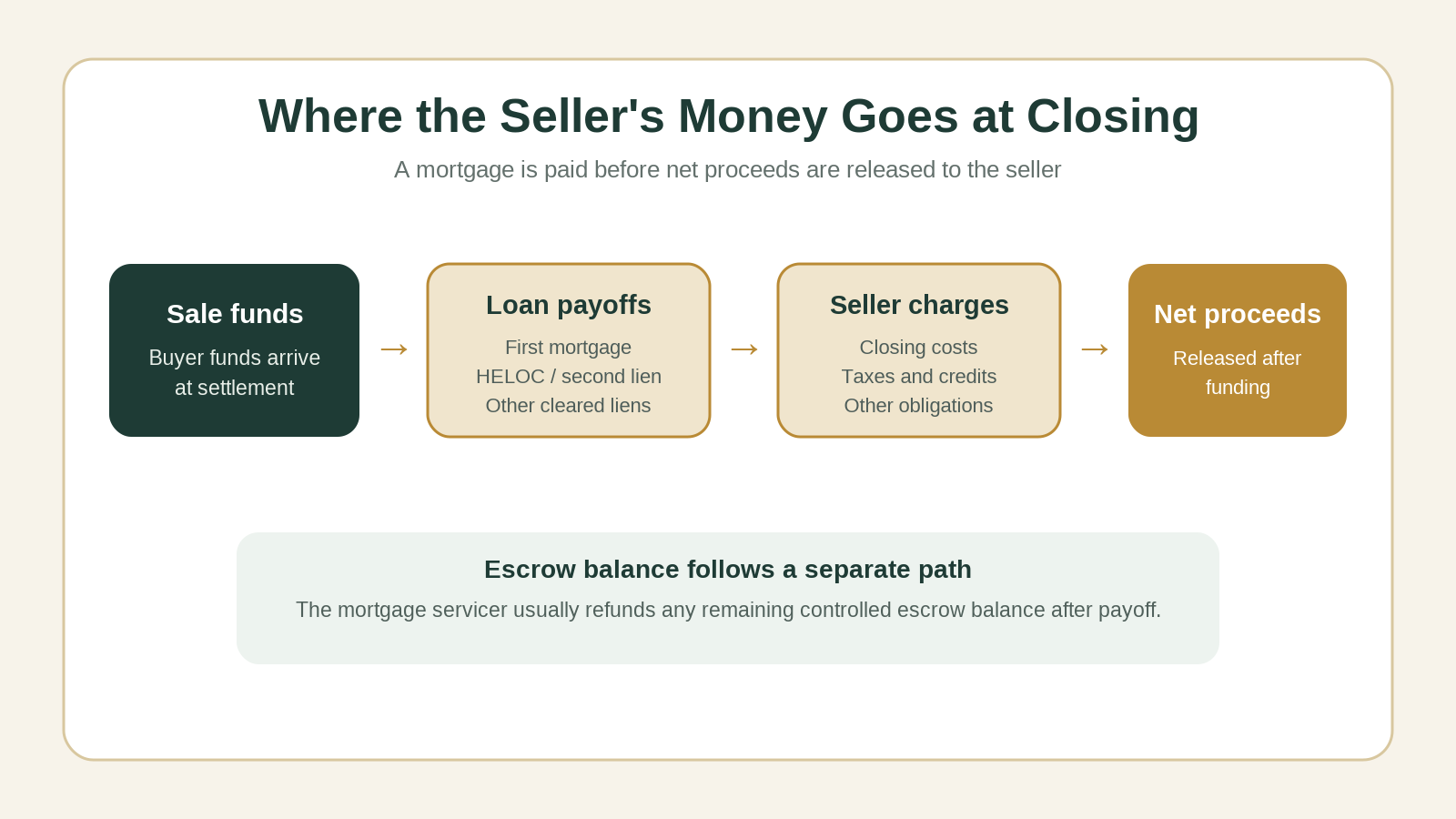
The basic sequence is “pay obligations first, release proceeds second.” Once buyer funds are available, the settlement agent disburses confirmed loan payoffs, cleared liens and transaction charges according to the final settlement documents. The seller receives net proceeds after funding conditions are satisfied. The Texas seller closing-day funding guide explains the final signing-to-funding gap.
Eight checks before closing
1. Identify the current loan servicer—not only the original lender
Servicing may have transferred after origination. Use the latest mortgage statement to confirm the loan number, current servicer, contact information and written-payoff request process. Do not send account numbers, identity documents or wire details through an unverified email.
2. Authorize the title company to request an official payoff early
The seller generally signs an authorization so the title company can request the payoff. Federal rules generally require an accurate payoff statement within seven business days after a written request from the consumer or an authorized person, subject to specified exceptions. See CFPB Regulation Z §1026.36(c)(3). Do not wait until closing day to begin.
The payoff should cover the expected funding date. Review the good-through date, per-diem interest and update process. If closing moves, the title company may need a revised figure.
3. List every debt connected to the property
Common omissions include a HELOC, home-equity or second-lien loan, renovation or solar financing, judgment lien, tax lien or another recorded claim. Even a HELOC with a zero balance may still be open; confirm whether it must be frozen, closed and released.
Title agents examine public records for deeds of trust, mortgages, judgments, tax records and liens. The Texas Department of Insurance describes that review in its official title FAQ. If the title commitment shows an unfamiliar or previously paid loan, use the Texas seller title-problem guide to organize the next questions.
4. Do not subtract only the mortgage from the sales price
Also account for broker compensation, title and escrow charges, tax adjustments, HOA documents or transfer charges, repair or closing-cost credits and any other seller obligation in the contract. Begin with a conservative net sheet and replace estimates with the formal payoff and final settlement statement. The Houston selling-cost and net-proceeds guide covers the broader calculation.
5. Address a shortage before closing day
If the expected sale funds will not cover all payoffs and obligations, the seller may need to bring the shortage or obtain an applicable lender-approved solution in advance. A short sale is not a unilateral decision to accept a lower price, and lender approval should never be assumed. Servicers, a Texas real estate attorney and a tax professional should address hardship, debt forgiveness, credit and tax consequences within their respective roles.
6. Keep making scheduled payments until payoff and funding are confirmed
Do not stop paying merely because the home is under contract or closing papers have been signed. The transaction can be delayed and the payoff may not yet be posted. Wait until the title company and servicer confirm the payoff before canceling autopay. If a payment overlaps, retain the records and ask the servicer how the excess will be refunded or credited.
7. Treat the mortgage escrow balance as separate from closing proceeds
A mortgage escrow account may hold money for property taxes and insurance. Federal rules generally require the servicer to return a remaining controlled escrow balance within 20 days after full payoff, excluding Saturdays, Sundays and legal public holidays. Rules for netting funds or crediting an eligible new escrow account may apply. See CFPB Regulation X §1024.34.
The servicer usually sends that refund separately; do not assume it appears in the seller’s closing proceeds. An escrow refund is also different from property-tax proration on the settlement statement: one is a loan-servicing account balance, while the other is an adjustment between buyer and seller.
8. Track the file after closing until refunds and lien release are complete
Confirm that the servicer account shows paid in full or a zero balance.
Track any excess payment, per-diem interest adjustment or other refund.
Give the servicer a current mailing address for an escrow refund check.
Ask the title company about the release or satisfaction recording process.
After funding and contractual delivery, coordinate the insurance cancellation or change date.
Keep the payoff statement, final settlement statement, wire record and paid-in-full documents.
Frequently asked questions
Can the buyer take over my low-rate mortgage?
Do not assume so. A buyer may take over a loan only when the loan permits assumption and the lender approves the buyer and process. A conventional sale normally pays off the seller’s loan. “Subject to,” assumption and a standard payoff are different structures that require lender and legal review.
When should the payoff statement be ordered?
Allow enough time for the servicer and title company, but make sure the statement covers the expected funding date. The title company should schedule the request and any update around the servicer’s process and the payoff’s validity period.
Can the escrow balance be used directly for seller closing costs?
Do not assume it can. The servicer may refund the balance, may net permitted amounts against the loan, or may credit an eligible new escrow account with the borrower’s agreement. The servicer’s treatment, applicable rule and settlement documents control.
Do I personally release the lien at the county after payoff?
The lender normally issues the applicable release or satisfaction for the recording process, but the seller should retain paid-in-full documents and confirm follow-up with the title company. A title company and attorney can help when an old paid loan remains unreleased.
Joyce's Featured Listings

AI-generated illustration: a Greater Houston housing scene, not a real or currently available listing.
If the sale is part of a move or portfolio change, browse Joyce's Featured Listings to understand current Greater Houston options, then plan the next budget alongside the expected net proceeds.
View Joyce's Featured Listings →
Want an early estimate of what may remain after the sale?
Send me the property address, expected sales price, latest principal balance, any HELOC or second loan and the expected timing. I can organize the inputs for a seller net sheet; the loan servicer supplies the official payoff, and the title company, Texas attorney and tax professional should confirm title, legal, debt and tax conclusions.
About Joyce Tang

Joyce Tang is a Greater Houston real estate agent and investor, co-founder of the North American Real Estate Association, founder of JoyHome and JoyNest, and co-leader of the Dr. Wang Real Estate Team.
She has helped more than 200 families buy or sell homes and has participated in more than 40 renovation projects. Her approach examines not only price, but also location, carrying cost, cash flow, risk and future exit options.
Disclaimer
This article is based on public Consumer Financial Protection Bureau and Texas Department of Insurance materials reviewed through November 22, 2026. It provides general information about Texas home sales, mortgage payoff and closing. It is not lending, legal, tax, title or financial advice. Loan terms, servicer procedures, title records, short-sale conditions and transaction documents vary. Use the official figures from the loan servicer, title company and final settlement documents, and consult the appropriate licensed professionals for disputes, hardship, debt forgiveness or tax consequences.