

A Houston rental with $2,400 monthly rent can still lose money. Rent minus the mortgage is not cash flow; the calculation also needs property tax, insurance, HOA, vacancy, routine maintenance, major replacements and management.
The $2,400 example below is hypothetical, not a Houston average or a promised result. I am using it because it exposes the exact mistake that makes an investment look profitable before closing and painful after closing.
The shortcut that creates a false $700 profit
Suppose rent is $2,400 and the mortgage principal-and-interest payment is $1,700. The quick calculation says the property produces $700 a month. That number is incomplete because principal and interest is only one part of the monthly cost.
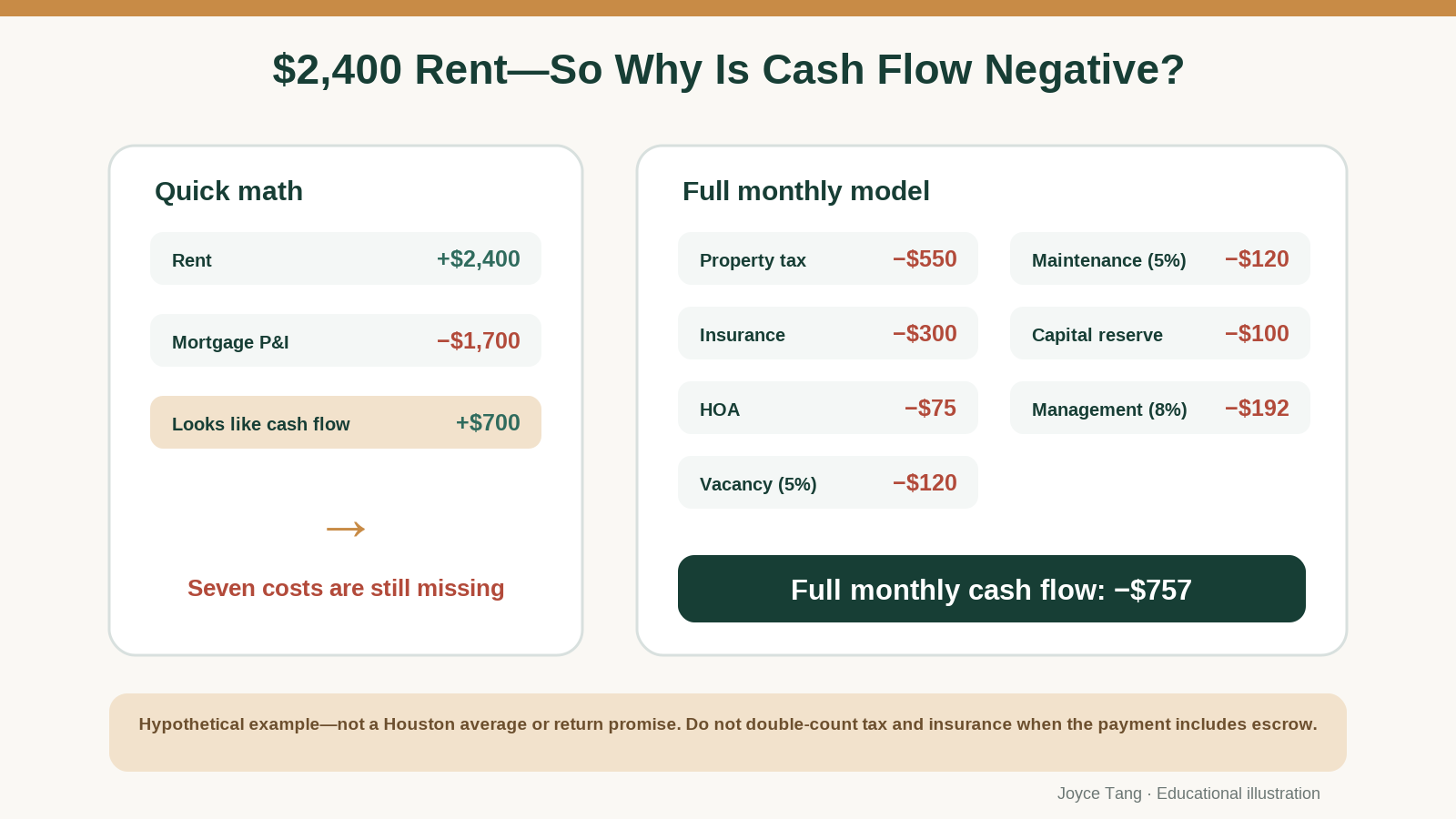
In the full hypothetical model, property tax is $550, insurance $300, HOA $75, vacancy reserve $120, routine-maintenance reserve $120, capital reserve $100 and management $192. After all eight expense lines, the monthly result is negative $757—not positive $700.
The percentages are planning assumptions for this illustration. They are not universal rules. A newer home may need less routine work at first; an older home with original HVAC, roof, plumbing or foundation concerns may need far more.
Eight costs a rental-property worksheet should separate
1. Mortgage principal and interest
Use the actual investment-property loan quote, not an owner-occupied advertised rate. Keep principal and interest separate from escrow so tax and insurance are not counted twice.
2. The complete property-tax bill
Texas property tax is local. A home can be taxed by the county, school district, city and special districts. Do not copy the seller’s current escrow or assume a homestead exemption will continue on a rental. Verify the address through the appraisal district and taxing units. The Texas Comptroller’s property-tax basics explains how local entities participate.
3. Property and landlord insurance
Use a bindable quote for the exact address and intended rental use. Confirm wind, hail, water, liability, loss-of-rents coverage, deductibles and whether flood coverage is separate. The Texas Department of Insurance shopping guide recommends comparing coverage as well as price.
4. HOA, MUD, PID and recurring assessments
HOA dues are not the same as MUD tax or a PID assessment. Put each obligation on its own line and read the current documents. A low purchase price can still carry a high monthly burden.
5. Vacancy and leasing cost
Even a good rental will not stay occupied forever. Model unpaid days plus cleaning, make-ready, marketing, lock changes and any leasing commission. My previous guide shows why one vacant month can erase years of a small renewal increase.
6. Routine maintenance
Service calls, small plumbing repairs, appliances, pest control, yard work and minor make-ready items arrive unevenly. A monthly reserve keeps one quiet month from looking more profitable than the full year.
7. Major capital replacements
Roof, HVAC, water heater, sewer, electrical and foundation work are not ordinary monthly repairs, but they are part of owning the property. Divide a realistic future amount into a monthly reserve instead of assuming these costs do not exist until something breaks.
8. Management and owner time
Professional management is a cash expense. Self-management may remove that invoice, but it does not make leasing, calls, bookkeeping, inspections and coordination free. Track the owner’s time separately so two investments can be compared honestly.
Three numbers investors often mix up
Cash flow is money left after monthly income and cash expenses, including debt service and reserves used in your model.
Principal paydown can build equity, but it is not spendable monthly cash flow.
Appreciation may improve total return, but it is uncertain and cannot repair a monthly budget that does not work today.
The security deposit is also not rental income. It is money held under the lease and applicable law, subject to permitted deductions and return requirements.
How I would underwrite one Houston rental
Start with recent signed leases for the same property type and micro-area, then reduce any concessions to an effective monthly rent.
Use the actual tax entities and a post-purchase value scenario, without assuming the seller’s exemption or escrow transfers.
Get an address-specific insurance quote and check whether flood or wind coverage is separate.
Review age and condition of roof, HVAC, water heater, plumbing, electrical, foundation and drainage, then create both maintenance and capital reserves.
Use the real financing quote, cash to close and expected holding period.
Stress-test one vacant month, 5% lower rent and one major repair. If the investment only works when nothing goes wrong, it does not work yet.
For the broader property-selection process, start with my Houston real-estate investing guide for beginners. This article is the deeper worksheet behind its cash-flow section.
Common questions
If my mortgage payment includes escrow, do I add tax and insurance again?
No. Break the payment into principal, interest, property tax and insurance, then include each cost once. Double-counting makes the deal look worse; leaving escrow unexamined can hide future tax or insurance changes.
Should I include a management fee if I plan to self-manage?
Show both versions. One measures current cash outlay; the other shows whether the property still works if your time changes or professional management becomes necessary.
Can appreciation make up for negative cash flow?
It might improve long-term return, but it is not guaranteed and does not pay today’s shortfall. Buy only when the monthly loss, liquidity and risk fit the owner’s actual plan—not because appreciation is needed to rescue the numbers.
Browse Joyce's Featured Listings

If you want to see what your budget can currently buy before building a property-specific model, browse Joyce's Featured Listings. Each home still needs its own rent, tax, insurance, condition and exit analysis.
View Joyce's Featured Listings
Want to test the real cash flow of one property?
Send me the address, expected rent, down payment, loan quote and planned holding period. If you already have tax, insurance, HOA or inspection information, include it. I can help organize the real-estate assumptions and identify which numbers still need a lender, insurer, tax professional, inspector or attorney.
About Joyce Tang

Joyce Tang is a Greater Houston real estate agent and investor, co-founder of the North American Real Estate Association, founder of JoyHome and JoyNest, and co-leader of the Dr. Wang Real Estate Team.
She has helped more than 200 families buy or sell homes and has participated in more than 40 renovation projects. Her approach examines not only price, but also location, carrying cost, cash flow, risk and future exit options.
Investment, tax, insurance and legal note
This article is general real-estate education, not investment, lending, tax, insurance, property-management or legal advice. The example is hypothetical and does not predict any property’s rent, expenses, occupancy, appreciation or return. Verify the exact address, lease, financing, taxes, insurance, HOA/MUD/PID obligations, flood information and property condition with the appropriate qualified professionals.