

A $100 monthly rent increase can look reasonable on paper. But if the tenant moves out and the home sits vacant for one month, a Houston landlord may need more than 23 months just to recover that lost rent—before cleaning, repairs, utilities or leasing costs.
That is why I would not start a renewal decision with “How much can I raise the rent?” I would start with “What will it cost if this tenant leaves, and how long will the higher rent take to pay me back?”
Houston demand is holding up, but landlords do not have blanket pricing power
HAR reported 3,761 single-family leases in September 2026, up 3.2% from a year earlier. Yet average rent slipped 0.6% to $2,333 and median rent fell 1.4% to $2,150. Leasing activity can rise while pricing power weakens when renters have enough alternatives. Source: HAR September 2026 Rental Market Update.
The correct conclusion is not that every landlord should hold rent flat. It is that a renewal increase must be supported by the property’s own submarket, condition and tenant-turnover math. Houston is not one rental market; two homes with the same bedroom count can face very different competition only a few miles apart.
This is the practical follow-up to the rental section in my October 26 Houston Housing Weekly.
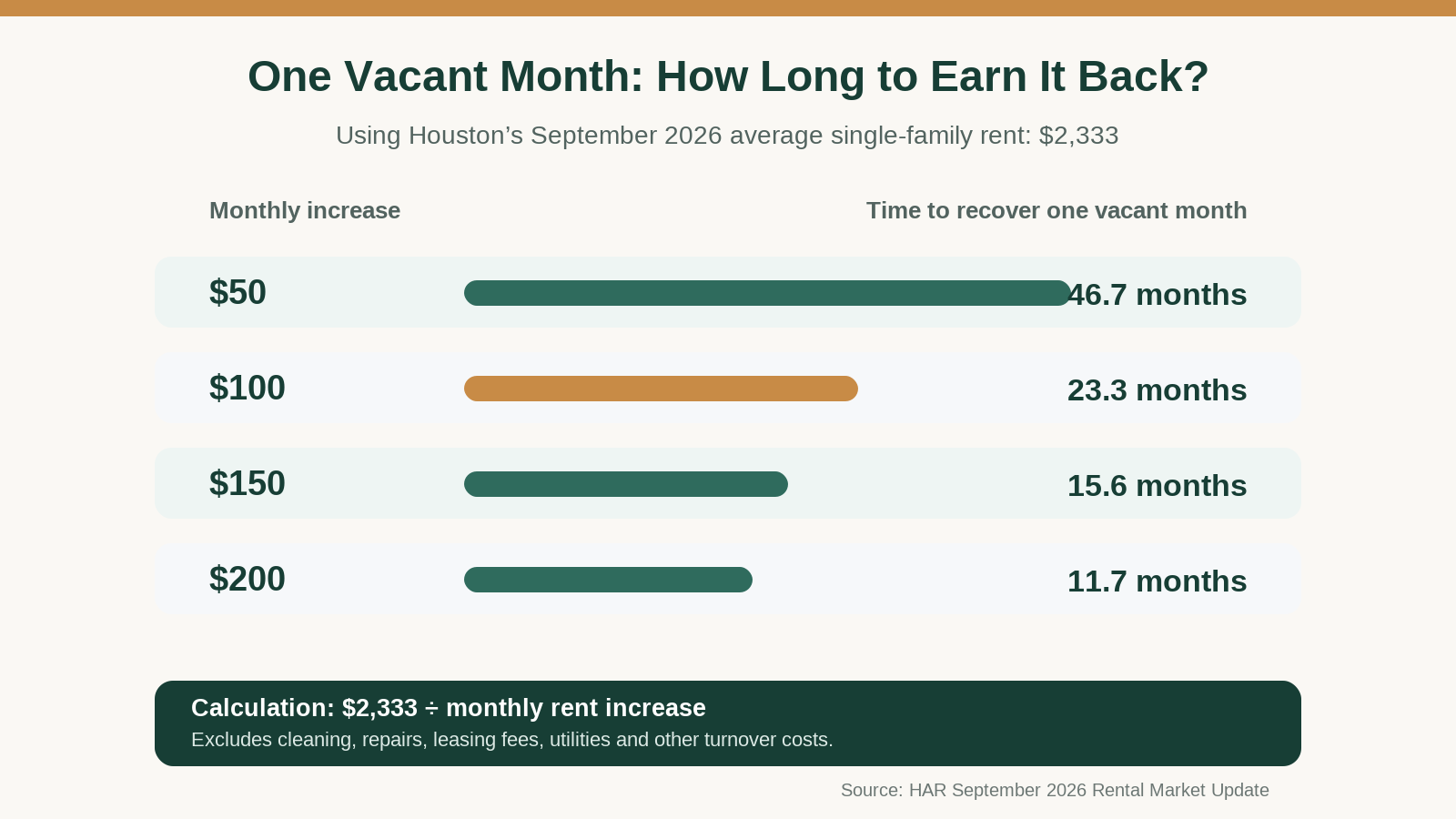
The vacancy-cost test
Using the September single-family average rent of $2,333, one vacant month produces the following simple break-even periods:
A $50 monthly increase takes about 46.7 months to recover $2,333.
A $100 monthly increase takes about 23.3 months.
A $150 monthly increase takes about 15.6 months.
A $200 monthly increase takes about 11.7 months.
The formula is simple: one month of lost rent divided by the monthly increase. It is intentionally conservative in only one direction—it still leaves out make-ready work, cleaning, paint, utilities, marketing, leasing commission, lock changes and the risk that the next tenant negotiates a concession.
A smaller concession can sometimes be cheaper. Giving a reliable tenant $50 a month for a 12-month renewal costs $600. One month of vacancy at $2,333 costs almost four times as much before turnover expenses. That does not mean a concession is always correct; it shows why the comparison belongs in the decision.
Five things I check before recommending a renewal increase
1. Recent signed leases—not the highest active asking rent
Active listings show what landlords hope to receive. Closed or leased comparables show what renters actually accepted. I would compare the same subdivision or micro-area, property type, bedroom count, condition, age and major features, with extra weight on the last 30 to 60 days.
2. The tenant’s business value
Payment history, care of the property, communication and lease compliance affect turnover risk and operating cost. Use consistent, documented business criteria for every tenant. Renewal terms and housing decisions must not vary because of race, color, religion, sex, disability, familial status, national origin or any other protected characteristic.
3. The real cost of turnover
Add realistic days vacant, make-ready repairs, cleaning, yard work, utilities, marketing, leasing fees and the owner’s time. If the home needs paint, flooring or an appliance before reletting, that cost belongs in the renewal decision now—not after the tenant gives notice.
4. Lease-end timing and current competition
A lease ending during a slower period may carry more vacancy risk than one ending when renter activity is stronger. Count the comparable homes available now and note concessions, days on market and condition. One nearby listing with an optimistic price is not a market.
5. The size of the gap between current rent and supported market rent
If the tenant is already near market, a large increase can create more risk than return. If the rent is materially below well-supported comparables, a phased adjustment may be easier to defend and absorb than one abrupt reset. The lease and applicable law still control timing, notice and permitted terms.
Three reasonable strategies
Hold the rent or offer a longer renewal when a dependable tenant is already near market and competing supply is high.
Use a modest increase when recent signed leases support it and the tenant still receives a fair value for the home’s condition.
Reset more meaningfully only when the home is clearly below market, the evidence is strong and the expected turnover cost still makes the change worthwhile.
My own rule is to calculate the downside first. A renewal is not about winning an extra $100 this month. It is about protecting the property’s net income over the next one to two years without ignoring taxes, insurance, repairs and future capital needs.
Common questions
Should the renewal rent always match the highest market listing?
No. The highest asking rent may never lease, and it may include different condition, location or incentives. Use recent signed leases and calculate effective rent after concessions.
What if property tax and insurance increased?
Those costs matter to the owner, but they do not automatically prove the market will support the same rent increase. Compare carrying-cost pressure with local signed leases and turnover risk before choosing the amount.
Is keeping the same tenant always better?
No. Serious payment, property-care or lease-compliance issues may outweigh vacancy cost. The decision should use documented, lawful and consistently applied business criteria—not assumptions about who the tenant is.
Related reading
Rent Is $2,400—So Why Is Cash Flow Still Negative? Eight Costs Houston Investors Miss
Rent Is Already Coming In—Is the Deal Ready? 8 Checks Before Buying a Tenant-Occupied Houston Home
Browse Joyce's Featured Listings

If you are comparing a future rental purchase with the economics of your current property, browse Joyce's Featured Listings to see the current range of Greater Houston opportunities. Availability and pricing change, so each property still needs its own rent and carrying-cost analysis.
View Joyce's Featured Listings
Want to test a renewal number for one property?
Send me the address, current rent, proposed renewal rent, lease-end date, property condition and any known turnover costs. I can help organize the local lease comparisons and vacancy-cost calculation before you decide whether to hold, raise or reposition the rent.
About Joyce Tang

Joyce Tang is a Greater Houston real estate agent and investor, co-founder of the North American Real Estate Association, founder of JoyHome and JoyNest, and co-leader of the Dr. Wang Real Estate Team.
She has helped more than 200 families buy or sell homes and has participated in more than 40 renovation projects. Her approach examines not only price, but also location, carrying cost, cash flow, risk and future exit options.
Market and legal-scope note
This article is general market education, not legal, tax, property-management or investment advice. Market rents, vacancy and expenses vary by property and date. Follow the lease and applicable fair-housing, notice and landlord-tenant requirements; consult the appropriate qualified professional for property-specific legal or tax questions. No rent, occupancy or return is guaranteed.