

Houston multifamily is moving toward firmer footing, but I would not call it a full recovery yet. Apartment demand is absorbing units faster, occupancy has improved and the construction pipeline is shrinking. Rent growth, concessions and financing, however, have not all turned at the same time.
That split matters to owners and buyers. A property can show better occupancy and still miss its cash-flow target if effective rent is soft, bad debt is rising, insurance or taxes reset higher, or the refinance is more expensive than the original model assumed.
First, what this report means by “multifamily”
This article is about professionally operated apartment properties with five or more units—the commercial multifamily market. It is not the same dataset as a condominium unit, a townhome or a two-to-four-unit residential purchase. Financing, operating statements, valuation and buyer pools are different.
The operating side improved in the third quarter
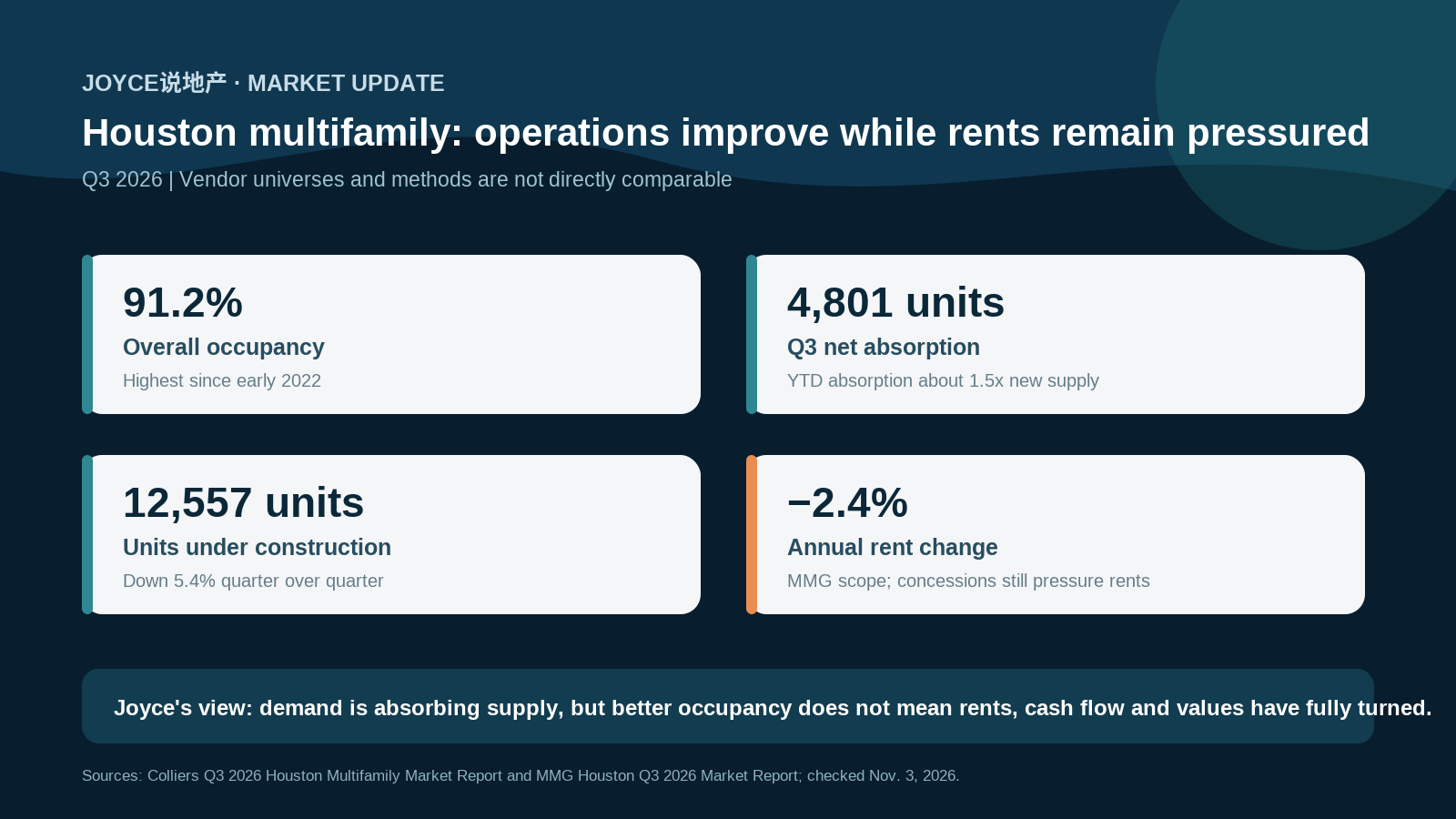
Colliers reported 4,801 units of Q3 net absorption. Year-to-date absorption ran at roughly 1.5 times new supply, lifting overall occupancy to 91.2%, the highest level since early 2022. More than 70% of third-quarter absorption was in Class A properties.
Net absorption means the net increase in occupied units. It is an important demand signal, but it does not tell us whether those leases were signed at full asking rent, with several weeks free, or after other concessions. Occupancy is only the first layer of the operating story.
Why two reports can show different occupancy numbers
MMG reported an 88.4% occupancy rate, average rent of $1,293 and a 2.4% annual rent decline for Q3. Colliers reported 91.2% occupancy. These figures should not be averaged or treated as a contradiction; research firms can use different property universes, stabilization rules, geographic boundaries and collection dates. See the MMG Q3 2026 Houston report.
I use the direction more than a false sense of precision: demand has improved, but rent pricing remains pressured. For a specific acquisition, the rent roll and trailing operating statements matter more than the metro headline.
The supply wave is easing—but it has not disappeared
Colliers counted 12,557 units under construction, down 5.4% from the prior quarter. Trailing four-quarter deliveries were 47% below their late-2023 peak. MMG described the active pipeline as 1.6% of existing inventory, its smallest share in more than a decade.
That is the strongest reason to expect operations to improve into 2027: fewer new communities will be competing for the same renter. It does not mean every submarket improves together. A property next to several lease-ups can still face aggressive concessions even when the metro pipeline is shrinking.
Rent recovery usually follows occupancy—not the other way around
Northmarq’s midyear report found that vacancy improved by 40 basis points in the second quarter, the largest quarterly improvement in nearly five years, while rents were mostly flat. Its Houston multifamily update supports the same pattern seen in Q3: leasing can improve before owners regain pricing power.
Concessions are the practical issue. A unit marketed at $1,500 with one month free on a 12-month lease produces $16,500 for the year before other costs—an effective average of $1,375 per month. Underwriting the $1,500 headline instead of the effective rent overstates revenue by $1,500 for that lease.
Capital is returning selectively, not blindly
Colliers reported that cross-border buyers represented 7.6% of Houston acquisition volume year to date, up from 5.2% for full-year 2025 and the highest share since 2019. That shows renewed interest, but it does not prove that every asset is easier to finance or that pricing has fully reset.
The market can improve operationally while transactions remain selective. Buyers still have to bridge the gap between current borrowing cost, required equity, seller expectations and the income a property can support today—not after an optimistic rent-growth assumption.
The numbers I would rebuild before trusting a cap rate
Current rent roll: occupied, vacant, notice, employee and down units separated clearly.
T-12 income: base rent, concessions, bad debt, application fees, utility reimbursements and other income shown separately.
Expense reset: property tax, insurance, payroll, utilities, contract services, repairs, management and replacement reserves.
Capital needs: roofs, HVAC, plumbing, electrical, drainage, paving, balconies, fire/life-safety and unit turns.
Debt terms: actual rate, amortization, interest-only period, reserves, covenants, prepayment and refinance assumptions.
Exit case: a conservative cap rate and realistic rent growth, not a return target used backward to justify the purchase price.
A seller’s cap rate is a starting calculation, not a conclusion. If taxes are based on the seller’s old assessment, insurance is a stale renewal, management is omitted or reserves are too small, the apparent yield can disappear quickly.
What owners should do before bringing a property to market
A clean story is worth more than a polished brochure. I would reconcile the rent roll to bank deposits, show concessions and delinquency honestly, document major repairs, explain one-time expenses and prepare a realistic forward tax and insurance estimate. Buyers will find the gaps during diligence; organizing the answers early reduces uncertainty.
For the decision process after acquisition, see After Closing on 216 Units, What Comes First in a Value-Add Plan? For a real negotiation example, read Why Did the Seller Choose Our Lower Offer?.
Joyce's view
I see a market that is stabilizing from the operating side, not one that has already completed its recovery. The shrinking pipeline gives well-located, well-operated properties a better setup for 2027. The risk is paying today for rent growth that has not arrived, or treating a high physical occupancy number as proof of strong collections and durable cash flow.
The best opportunity is not automatically the newest property or the highest advertised cap rate. It is the asset where the rent roll, expenses, physical condition, debt and exit plan still work after conservative adjustments.
Frequently asked questions
Does 91.2% occupancy mean Houston apartments are fully recovered?
No. It is an improvement in one research universe. Rents, concessions, collections, expenses and financing can recover at different speeds, and individual submarkets vary.
Can I use metro averages to underwrite a small apartment building?
Only as context. A 10-, 30- or 80-unit property can behave very differently from the institutional sample. Use the property’s leases, T-12, physical condition and direct competitors.
Is a shrinking construction pipeline automatically bullish for rents?
It reduces future supply pressure, but rent growth still depends on jobs, household formation, affordability, concessions and the remaining lease-up inventory.
Browse Joyce's Featured Listings

If you want to compare current residential and investment opportunities after reading the market update, browse Joyce's Featured Listings. Availability and pricing change over time.
View Joyce's Featured Listings
If you are evaluating a multifamily property, send me the address, unit count, asking price, rent roll and T-12. I can help organize the market, operating and physical questions before you decide whether the deal deserves deeper underwriting.
About Joyce Tang

Joyce Tang is a Greater Houston real estate agent and investor, co-founder of the North American Real Estate Association, founder of JoyHome and JoyNest, and co-leader of the Dr. Wang Real Estate Team.
She has helped more than 200 families buy or sell homes and has participated in more than 40 renovation projects. Her approach examines not only price, but also location, carrying cost, cash flow, risk and future exit options.
Disclaimer: This article summarizes public Q2 and Q3 2026 market reports for general education. Research providers use different data universes and methods, and market averages do not value a specific property. This is not an appraisal, lending commitment, tax, legal, insurance or investment advice. Verify the current rent roll, operating statements, physical condition, debt terms and professional advice before making a decision.