

My read this week: Houston is already a buyer-leaning market, and the latest rental numbers show that landlords are dealing with the same basic issue—more activity does not automatically create pricing power. Single-family leasing increased in September, yet average and median rents slipped. Mortgage rates eased slightly, but not enough to change affordability.
That combination matters. Buyers have choices, renters have choices, and builders are using short-dated incentives to compete for the smaller group of households ready to make a decision before year-end.
1. More single-family leases, but slightly lower rents
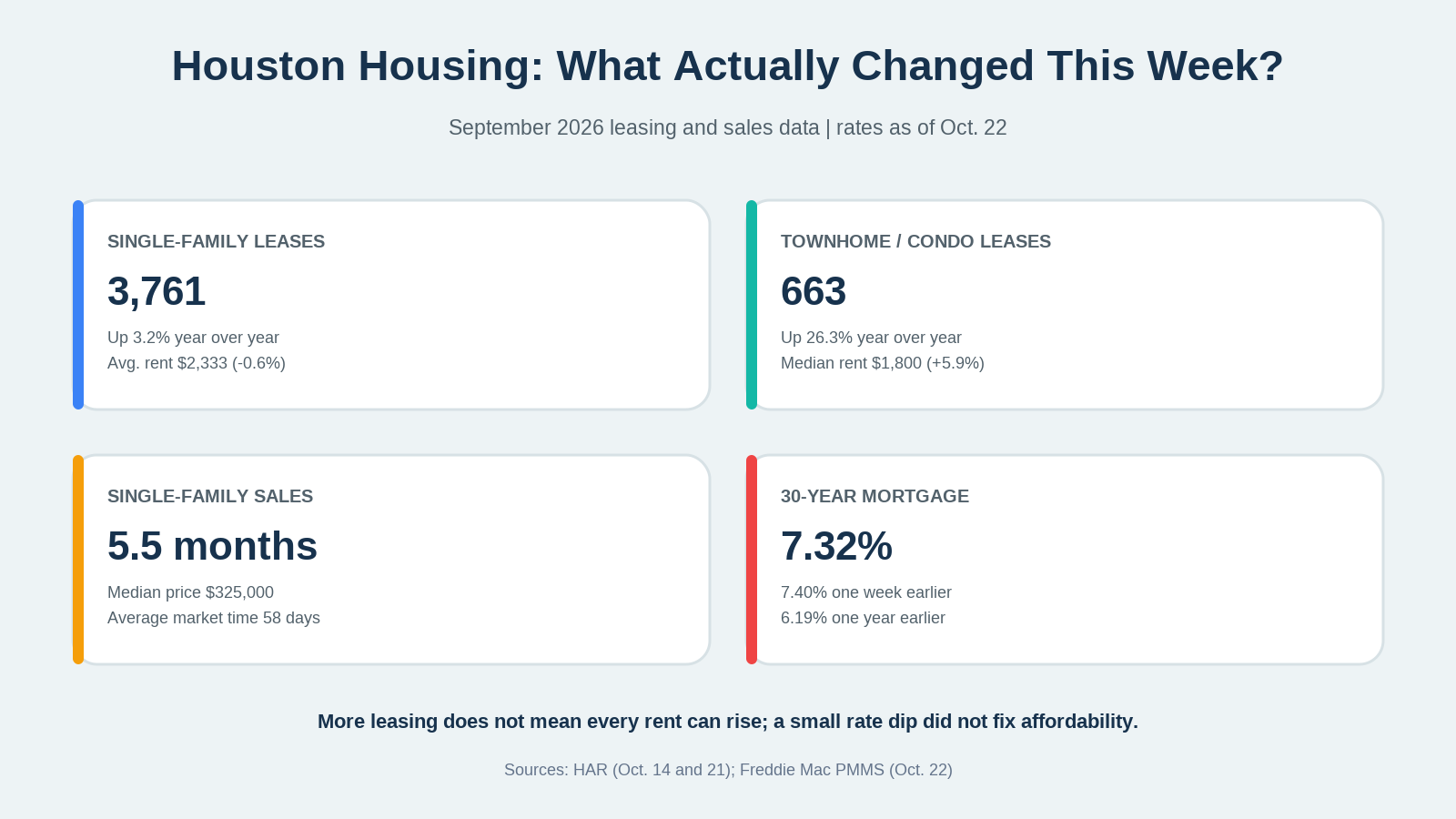
HAR reported 3,761 single-family leases in September, up 3.2% from a year earlier. Average rent edged down 0.6% to $2,333, while median rent fell 1.4% to $2,150. That is a useful reminder: demand can be healthy and still fail to support a rent increase when tenants have enough alternatives. Source: HAR September 2026 Rental Market Update.
The townhome and condominium segment moved differently. Leases jumped 26.3% to 663, the median rent rose 5.9% to $1,800, and the average rent reached $1,958. But active rental inventory also increased 8.8%, and average time to lease stretched four days to 48. I would not use the 5.9% median increase as permission to raise every unit. Mix, location, condition, HOA costs and competing listings still decide the result.
For a landlord, one empty month usually costs more than a modest renewal concession. I would price a new listing against leases signed in the same community during the last 30 days—not against the highest active asking rent—and calculate HOA, insurance, maintenance and a realistic vacancy period before calling the property cash-flow positive.
2. The resale market still gives prepared buyers the advantage
There was no newer monthly resale report this week, so September remains the correct benchmark: a $325,000 single-family median price, 5.5 months of inventory, 58 average days on market and pending sales down 11.6%. Townhome and condo sales were weaker, with the median price down 9.1% to $209,000 and inventory at 9.3 months. Source: HAR September 2026 Housing Market Update.
I would not describe Houston as “entering” a buyer’s market. Buyers already have more time and more alternatives. The limit is that the advantage is uneven: a well-priced home in a tight submarket can still move quickly, while an overpriced listing or a condo with weak HOA finances can sit.
For sellers, the important signal is repeated showings without a serious offer. Compare recent closings, current competition and nearby new construction before the listing becomes stale. For buyers, use longer market time to negotiate repairs, closing costs or a properly structured rate buydown, but do not let negotiating room distract from inspection, insurance, taxes and future resale. This continues the pattern I covered in last week’s Houston housing report.
3. A small mortgage-rate dip did not fix the payment problem
Freddie Mac reported a 7.32% average 30-year fixed rate as of October 22, down from 7.40% one week earlier. The 15-year average was 6.68%, and the 30-year rate was 6.19% a year earlier. The survey reflects qualifying conventional purchase applications nationwide; it is not a quote for every Houston borrower. Source: Freddie Mac PMMS.
On a $400,000, 30-year loan, principal and interest falls by only about $22 a month when the rate moves from 7.40% to 7.32%. Compared with 6.19%, today’s payment is still about $300 higher before property tax, insurance, HOA dues or mortgage insurance.
My advice is simple: refresh the preapproval and payment ceiling before writing an offer. Compare APR, points, lock period and cash to close. If a seller offers a credit, ask the lender to compare a permanent buydown with a price reduction over the years you realistically expect to hold the property.
4. Builder incentives are large—but tied to exact homes and deadlines
The Highlands’ official incentive page currently lists select David Weekley Houston homes with flex dollars equal to 7% of base price, capped at $40,000, for contracts from October 19 through December 31; the financing portion is subject to separate limits and use of the designated lender. Drees lists up to $50,000 toward price, options or financing plus up to $10,000 toward closing costs on qualifying homes through November 22. Perry lists up to $55,000 in flex cash and certain 4.99% loan offers, each with property, credit, lender and closing conditions. Source: The Highlands builder incentive page.
The biggest advertised number is not the value of the deal. Ask for a written worksheet for the exact lot and home showing purchase price, APR, points, required lender, lot premium, options, cash to close, occupancy rules, closing deadline and which incentives cannot be combined. Then compare five-year cost with a resale home. My full framework is in Are Houston builder rate buydowns really a better deal?.
5. Two rule updates are narrow—not new borrower hurdles
Fannie Mae updated its AI and machine-learning governance letter on October 21. The document tells seller/servicers how to govern AI used in origination or servicing; it does not create a new universal credit-score, down-payment or debt-to-income threshold for borrowers. Source: Fannie Mae Lender Letter LL-2026-04.
Texas rules and forms effective October 25 also incorporated qualifying lessees into the regular binding-arbitration process for property-tax disputes. The narrow case is a lessee contractually obligated to reimburse the owner for property taxes, where the lessee or owner protested, the owner did not appeal, and the property qualifies under the value rules. This is relevant to some commercial or master-lease structures, not a new obligation for an ordinary residential tenant. Sources: Texas Comptroller property-tax law changes and regular binding arbitration guidance.
What I would do this week
Buyer: update the payment ceiling, then prioritize homes with longer market time, prior reductions or relist history where the condition still makes sense.
Seller: if showings are happening without offers, compare net payment—not only price—against nearby builder inventory and adjust before the listing goes stale.
Landlord: protect occupancy first; price against recent signed leases and include a realistic vacancy period in the cash-flow calculation.
Condo or townhome investor: use the slower resale market as negotiating leverage, but review HOA reserves, insurance, special assessments, litigation and rental restrictions before offering.
New-home buyer: require a property-specific incentive sheet and compare net price, APR and five-year cost instead of the headline discount.
Quick questions
If leasing is up, why did single-family rent fall?
Because transaction volume and pricing power are different. More households can lease while additional choices, condition differences and price sensitivity keep the typical rent from rising.
Does 7.32% mean buyers should wait for another drop?
No one can promise the next weekly move. Update the budget at the current quote and treat any future refinancing as a possibility, not part of today’s approval.
Is the biggest builder credit always the best offer?
No. It may be tied to a specific home, lender, occupancy type or closing deadline. Compare net price, APR, points, cash to close and expected holding period.
Browse Joyce's Featured Listings

If you want to see what the current inventory looks like before applying this week’s numbers to your own plan, browse Joyce's Featured Listings. This is the stable listings hub; individual availability and pricing can change.
View Joyce's Featured Listings
Want to run the numbers for one property?
Send me the address or target area, budget, down payment and timing. For an investment, include expected rent and holding period; for a sale, include property condition and current listing status. I can help organize the property-specific questions before you decide how aggressively to move.
About Joyce Tang

Joyce Tang is a Greater Houston real estate agent and investor, co-founder of the North American Real Estate Association, founder of JoyHome and JoyNest, and co-leader of the Dr. Wang Real Estate Team.
She has helped more than 200 families buy or sell homes and has participated in more than 40 renovation projects. Her approach examines not only price, but also location, carrying cost, cash flow, risk and future exit options.
Data and professional-scope note
Market data, mortgage rates and builder offers reflect the cited sources and dates and may change. Payment examples include principal and interest only and are not loan quotes. Builder offers require qualification and may change or expire. Confirm financing with a licensed lender, property-tax or legal questions with the appropriate qualified adviser, and all property-specific facts during due diligence.