

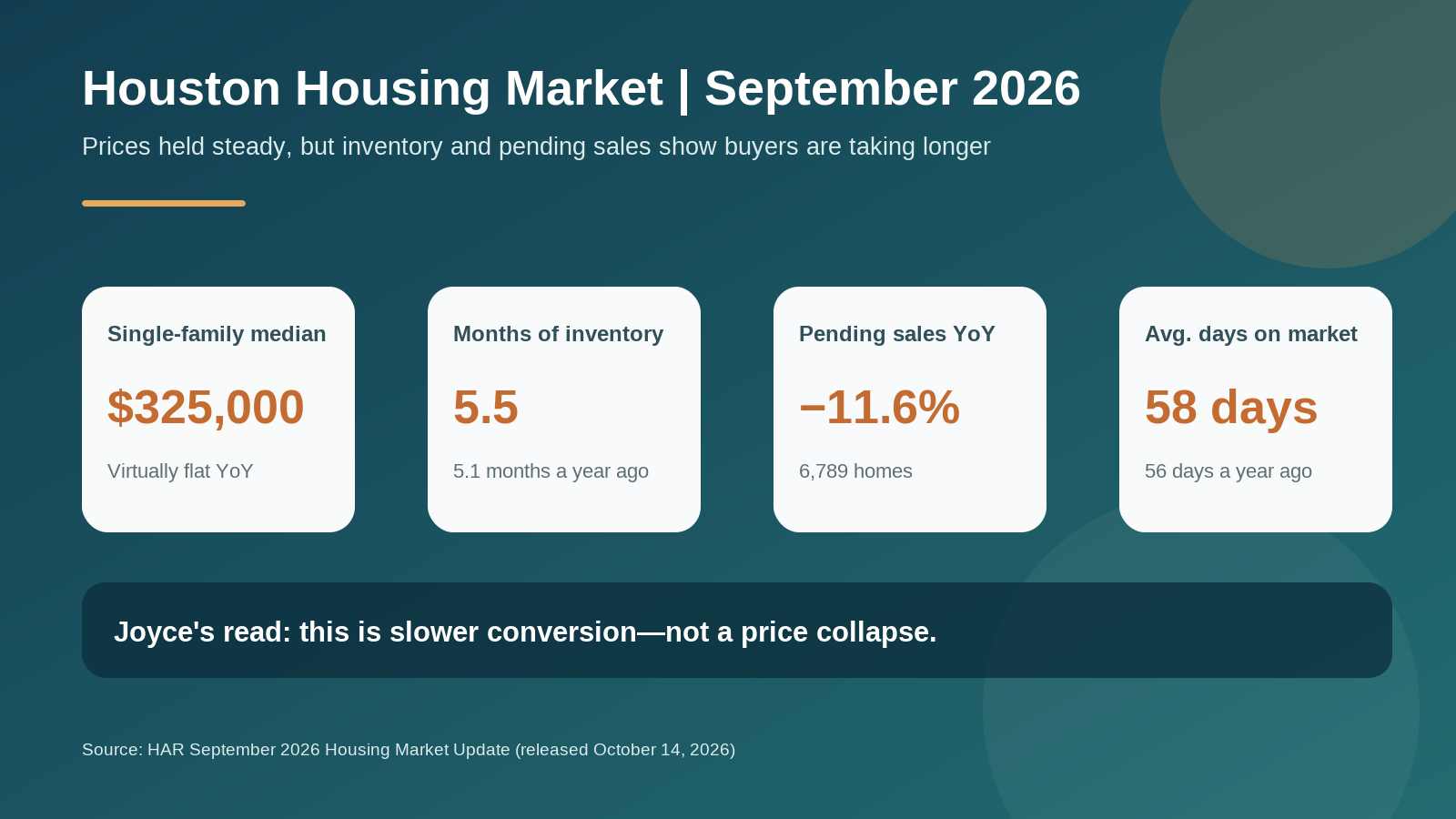
My read this week: Houston home prices have not collapsed, but buyers are taking longer to commit. September’s median single-family price was essentially flat, while inventory rose, days on market lengthened and pending sales fell 11.6%. With the average 30-year mortgage rate at 7.40%, this is still a buyer-leaning market—but affordability, not panic, is driving the negotiation.
The most important distinction is between price and market speed. A stable median does not mean sellers have the same leverage they had when homes moved quickly. Buyers now have more time and more alternatives, and sellers need to give them a clear reason to choose one home over another.
1. Houston prices held—but the pipeline weakened
HAR reported 7,030 single-family closings in September, down 5.7% from a year earlier. The median price was $325,000, virtually unchanged year over year. Active listings rose 6.3% to 40,192, months of inventory increased to 5.5 from 5.1, and average days on market moved from 56 to 58. Pending sales fell more sharply—11.6% to 6,789—which matters because it is a forward-looking sign that fewer current shoppers are converting into contracts. Source: HAR September 2026 Housing Market Update.
Compared with August, the median moved from $330,000 to $325,000, inventory from 5.3 to 5.5 months and average days on market from 54 to 58. Month-to-month movement can be seasonal, so I would not call this a price crash. I would call it a slower market where buyers can be selective and sellers cannot rely on last year’s pace.
For sellers, the warning is not one quiet open house; it is repeated showings without a serious offer. After two or three weeks, compare the home against recent closed sales, current competition and nearby builder incentives. For buyers, homes on market more than 30 days, relisted homes and homes with prior price reductions deserve a closer look—but condition and total carrying cost still decide whether the deal is good.
This continues the trend I discussed in Houston’s record inventory without a price collapse.
2. A 7.40% mortgage rate keeps shrinking the buyer pool
Freddie Mac reported that the average 30-year fixed rate remained at 7.40% on October 15. The 15-year average eased slightly to 6.71% from 6.73%, while the 30-year rate was 6.27% one year earlier. These are national survey averages for conventional purchase applications, not a quote for every Houston buyer. Source: Freddie Mac PMMS release.
On a $400,000, 30-year loan, principal and interest is about $2,770 at 7.40%, versus about $2,468 at 6.27%—roughly $301 more each month before property tax, insurance, HOA dues or mortgage insurance. A flat rate for one week does not mean the pressure has eased; buyers are still qualifying against a much higher payment than last year.
My advice: refresh the preapproval and payment ceiling before writing an offer. Compare APR, points, lock period and cash to close. For a financed buyer, the same seller dollar may be more useful as closing-cost help or a permanent rate buydown than as a small price reduction, but the lender has to model that for the actual loan and expected holding period.
3. FHA opened multifamily financing to qualifying Build-to-Rent communities
HUD announced on October 14 that qualifying Build-to-Rent communities can now use FHA-insured multifamily financing under Section 221(d)(4) for new construction and Section 223(f) for the acquisition or refinancing of recently completed projects. The policy is effective immediately. It covers professionally managed communities of single-family homes, duplexes or triplexes—not scattered rental houses owned by a small investor. Sources: HUD announcement and Mortgagee Letter 2026-12.
To qualify, the project generally needs at least five long-term rental units on one cohesive contiguous site and must operate as a single multifamily rental property. Parcels or buildings cannot be sold off during the insured loan term. For market-rate projects, underwriting must use the greater of a 7% vacancy assumption or the supported market rate.
Why this matters in Houston: it may broaden financing options for larger rental-community developers, but it does not turn every rental subdivision into an easy deal. More buildings mean more roofs, exterior systems and replacement reserves; HUD itself calls for conservative vacancy and maintenance assumptions. Individual investors should read this as a supply and competition signal, not as a new loan program for buying one or two rentals.
4. Year-end builder incentives are being renewed, not simply disappearing
The prior David Weekley 7%-of-base-price promotion ended October 18, but a new offer began October 19 and runs through December 31 on select Houston homes: up to 7% of the base price in flex dollars, capped at $40,000, with financing incentives limited to stated terms. A separate offer advertises up to $25,000 in financing and closing-cost assistance through December 31.
Current official community pages also advertise Perry incentives of up to $55,000 with a 4.99% rate on qualifying homes, and Drees incentives at The Highlands of up to $50,000 toward price, options or financing plus up to $10,000 in closing costs for qualifying contracts through November 22. Sources: Bridgeland builder incentives and The Highlands builder incentives.
The lesson is not “buy before the countdown ends.” It is to get a written worksheet for the exact home showing net price, rate, APR, points, required lender, lot premium, upgrades, occupancy limits, closing deadline and what cannot be combined. My comparison framework is in Are Builder Buydowns Really a Better Deal?.
5. Texas insurance changes create rights—not an automatic premium cut
Beginning January 1, 2027, Texas insurers must distribute the updated Consumer Bill of Rights for homeowners, dwelling and renters insurance with new policies and certain renewals. The update explains rights including a written reason for cancellation or nonrenewal, appraisal where the policy allows it for disputes over loss amount, and updated use of credit information. TWIA and the Texas FAIR Plan are excluded from this specific rule. Source: Texas Register adopted rule.
Insurers must update credit information at least every three years, and a policyholder may request re-underwriting and re-rating once a year using current credit information. That does not guarantee a lower premium. If your credit has materially improved, make the request in writing before renewal, keep the response and still compare the property-specific coverage, deductible, roof terms, water exclusions and wind or flood needs.
What I would do this week
Buyer: update the payment ceiling, then focus on homes with longer market time, relist history or meaningful condition issues that can support a property-specific negotiation.
Seller: if showings are happening but offers are not, compare price, condition and financing support now—before the listing becomes stale.
Townhome or condo buyer: use the 9.3-month inventory as a reason to slow down, then verify HOA reserves, insurance, special assessments, litigation and rental rules before treating the lower price as value.
New-home buyer: compare builder incentives using net price, APR and five-year cash cost, not the largest advertised dollar amount.
Rental-community developer: ask an FHA multifamily lender whether the project structure meets Mortgagee Letter 2026-12, then stress-test vacancy, absorption and replacement reserves.
Questions buyers and sellers are asking
If prices are flat, is Houston really a buyer’s market?
Yes in practical terms, but not uniformly. Buyers have more inventory, more time and more competing options, while pending sales are down. A specific home can still attract strong competition if it is well priced and difficult to replace.
Should a seller cut the price or offer a rate buydown?
There is no universal answer. A cash buyer may value price more; a financed buyer may gain more monthly-payment relief from a properly structured credit. Compare both using the actual loan and the home’s appraised-value risk.
Does the FHA Build-to-Rent change help me buy a single rental house?
No. The new policy applies to qualifying multifamily rental communities with at least five units on a cohesive site, not one-to-four scattered rental purchases.
Browse Joyce's Featured Listings

If you want to see what today’s inventory looks like before applying these numbers to your own plan, browse Joyce's Featured Listings. This is the stable listings hub; individual availability and pricing can change.
View Joyce's Featured Listings
Want to apply this week’s numbers to one property?
Send me the address or target area, budget, down payment and timing. If it is an investment, include expected rent and holding period; if you are selling, include the property condition and current listing status. I can help organize the property-specific questions before you decide how aggressively to move.
About Joyce Tang

Joyce Tang is a Greater Houston real estate agent and investor, co-founder of the North American Real Estate Association, founder of JoyHome and JoyNest, and co-leader of the Dr. Wang Real Estate Team.
She has helped more than 200 families buy or sell homes and has participated in more than 40 renovation projects. Her approach examines not only price, but also location, carrying cost, cash flow, risk and future exit options.
Data and professional-scope note
Market, mortgage, builder-incentive, FHA and insurance information reflects the cited sources and dates and may change. Payment examples include principal and interest only and are not loan quotes. Builder offers require qualification and may change or expire. Confirm financing with a licensed lender, insurance with a licensed insurance professional, legal or tax questions with the appropriate licensed adviser, and property-specific facts during due diligence.