

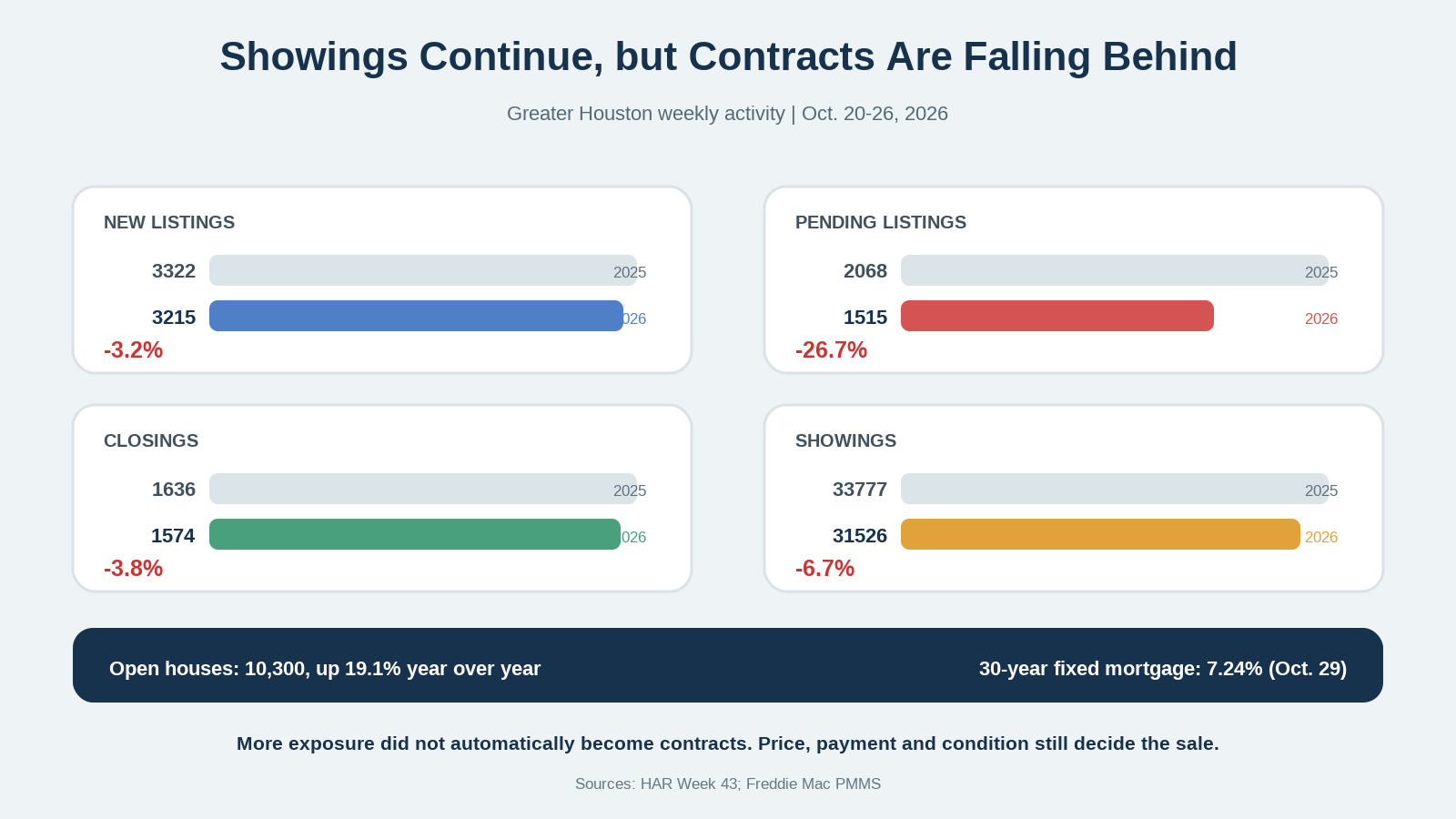
My read this week: the Federal Reserve held its benchmark rate steady and the average 30-year mortgage rate eased to 7.24%, but Greater Houston contracts did not rebound. Pending listings for October 20-26 were down 26.7% from the same week last year, much more than the 6.7% decline in showings.
That gap is the story. Buyers are still looking, and sellers are holding more open houses, but price, monthly payment and property condition are stopping many shoppers from becoming contracts. Houston was already buyer-leaning; this week confirms that the negotiating advantage remains uneven rather than disappearing.
1. More marketing activity did not produce more contracts
HAR’s Week 43 snapshot covers October 20-26 across the Houston MSA. New listings declined 3.2% year over year to 3,215, pending listings fell 26.7% to 1,515, closings declined 3.8% to 1,574, and showings fell 6.7% to 31,526. Open houses moved the other way, rising 19.1% to 10,300. Source: HAR Week 43 Weekly Activity Snapshot.
Those figures do not create a formal showing-to-contract conversion rate because the activities do not necessarily involve the same homes or buyers. But the direction is useful: showing activity is holding up better than contracts, even while sellers are offering more opportunities to tour homes.
HAR also reported listing-page views down 10.9%, but noted that much of the decline came from reduced automated bot traffic after security changes. I would not use that number as evidence that consumer demand suddenly dropped 10.9%. Human showings and pending listings are the more useful signals this week.
2. The Fed held rates—mortgage rates still move on their own
On October 28, the Federal Open Market Committee voted 10-2 to keep the federal funds target range at 3.75%-4.00%. The two dissenters preferred another quarter-point increase. The Fed said economic activity remained strong and inflation was still elevated. Source: Federal Reserve October 28 statement.
One day later, Freddie Mac reported a 7.24% national average for a 30-year fixed mortgage, down from 7.32% the prior week and 7.40% two weeks earlier. The 15-year average was 6.60%. Source: Freddie Mac PMMS archive.
The Fed does not set 30-year mortgage rates directly. Treasury yields, inflation expectations, lender pricing and mortgage-market risk all matter. On a $400,000, 30-year loan, moving from 7.32% to 7.24% reduces principal and interest by only about $22 a month. Compared with 6.19% a year earlier, the payment is still about $279 higher before tax, insurance, HOA dues or mortgage insurance.
For buyers, this is not enough of a change to reuse an old preapproval. Update the rate, cash to close and payment ceiling before making an offer. If a seller offers a credit, ask the lender to compare a permanent buydown, a temporary buydown and a price reduction using the same holding-period assumptions.
3. Houston prices have not collapsed—the market is taking longer to clear
There is no October monthly report yet, so September remains the correct market baseline: the single-family median price was $325,000, inventory reached 5.5 months, average market time was 58 days, and pending sales were down 11.6% year over year. Townhome and condo inventory was 9.3 months, with the median price down 9.1% to $209,000. Source: HAR September 2026 Housing Market Update.
The weekly pending decline is sharper than the monthly figure, but one week does not prove that prices are about to drop by the same amount. It tells us that buyer commitment is weak right now. Sellers should respond to repeated showings without offers before the listing becomes stale; buyers should use longer market time to negotiate, but still separate a negotiable property from one with expensive condition, insurance or HOA problems.
This continues the pattern in last week’s Houston housing report: buyers have options, yet affordability still limits what many can comfortably purchase.
4. November builder incentives add another layer of competition
Bridgeland is offering an additional $5,000 incentive on eligible new homes contracted from October 1 through November 30, 2026 and closed by March 31, 2027. The credit may be applied to closing costs, design-center upgrades or price, and the community says it may be stackable with certain builder incentives. Exact eligibility and combinations still require written confirmation. Source: Bridgeland fall incentive announcement.
A resale seller near active new construction is competing with the buyer’s monthly payment, not only the builder’s list price. A new-home buyer should request a property-specific worksheet showing net price, APR, points, required lender, lot premium, upgrades, cash to close, occupancy restrictions, closing deadline and non-combinable offers. My full comparison framework is in Are Houston builder rate buydowns really a better deal?.
What I would do this week
Buyer: refresh the preapproval at the current rate, then focus on homes with longer market time, prior price reductions or relist history where the condition still works.
Seller: if showings are happening without serious offers, compare the buyer’s payment against both resale competition and nearby builder financing before adding more marketing.
Investor: stress-test rent, vacancy, tax, insurance, HOA and financing at today’s numbers; do not let a lower purchase price hide a weak monthly cash flow.
New-home buyer: get the exact incentive in writing for the specific home and compare five-year cost, not the largest advertised credit.
Quick questions
Did the Fed cut or raise rates on October 28?
Neither. It held the federal funds target range at 3.75%-4.00%. Two members preferred a quarter-point increase.
Why did mortgage rates fall if the Fed did not cut?
Mortgage rates respond to the bond market, inflation expectations and lender pricing, not only the Fed’s overnight policy rate. A weekly decline can happen without a Fed cut.
Does a 26.7% drop in pending listings mean Houston prices will fall 26.7%?
No. Pending volume and price are different measures. The weekly number shows weaker contract activity; price direction still depends on submarket supply, property condition, financing and seller response.
Browse Joyce's Featured Listings

If you want to compare this week’s market signals with current options, browse Joyce's Featured Listings. This is the stable listings hub; individual prices and availability can change.
View Joyce's Featured Listings
Want to apply this week’s data to one property?
Send me the address or target area, budget, down payment and timing. If it is an investment, include expected rent and holding period; if you are selling, include condition and current listing history. I can help organize the property-specific numbers and risks before you decide how aggressively to move.
About Joyce Tang

Joyce Tang is a Greater Houston real estate agent and investor, co-founder of the North American Real Estate Association, founder of JoyHome and JoyNest, and co-leader of the Dr. Wang Real Estate Team.
She has helped more than 200 families buy or sell homes and has participated in more than 40 renovation projects. Her approach examines not only price, but also location, carrying cost, cash flow, risk and future exit options.
Data and professional-scope note
Market activity, mortgage rates and builder incentives reflect the cited sources and dates and may change. Payment examples include principal and interest only and are not loan quotes. The Federal Reserve does not directly set mortgage rates. Builder offers require qualification and written confirmation. Confirm financing with a licensed lender, insurance with a licensed insurance professional, and property-specific facts during due diligence.