
A water softener, whole-house filter or under-sink reverse-osmosis system does not automatically mean the water is safer—or that the equipment deserves extra value in the purchase price. These systems do different jobs. A buyer should identify the system, its specific treatment claims, ownership or lease terms, consumables and service history, then verify what the water is actually like before and after treatment.
I would not rely on appearance, a generic NSF mark or a single TDS reading. Start with the home’s water source and the problem you are trying to solve, then decide whether the equipment is useful and what it will cost to keep operating.
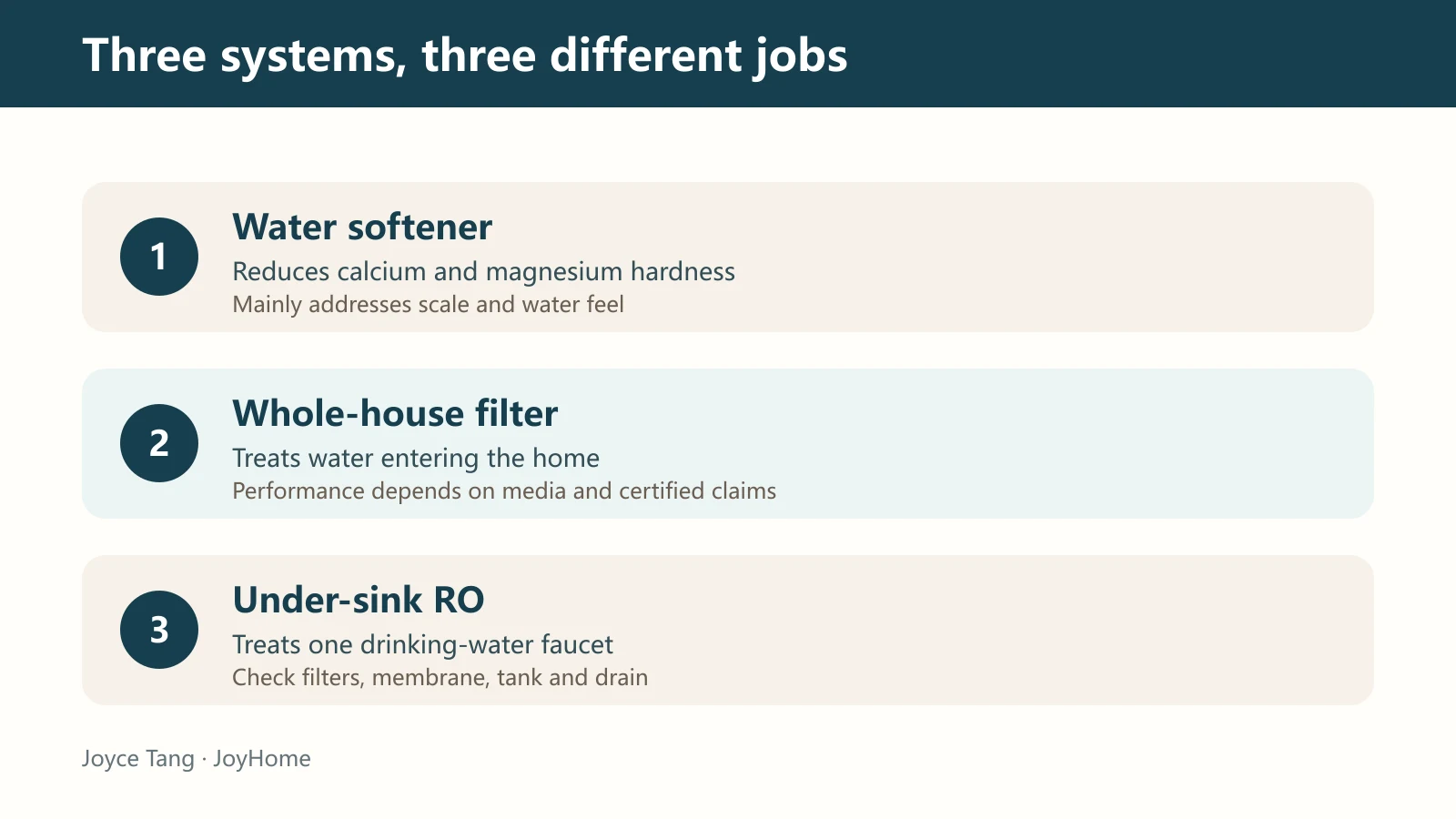
First, separate three systems that listings often group together
A softener mainly addresses hardness
A common ion-exchange softener reduces calcium and magnesium hardness. That can reduce scale and improve soap performance and water feel. Hardness alone is not a complete drinking-water safety measure, and a softener is not a universal contaminant-removal system.
A whole-house filter treats incoming water
A point-of-entry filter may address sediment, chlorine, odor or specific substances, but performance depends on the media, flow rate and exact certified claims. A large tank or cartridge does not tell you what the system removes.
Under-sink RO usually serves one drinking-water faucet
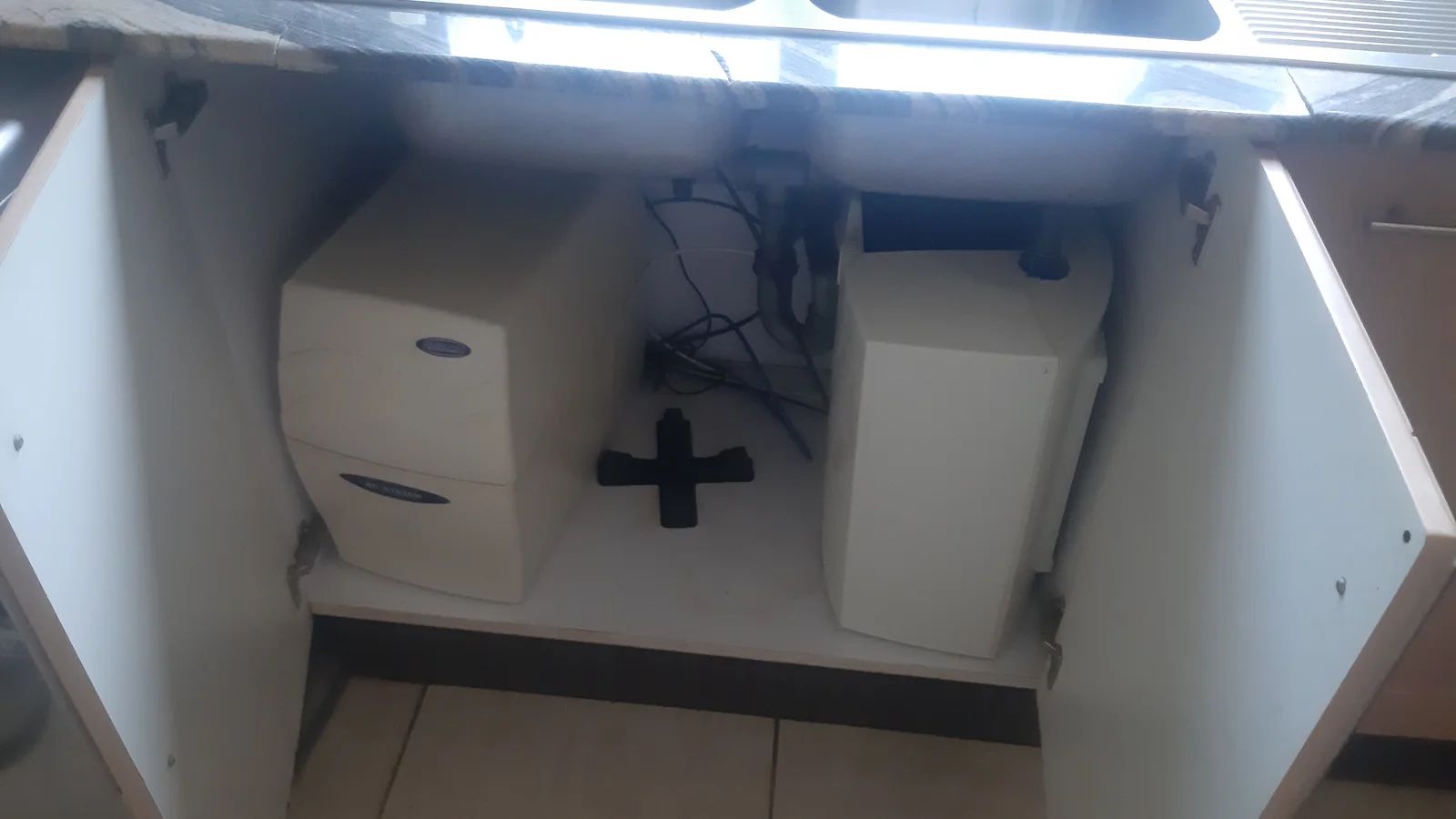
Reverse osmosis commonly includes prefilters, a membrane, storage tank and drain connection. It does not mean the entire home is treated. Expired filters, a weak storage tank or a poor drain connection can all affect performance.
Seven checks before you rely on the equipment
1. Identify the water source and the actual concern
Confirm whether the property receives public water from a city, utility district or MUD, or uses a private well. Public systems test regulated contaminants, but the buyer should still locate the annual Consumer Confidence Report for the exact system—not substitute the word “Houston” from the mailing address. A private well needs testing based on the property and its risks.
Are you addressing scale, chlorine taste, discoloration, odor or a specific health-related contaminant? Different concerns require different equipment. Do not start with the device and reverse-engineer a problem it may not solve.
2. Record the model, serial number and certified claims
Photograph the nameplate, cartridges, control valve and installation labels. NSF/ANSI 44 commonly applies to ion-exchange softeners; 42 covers many aesthetic effects such as taste and odor; 53 addresses specified health-effect claims; and 58 applies to reverse-osmosis systems. Certification to one standard does not mean every contaminant is reduced. Check the exact model and exact claim.
3. Determine whether the equipment is owned or leased
Some systems are purchased outright. Others are tied to monthly service, consumable delivery or a long-term lease. Request the contract, payoff, transfer terms, cancellation fees and equipment ownership. Do not discover after closing that the unit does not transfer free and clear or that you inherited an agreement you never reviewed.
4. Trace the bypass and the fixtures actually served
Confirm that the bypass operates and identify which cold, hot and drinking-water lines pass through each device. Irrigation, pool fill or kitchen cold water may bypass a softener. There is no single layout for every house, but the flow should match your goal. A neat installation is not proof of correct routing; use a licensed plumber when the path is unclear.
5. Inspect drains, leaks, corrosion and service space
Softener regeneration and RO systems both involve drainage. Look for secured drain lines, appropriate backflow protection, water stains, salt residue, mold, corrosion or persistent dampness. Make sure there is room to replace filters, add salt and service the controls. Model instructions and the applicable local requirements govern the exact installation.
6. Price the maintenance and consumables
Request dates for filter, membrane, resin, UV lamp if present and battery replacement, plus salt and service history. EPA guidance calls for checking salt, cleaning the brine tank as needed and periodic professional service. The purchase price is only part of the cost; include consumables, salt, regeneration water, service fees and the effects of long periods without use.
7. Verify the treated water—do not stop at TDS
A TDS meter estimates total dissolved solids from conductivity. It does not prove that water is “safe,” identify the individual substances or cover microbial risks. Test hardness, chlorine or another measure that matches the system’s purpose. For health concerns or private wells, use a qualified laboratory and a test plan based on the actual risk. Before-and-after samples are more useful than one isolated reading.
Collect these records before closing
Manufacturer, model, serial number, installation date and manuals.
Purchase receipt or lease/service agreement, including transfer, cancellation and payoff terms.
Filter, membrane, resin, salt, UV-lamp and other maintenance records.
Installation invoice, warranty and repair history.
The exact public water system’s annual report or the latest relevant private-well testing.
Written findings from the appropriate water-treatment professional or licensed plumber.
How should a buyer negotiate a concern?
An overdue filter or routine brine-tank service is a defined item. Unclear ownership, an untransferable lease, chronic leakage, questionable drainage or a system that no one can explain is a different issue.
Get a written scope from the appropriate professional, then compare seller correction, an allowed credit that lets the buyer control the work after closing, or treating the equipment as having no value—and possibly a removal cost—in the overall purchase decision. Do not assign used-equipment value from the seller’s original invoice.
Frequently asked questions
Does soft water prove that it is safe to drink?
No. Softening reduces hardness minerals; it does not establish that every health-related water-quality measure is acceptable. Use the source information and appropriate targeted testing.
Is lower TDS always better?
No. TDS is a limited combined reading. It does not distinguish desirable minerals from substances of concern and does not address every microbial risk. It can help track some system performance but cannot replace targeted testing.
Is an NSF mark enough?
No. Verify the exact model, standard number and certified reduction claims. A taste-and-odor claim is not the same as certification for every health-effect contaminant.
Should irrigation also receive softened water?
That depends on system design, salt and water use, landscaping and the plumbing layout. Do not change a bypass casually; first confirm the existing flow and the intended result with the appropriate professional.
Related inspection guides
If you see corrosion, poor flow or evidence of partial repiping, continue with the Houston water-supply pipe and repipe checklist. Because treatment equipment can interact with hot-water plumbing and drainage, also review the six water-heater warning signs.
Sources and image note
Primary references: TCEQ guidance for finding your drinking-water quality information, TCEQ Consumer Confidence Report resources, EPA cation-exchange water-softener guidance, EPA home-maintenance guidance and NSF water-treatment standards overview. Sources checked October 31, 2026.
The cover is a real under-sink filter photograph by Fanti Salms, cropped, color-adjusted and compressed from Wikimedia Commons under CC BY-SA 4.0; the adaptation is shared under the same license. It illustrates equipment only and is not a Houston listing. The comparison graphic was created by Joyce Tang / JoyHome, and all key information also appears in searchable text.
Joyce's Featured Listings

When a home has water-treatment equipment, ask more than whether it exists. Browse Joyce's Featured Listings, then include the equipment, contracts and water information in the option-period review for the homes that fit your plans.
View Joyce's Featured Listings
Looking at a home with a softener or filtration system?
Send me the address, water provider, equipment nameplate photos and the seller’s contracts and service records. I can help organize the questions for the seller, inspector, plumber, water-treatment company and the title or lending professionals involved in the transaction.
About Joyce Tang

Joyce Tang is a Greater Houston real estate agent and investor, co-founder of the North American Real Estate Association, founder of JoyHome and JoyNest, and co-leader of the Dr. Wang Real Estate Team.
She has helped more than 200 families buy or sell homes and has participated in more than 40 renovation projects. Her approach examines not only price, but also location, carrying cost, cash flow, risk and future exit options.
Important notice
This article provides general home-purchase and equipment-review information. It is not drinking-water safety, environmental, medical, plumbing, product-certification, contract or legal advice and does not replace the water provider, a qualified laboratory, a licensed plumber, a water-treatment professional or other licensed professionals for the specific address and equipment. Consult an appropriate medical professional for health-specific drinking-water questions. Private wells, suspected contaminants, or unusual color or odor require testing based on the specific risk.