
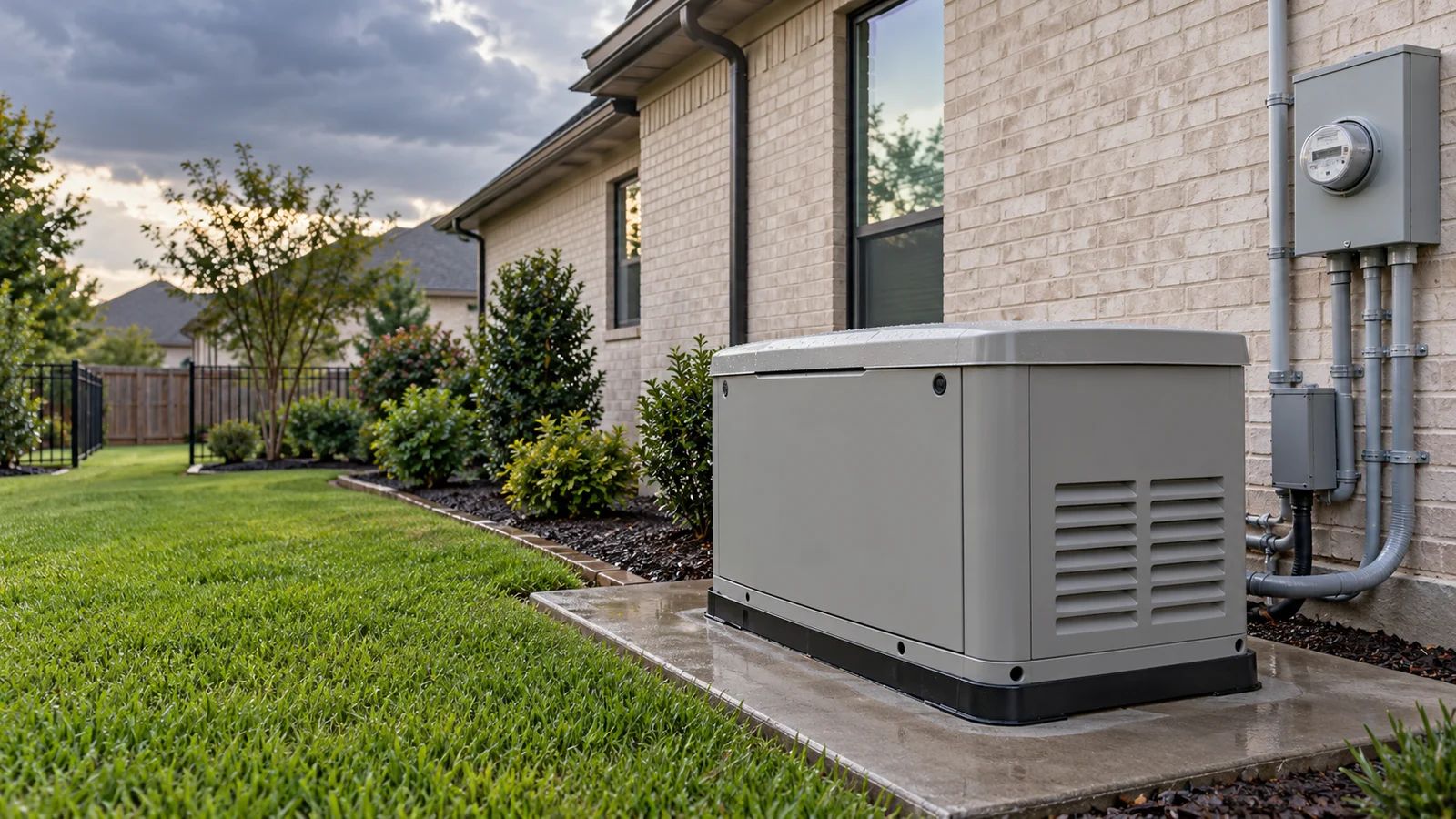
A permanently installed standby generator can make outages much easier to manage, but the presence of a unit does not prove the entire house is covered—or that permits, fuel capacity, flood exposure and maintenance are in order. I treat it as its own electrical, fuel and mechanical system, not as an automatic dollar-value upgrade.
What matters is which loads it actually serves, whether the transfer equipment works correctly, whether the fuel supply is adequate, where the unit sits and how consistently it has been maintained.
Start with the question most listings do not answer: What will it power?
“Whole-house generator” is common marketing language, but it does not always mean every appliance can run at once. One system may serve refrigeration, lights, internet, garage doors and one air conditioner. Another may have more capacity but use load-management modules to sequence air conditioners, water heating or other large loads.
Photograph the model, serial number, rated output and fuel type, then locate the automatic transfer switch and panel labels. List the loads that matter to you—multiple air conditioners, electric or gas water heating, refrigeration, medical equipment, a well pump, pool equipment or EV charging can materially change the analysis.
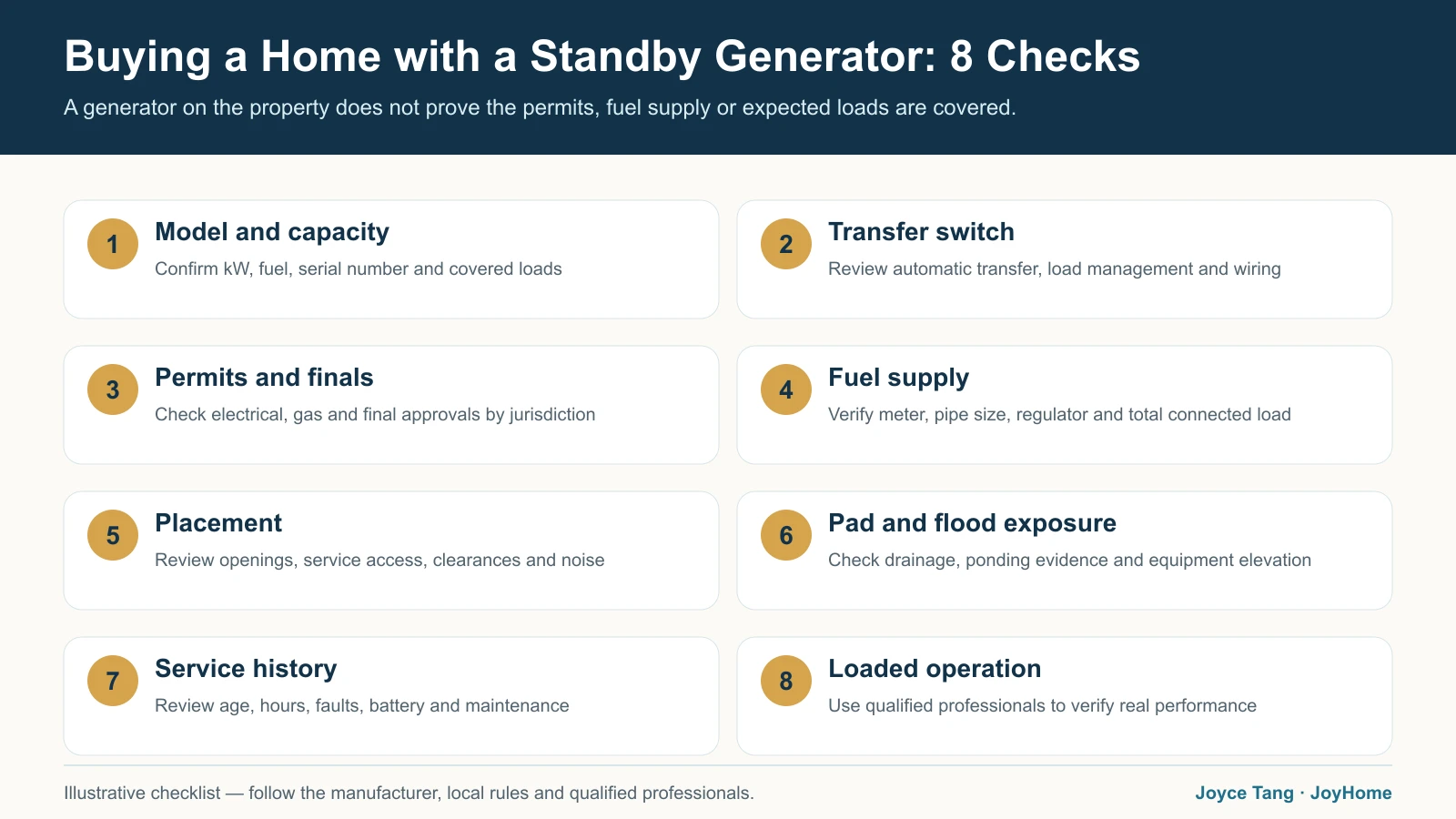
Eight checks before you rely on the system
1. Model, age and usable capacity
Confirm the manufacturer, model, serial number, kW rating, fuel, installation date and operating hours. A clean enclosure does not prove that the engine, controls and battery are equally new. Ask a qualified professional to compare capacity with the home’s actual loads instead of stopping at the nameplate.
2. Automatic transfer and load management
The automatic transfer switch moves the home from utility power to generator power. Review its rating, wiring, labeling and any load-management modules for compatibility with the generator and distribution system. An engine that starts does not prove that power reaches the expected circuits correctly and consistently.
3. Permits and final approvals
For a property inside Houston city limits, the Houston Permitting Center’s residential standby-generator guide calls for the related electrical and plumbing permits to be obtained by the appropriate licensed contractors. City inspection also addresses manufacturer instructions, fuel supply, the equipment base and electrical installation.
Greater Houston has many jurisdictions. A Houston mailing address does not necessarily place a property inside the city. Confirm the governing city, county or authority, then check permit numbers and final inspection status. City of Houston projects can be researched through the Houston Permit Portal.
4. Gas meter, piping and regulator
A natural-gas generator adds substantial demand when it starts and carries load. The calculation should include furnaces, water heaters, pool heaters, fireplaces and other gas appliances that may operate at the same time. Meter capacity, pipe size and regulator configuration are not reliable visual guesses; use the equipment data and a licensed gas or plumbing professional.
5. Placement, clearances and service access
Review the relationship to doors, windows, wall or attic air intakes, meters, fences and combustible materials. Confirm that the lid can open and a technician has working space. Exact clearances come from the specific model’s installation instructions and applicable local rules—not another home with the same brand. Tight side yards may also raise noise and HOA questions.
6. Pad, drainage and flood exposure
A generator is most valuable after severe weather, exactly when poor drainage can become a problem. Look for settlement, ponding, erosion and water marks around the approved base. FEMA utility-flood guidance recommends elevating generators, transfer switches and related electrical equipment above the appropriate flood-protection elevation and locating exhaust so it cannot enter building openings.
There is no single elevation that fits every property. Review the address-specific flood information, site elevation, equipment location and insurance requirements.
7. Maintenance, battery and fault history
Request maintenance records, oil and filter changes, battery date, repair invoices, fault logs, operating hours and remote-monitoring information. A weekly exercise cycle shows that the unit attempted to start; a brief no-load exercise does not prove reliable performance during a real outage. Confirm whether the warranty and service plan can transfer.
8. A safe loaded operational test
A buyer or agent should not casually disconnect utility power as a test. Have a qualified generator technician—and a licensed electrician when appropriate—check startup, automatic transfer, voltage and frequency behavior, unusual noise, leaks, fault codes and major loads under safe conditions. The report should identify what was actually powered, not simply state “unit operates.”
Collect these records before closing
Generator model, serial number, rating, fuel type and installation date.
Electrical and fuel-system permit numbers and final inspection records.
Manufacturer manuals, original invoice and installer information.
Transfer-switch and load-management documentation, preferably with a circuit or load schedule.
Maintenance invoices, fault history, operating hours and battery replacement date.
Warranty, monitoring subscription and service-plan transfer terms and fees.
How should a buyer negotiate a problem?
I would not reduce every finding to “have the seller fix it.” Deferred service or an aging battery is a defined scope. Missing approvals, insufficient fuel capacity, incompatible transfer equipment or a flood-prone location are different risks with different solutions.
Get a written scope from the appropriate professional, then compare seller correction with required approvals, an allowed credit that lets the buyer control the work after closing, or treating the unresolved system as part of the overall purchase decision. Do not use the retail price of a new generator to assign value to an older installed system.
A standby generator is not a portable generator
This article focuses on permanently installed standby systems connected through transfer equipment. Portable generators have different connection, fuel and carbon-monoxide risks. The U.S. Consumer Product Safety Commission says portable generators belong outdoors only, at least 20 feet from the home with exhaust directed away, and recommends working CO alarms on every level and outside sleeping areas.
Frequently asked questions
Does a standby generator automatically lower home-insurance cost?
No. Insurers may review the equipment, installation, permits, maintenance and other property risks, and carrier rules differ. Give the address and system details to the insurance professional before making an offer; do not assume a discount in the carrying-cost calculation.
Can a standard home inspection fully evaluate the generator?
A general inspection may identify visible concerns, but it is not a complete generator, gas and electrical specialty evaluation. Capacity, fuel demand, transfer behavior and internal faults often require the appropriate specialists.
Does a missing permit mean the generator must be removed?
Not automatically. Confirm the installation date, jurisdiction and rules that applied, then ask the authority and licensed contractors about permits, corrections or other resolution. An installer invoice is not the same as a final approval.
The seller says the system is sold “as is.” Is an inspection still useful?
Yes. “As is” affects the negotiation and responsibility structure; it does not tell you whether the system is safe or reliable. An inspection can still define the repair, replacement or decommissioning budget.
Related inspection guides
The generator ultimately connects to the home’s distribution system, so continue with the electrical panel and wiring checklist. Outages and fuel-burning equipment also make the smoke and carbon-monoxide alarm guide relevant. If the unit sits near a low area, combine this review with the Houston home flood-risk checklist.
Sources and image note
Primary references: Houston Permitting Center Residential Standby Generator Permit & Inspection Guide, City of Houston Permit Portal, FEMA utility flood-protection guidance and U.S. Consumer Product Safety Commission carbon-monoxide guidance. Sources checked October 30, 2026.
The cover is an AI-generated illustration of a residential standby-generator setting. It is not a real listing, inspection record or brand installation. The checklist graphic was created by Joyce Tang / JoyHome, and all important information also appears in searchable text.
Joyce's Featured Listings

When a home has a generator, ask more than whether it exists. Confirm what it powers, whether approvals are complete and who will maintain it. Browse Joyce's Featured Listings, then include the system records in the option-period review for the homes that fit your plans.
View Joyce's Featured Listings
Looking at a home with a standby generator?
Send me the address, generator nameplate, transfer-switch photos and the seller’s permit and maintenance records. I can help organize the questions for the seller, inspector, electrician, fuel professional and insurance agent before you decide how to handle the system during the option period.
About Joyce Tang

Joyce Tang is a Greater Houston real estate agent and investor, co-founder of the North American Real Estate Association, founder of JoyHome and JoyNest, and co-leader of the Dr. Wang Real Estate Team.
She has helped more than 200 families buy or sell homes and has participated in more than 40 renovation projects. Her approach examines not only price, but also location, carrying cost, cash flow, risk and future exit options.
Important notice
This article provides general home-purchase and equipment-review information. It is not electrical, gas, plumbing, generator-service, building-code, flood, insurance, legal or engineering advice and does not replace the authority having jurisdiction or licensed and qualified professionals for the specific property and equipment. Requirements vary by jurisdiction, installation date and model. If you smell gas, observe abnormal exhaust, receive a CO alarm, see exposed wiring or sparks, or find water contacting electrical equipment, leave the hazard area and contact 911, the fire department, the utility or the appropriate emergency professional.