
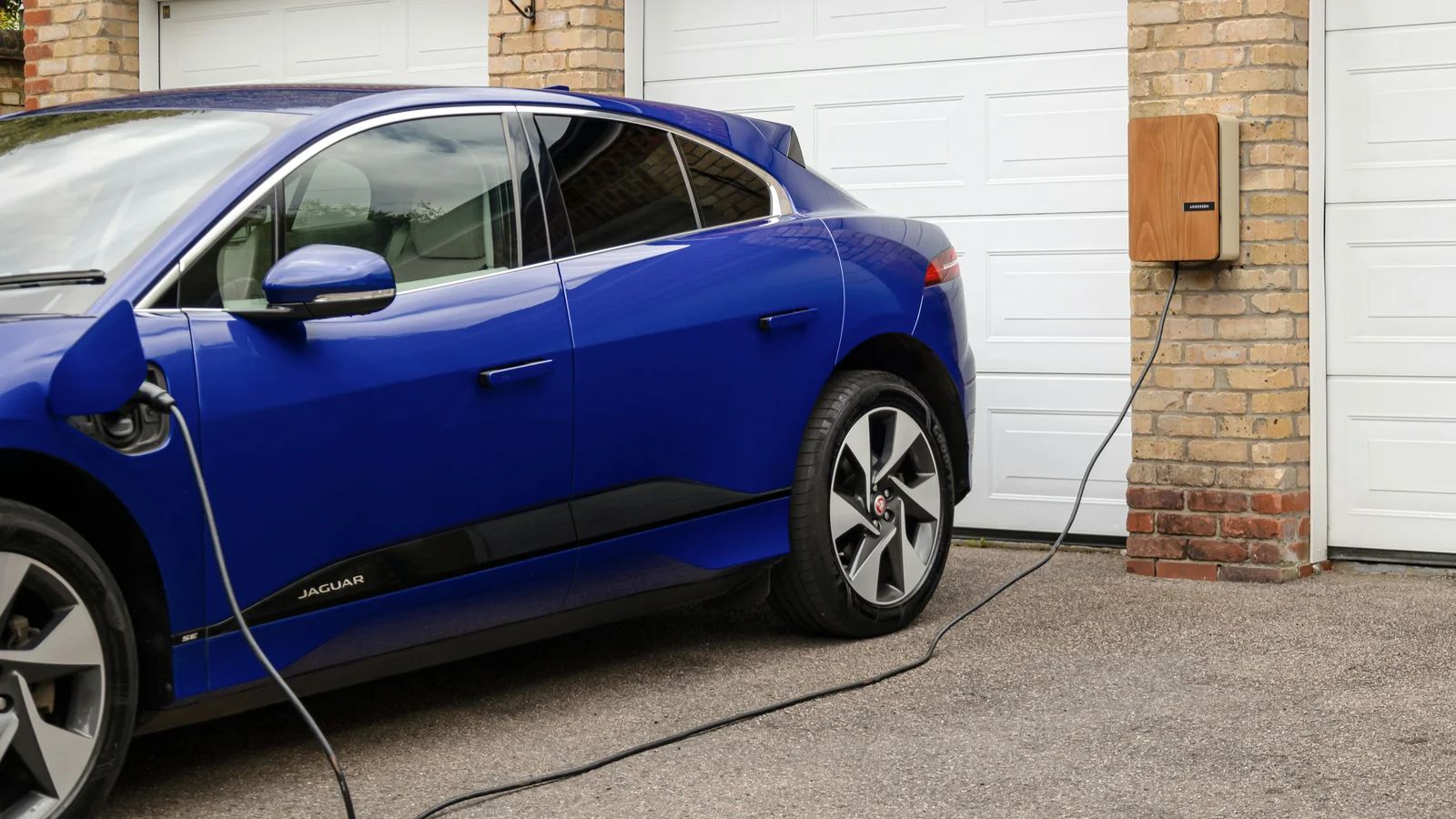
A wall-mounted EV charging unit does not prove that your vehicle will charge at the speed you expect—or that the panel, dedicated circuit, permits and ownership are all in order. Separate the wall unit from the electrical infrastructure behind it. The infrastructure is often the more expensive and harder part to correct.
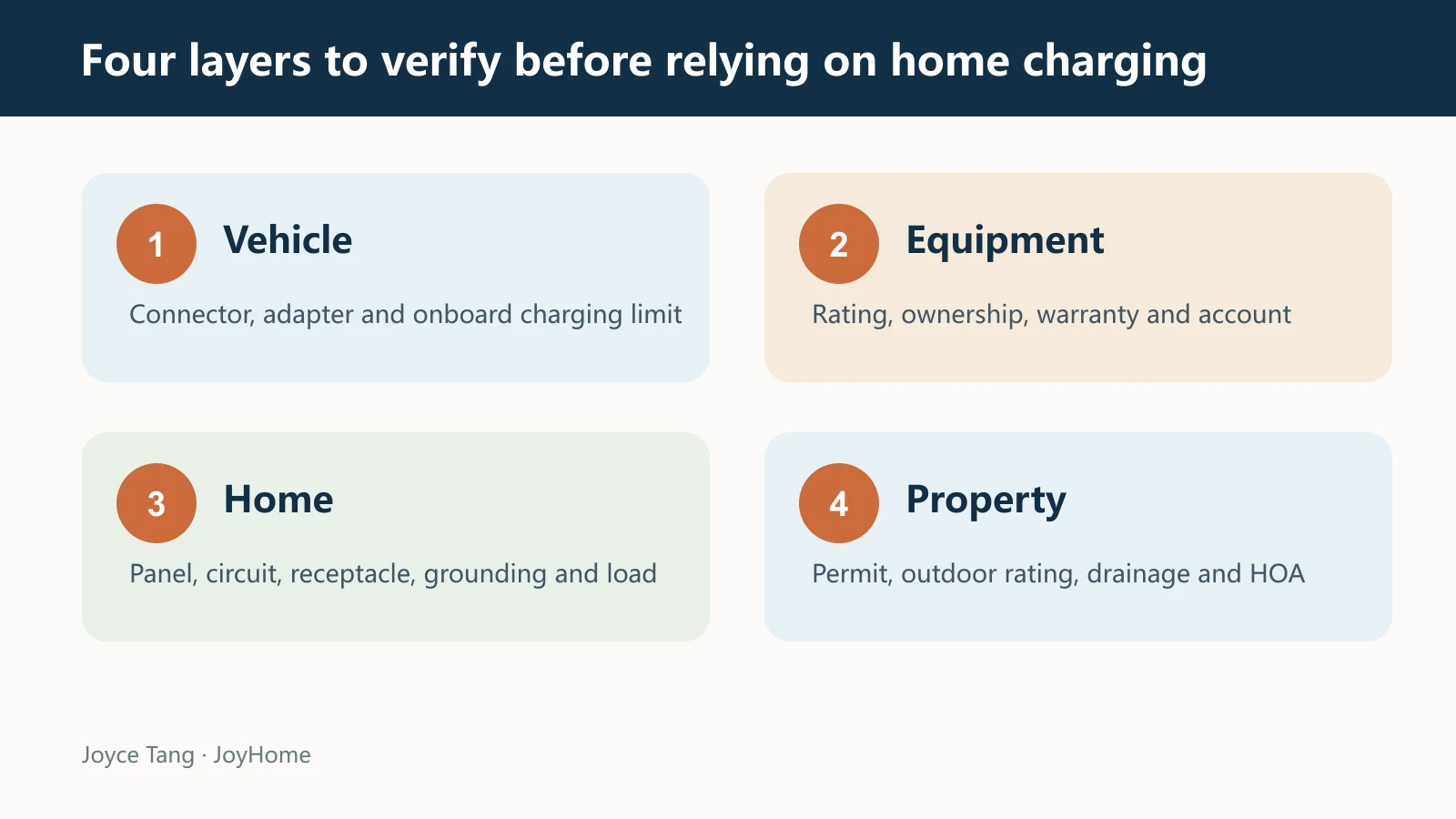
I would review four layers: the vehicle, the equipment, the home and the property. Connector compatibility is only the first question. Long-term usability depends on output, electrical capacity, installation conditions and whether you can actually take ownership and control of the system after closing.
Start with Level 1 versus Level 2—not the word “fast”
U.S. Department of Energy guidance describes most home charging as AC Level 1 or AC Level 2. Level 1 generally uses 120-volt power and charges more slowly. Residential Level 2 typically uses 240-volt service for faster overnight charging. A home wall unit is not the same as a public DC fast charger.
Actual speed is limited by the charging equipment, circuit capacity, the vehicle’s onboard charger, battery condition and temperature. A high number on the wall unit does not mean every vehicle can accept that output.
Eight checks before you rely on the installation
1. Connector, adapter and vehicle limit
Identify whether the equipment uses J1772, NACS/J3400 or another connector. Confirm whether your vehicle needs an adapter and whether that adapter supports the intended power and use. A connector that physically fits is not the whole answer; the onboard charger may cap the rate below the wall unit’s rating.
2. Hardwired unit, receptacle-based unit or portable cordset
One property may have a hardwired wall box, another a plug-in Level 2 unit, and another only the seller’s portable vehicle cord hanging on the wall. They do not leave the same value for a buyer. Record the manufacturer, model, serial number, rated current and power, and identify every cable, adapter, bracket and accessory expected to remain.
3. Ownership and contract inclusion
The unit may be owned outright or connected to a solar, energy-management, networking or service agreement. Smart equipment may also require account release, admin transfer or a factory reset. Confirm the equipment and accessories in the transaction documents instead of assuming that everything visible on the wall will remain fully usable.
4. Panel and service capacity
Level 2 charging is a substantial continuous load. An empty breaker space does not prove that the home has adequate capacity. Air conditioning, electric water heating, pool equipment, a dryer and other large loads all matter. Have a licensed electrician evaluate the equipment, desired charging rate and whole-home load rather than relying on one number on the main breaker.
5. Dedicated circuit, breaker, wiring and receptacle
Review the breaker label, conductor size, grounding, protective devices, junction box, receptacle and hardwire method against the equipment requirements. Loose receptacles, discoloration, heat marks, extension cords or unexplained adapters deserve further review. A status light does not prove reliable performance under hours of continuous load.
6. Permit and final approval
DOE guidance notes that installations must comply with local rules and may require permits. Greater Houston has multiple cities, counties and authorities; a Houston mailing address does not prove City of Houston jurisdiction. Identify the authority first, then verify the electrical permit and final inspection. City projects can be researched through the Houston Permit Portal.
7. Outdoor rating, drainage, cable placement and impact exposure
For equipment outside the garage or beside a driveway, confirm that the exact model is outdoor-rated and that the connector and cable will not sit in water, create a trip hazard, be run over or face vehicle impact. Houston rain makes wall penetration, drainage and low spots relevant. If the location is flood-prone, combine the installation review with address-specific flood and insurance information.
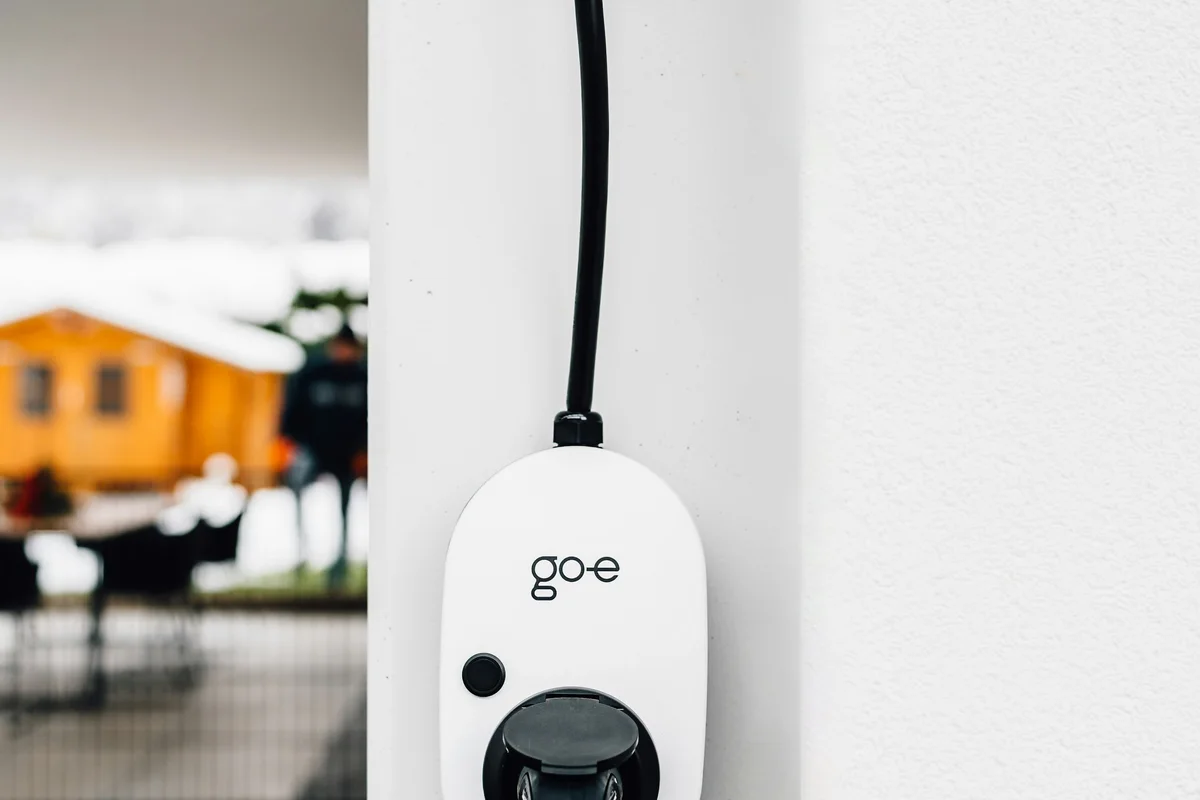
The photo above is an example of outdoor wall-mounted charging equipment. Outdoor suitability must be verified from the exact model label and installation instructions, not appearance alone.
8. Network, account, warranty and operating cost
Smart units may depend on Wi-Fi, an app, cloud service, charging schedules or a utility plan. Confirm account release, warranty transfer, subscription requirements and basic operation if the network is unavailable. Ask the utility about current rate options, but do not apply the seller’s historic bill to your vehicle and driving pattern.
Collect these records before closing
Manufacturer, model, serial number, rating and installation instructions.
Purchase invoice, warranty, account-transfer steps and service agreements.
Electrical permit number and final inspection or authority record.
Installer information, circuit and panel labels, and repair history.
A written list of the wall unit, cables, adapters and accessories that remain.
HOA or condominium rules for parking, common power, exterior walls and charging equipment.
How should the system be tested?
A buyer or agent should not open the panel, modify breakers or perform an improvised full-load test. Have a licensed electrician review the circuit and installation, then test the equipment under manufacturer guidance with a compatible vehicle when practical. Confirm handshake, start and stop, reasonable output, fault codes, abnormal heat and nuisance tripping.
If no compatible vehicle is available, the electrician can still evaluate the circuit, device self-check and account status, but “no error light” is not a complete performance guarantee.
How should a buyer negotiate a problem?
Separate an equipment problem from an infrastructure problem. Replacing a failed wall unit may be a defined expense. Inadequate service capacity, a panel upgrade, poor circuit location, missing approvals or uncertain condominium parking rights can be much larger issues.
Get a written scope from a licensed electrician, then compare seller correction, an allowed credit, or redesigning the installation after closing around your own vehicle. Do not assign the value of a new charger to the entire existing installation.
Condos and townhomes need another layer of review
Equipment beside your parking space does not prove that the circuit, wall or meter belongs to you. Confirm the parking right, private versus common meter, cost allocation, HOA approval and who can authorize future work. “Other owners have one” is not documentation.
Frequently asked questions
Does a 240-volt receptacle work for every EV?
Not automatically. The receptacle type, circuit rating, portable charging equipment, vehicle connector and onboard charging limit must align, and the receptacle condition still matters.
Does a higher-rated wall unit always charge faster?
No. Actual power is limited by the lowest-capacity part of the equipment, circuit, vehicle onboard charger and battery conditions.
Does a wall charger automatically stay with the home?
Do not guess. Attachment, contract language, accessories and service agreements can affect the result. Confirm equipment that matters to you in the transaction documents.
Will a standard home inspection fully evaluate EV charging?
A general inspection may identify visible concerns, but load calculations, conductor sizing, prolonged operation and permit research typically require a licensed electrician and the applicable authority.
Related inspection guides
Home charging ultimately connects to the distribution system, so begin with the Houston electrical panel and wiring checklist. If equipment sits near a low spot, add the Houston flood-risk review beyond the map. Before closing, share the installation with the insurance professional and use the Houston home-insurance checklist.
Sources and image note
Primary references: U.S. Department of Energy AFDC home-charging guidance, consumer charging and connector guidance, charging-equipment level overview, Houston Permit Portal and the TREC One to Four Family Residential Contract page. Sources checked November 1, 2026.
The cover is a real residential charging scene by Andersen EV; the outdoor-equipment photo is by go-e. Both are from Unsplash under the Unsplash License, cropped and compressed for the article. They illustrate equipment settings, are not Houston listings and do not endorse the pictured brands. The comparison graphic was created by Joyce Tang / JoyHome.
Joyce's Featured Listings

If home charging matters to your move, browse Joyce's Featured Listings to understand current options, then put garage location, electrical capacity and charging records into the option-period review instead of relying on a wall box in the listing photos.
View Joyce's Featured Listings
Looking at a home with EV charging equipment?
Send me the address, vehicle model, equipment nameplate, panel photos and the seller’s invoice and permit records. I can help organize the questions for the seller, inspector, electrician, HOA and insurance professional.
About Joyce Tang

Joyce Tang is a Greater Houston real estate agent and investor, co-founder of the North American Real Estate Association, founder of JoyHome and JoyNest, and co-leader of the Dr. Wang Real Estate Team.
She has helped more than 200 families buy or sell homes and has participated in more than 40 renovation projects. Her approach examines not only price, but also location, carrying cost, cash flow, risk and future exit options.
Important notice
This article provides general home-purchase and equipment-review information. It is not electrical, vehicle-compatibility, building-code, insurance, HOA, contract or legal advice and does not replace a licensed electrician, the equipment or vehicle manufacturer, the authority having jurisdiction or other licensed professionals for the specific home and equipment. Stop using equipment and contact the appropriate emergency service or licensed professional if you observe a burning odor, abnormal heat, sparks, smoke, water intrusion or repeated breaker trips.