

A sharp stock-market selloff does not automatically make Houston home prices fall the next week. Real estate usually feels the shock through mortgage rates, down-payment wealth, jobs and confidence, lending conditions, and commercial-property financing—and each channel moves at a different speed.
My short answer is this: buyers and investors should update their cash and financing assumptions, but they should not turn one bad trading day into a housing-crash forecast. Houston already had a slower, higher-inventory market before the November 20 selloff, so local supply, property quality and monthly carrying cost still matter more than a headline.
What actually happened on November 20
The selloff was real. On November 20, 2026, the S&P 500 fell 3.7%, the Nasdaq Composite dropped 5.28%, and Nvidia closed 14% lower as investors reassessed AI spending, crowded technology positions and company-specific risks. The S&P 500 entered correction territory. Source: Associated Press market report.
I would not carry every claim from a viral market commentary into a real-estate decision. Some market stories mix verified index moves with forecasts, rumors or company-specific events. For housing, the useful question is not “Did Nvidia fall?” It is “Did the selloff change borrowing costs, household liquidity, employment or credit availability?”
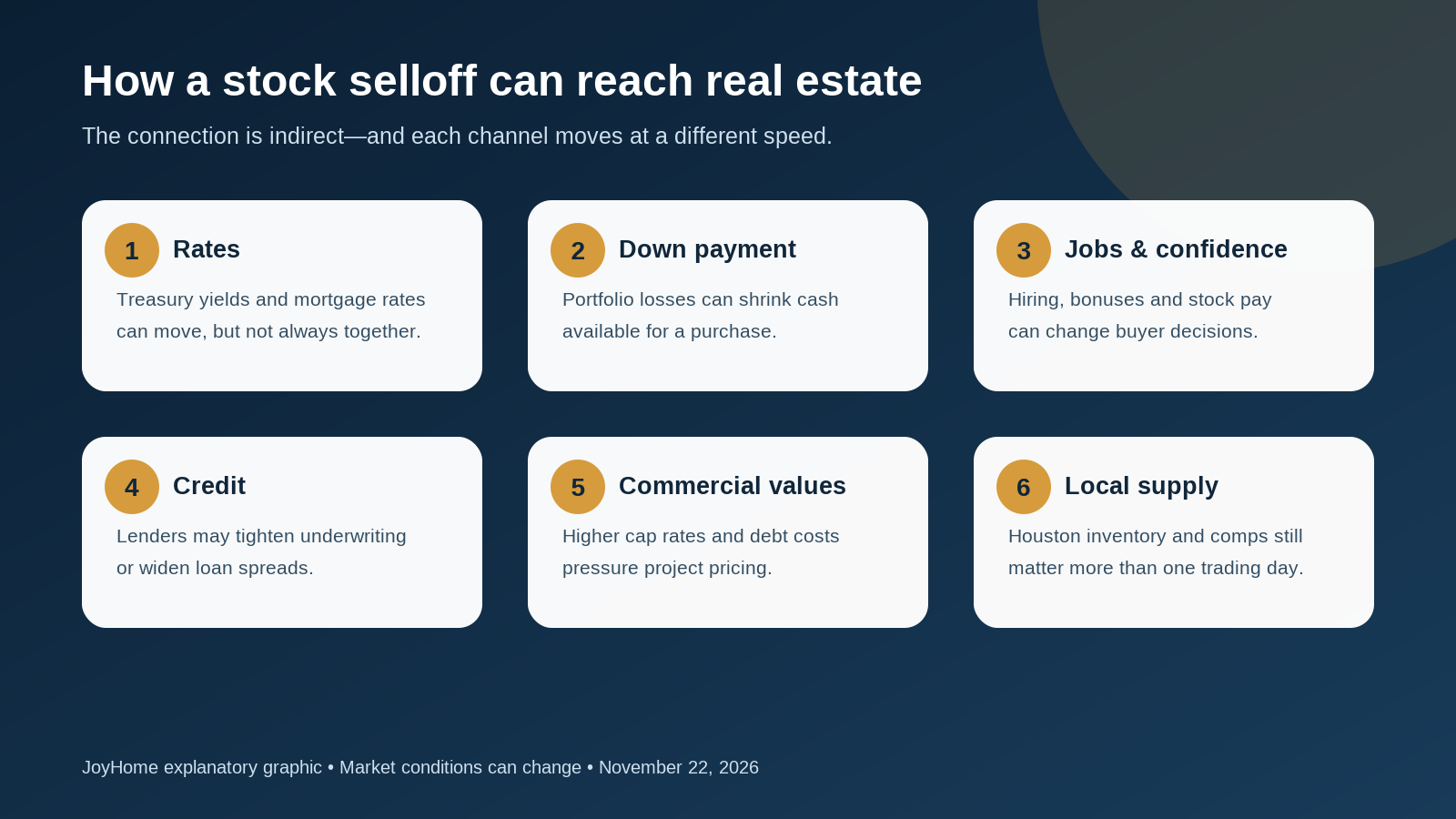
1. Mortgage rates may get relief from a risk-off move—but it is not guaranteed
When investors leave stocks and buy U.S. Treasuries, Treasury prices can rise and yields can fall. That happened on November 20: the 10-year Treasury yield moved from 5.04% on November 19 to 4.92% on November 20. Source: U.S. Treasury daily yield curve.
That can help mortgage pricing, but mortgage rates do not follow the stock market tick for tick. Lender spreads, inflation expectations, bond-market volatility and loan demand all matter. Freddie Mac’s weekly survey had already risen to 7.28% on November 19, up from 7.11% the prior week. Source: Freddie Mac PMMS.
This is why I would not tell a buyer that a stock selloff means cheaper mortgages are coming. I would ask a lender for a fresh quote, compare the rate, APR, points and lock period, and then calculate the payment at today’s terms.
2. The first housing impact may be the down payment, not the home price
Many buyers keep part of their down payment, closing funds or reserves in a brokerage account. If that portfolio drops sharply, the buyer may have to sell more shares, bring less cash, reduce the price range or postpone the purchase.
The effect is usually stronger for buyers whose compensation includes stock or bonuses and for higher-end buyers using investment assets to support a cash purchase or large down payment. It can also affect proof of funds and post-closing reserve requirements.
My practical rule is simple: money needed within the next few months for earnest money, down payment, closing costs and emergency reserves should not depend on a volatile stock position. Before making an offer, update the actual cash balance and let the lender recheck asset statements.
3. Jobs and confidence matter more than one day’s wealth loss
A one-day market decline rarely changes the housing market by itself. A longer downturn can matter if companies slow hiring, reduce bonuses, cut stock compensation or cancel expansion plans. That affects whether households feel secure enough to buy and how much they are willing to commit each month.
Houston is not as dependent on technology employment as some West Coast markets, but it is not isolated. Energy, health care, engineering, finance, construction and entrepreneurial households all use capital markets. A broader slowdown can reach housing through hiring and business investment even when the original selloff began with AI stocks.
4. Commercial real estate can feel the pressure faster
Commercial property is often more sensitive because values are tied closely to debt cost, required return and future cash flow. If lenders widen spreads or demand more equity and reserves, the same rent roll supports a lower loan amount. Buyers may then require a higher cap rate or a lower price.
The AI story has a more direct real-estate link through data centers, powered land, industrial construction, transmission infrastructure and specialized facilities. If major technology companies slow capital spending, some projects may be delayed or re-priced. That does not mean a normal Houston warehouse, apartment building or neighborhood retail center automatically loses value; tenant demand, lease terms, replacement cost and local supply still control the underwriting.
For apartment investors, see the Q3 Houston multifamily market analysis for the local operating picture rather than using stock-market volatility as a substitute for rent, occupancy and supply data.
5. Houston already had a buyer-leaning market before the selloff
HAR’s October report showed 6,348 single-family sales, down 14.9% year over year. The median price fell 3.0% to $320,000, active listings reached 40,253, and inventory rose to 5.5 months—the highest since 2012. Pending sales were down 17.6%. Source: HAR October 2026 market update.
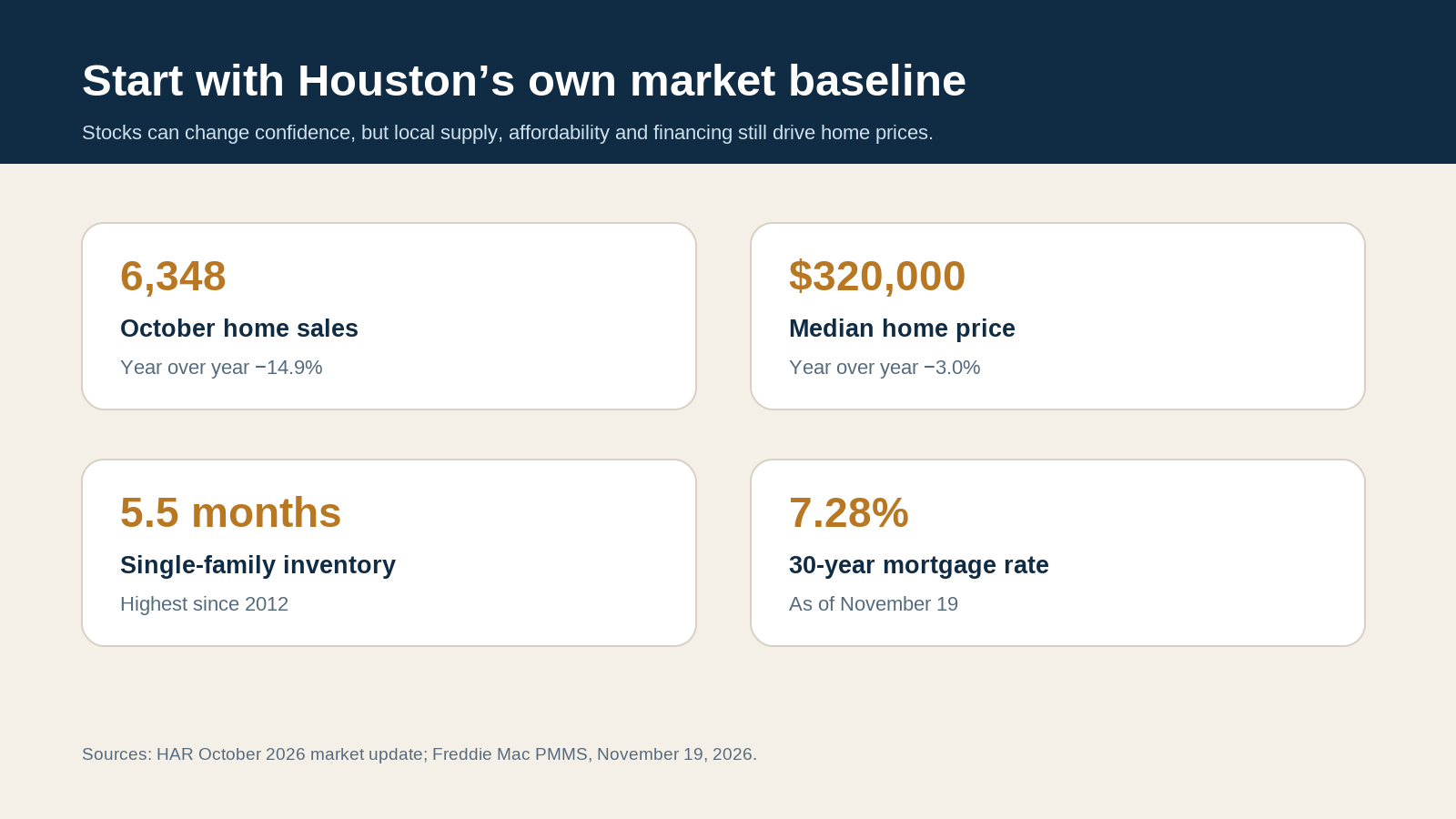
Those figures tell me that Houston buyers already had more choice and more negotiating room. The stock selloff may add caution, especially for equity-heavy buyers, but it did not create the local slowdown. Elevated mortgage costs and increased inventory were already doing that.
For the wider residential and commercial context, read the November 16 Houston real estate weekly.
6. Inflation is the uncomfortable part of the story
A stock selloff can push investors toward bonds, yet inflation can keep long-term borrowing costs high. In a November 20 speech, Federal Reserve Governor Lisa Cook said estimated October PCE inflation was 3.8%, explained that she had preferred another quarter-point rate increase at the October meeting, and said the latest data had not convinced her inflation was returning to a sustainable path. Source: Federal Reserve speech.
That is the conflict real-estate buyers need to understand: fear in stocks can lower Treasury yields for a day, while persistent inflation can keep the longer-term rate outlook difficult. No one should build a purchase decision around a guaranteed December move or a promised mortgage-rate decline.
What I would do now
If you are buying
Update the pre-approval and mortgage quote instead of relying on last week’s rate.
Separate the down payment and closing funds from money still exposed to large market swings.
Keep post-closing reserves; do not use every liquid dollar to increase the down payment.
Use Houston’s longer market time and competing inventory to negotiate, but inspect the property and neighborhood risks on their own merits.
If you are selling
Price from recent local sales and current competing listings, not from a national stock headline.
If the likely buyer needs financing, compare a price reduction with a closing-cost or rate-buydown credit using that buyer’s loan scenario.
Expect equity-heavy and higher-end buyers to become more selective when portfolios are volatile.
If you are investing
Stress-test the deal at today’s interest rate, a lower loan amount and a slower exit.
For commercial property, check maturity dates, rate caps, lender covenants, tenant concentration and required capital before focusing on headline cap rates.
For AI-linked land or data-center projects, verify power, interconnection, construction timing and the credit of the actual end user rather than assuming AI demand alone protects the deal.
Common questions
Will Houston home prices fall because the stock market fell?
Not automatically. A sustained market decline can weaken demand through wealth, employment and credit, but Houston prices still depend on local inventory, affordability, property condition and neighborhood-level demand.
Should I wait for mortgage rates to fall after the selloff?
A risk-off move can lower Treasury yields, but inflation and lender spreads can offset that benefit. Compare today’s payment and available negotiation with the cost and uncertainty of waiting.
Should I sell stocks now to fund a home purchase?
That is a personal investment and tax decision, not a real-estate rule. Confirm the closing timeline, required cash and reserve amount, then discuss the asset sale and tax impact with the appropriate financial and tax professionals.
Which real-estate segment is most exposed?
Highly leveraged commercial deals, projects needing near-term refinancing, and developments tied directly to AI capital spending can react faster. Ordinary resale homes usually respond more slowly through rates, jobs, confidence and local supply.
Browse Joyce's Featured Listings

If the market volatility has changed your budget, browse Joyce's Featured Listings to compare current asking prices with the monthly payment and cash reserve you are comfortable carrying. This is the stable listings hub; individual prices and availability can change.
View Joyce's Featured Listings
Want to recheck your real-estate plan?
Send me your target area, price range, down-payment plan and timing. I can help compare local inventory, realistic carrying cost and negotiation options before you decide whether to move now or wait.
About Joyce Tang

Joyce Tang is a Greater Houston real estate agent and investor, co-founder of the North American Real Estate Association, founder of JoyHome and JoyNest, and co-leader of the Dr. Wang Real Estate Team.
She has helped more than 200 families buy or sell homes and has participated in more than 40 renovation projects. Her approach examines not only price, but also location, carrying cost, cash flow, risk and future exit options.
Market, investment and financing disclaimer
This article is general real-estate market commentary based on the cited sources and dates and may become outdated. It is not investment, securities, lending, legal or tax advice, and it does not predict future home prices, interest rates or investment returns. Mortgage terms, property values and underwriting vary by borrower and property. Consult the appropriate licensed financial, lending, legal and tax professionals for personal decisions.