

Lower Houston townhome and condo prices can create real opportunities, but a lower unit price is not enough. With 9.3 months of inventory and sales down 21% year over year in September, buyers have negotiating room—but they also need to verify the financial and physical health of the entire project before treating a discount as value.
My view is simple: with a detached home, the main due diligence is usually the property and the lot. With a condo, the HOA budget, reserves, insurance, repairs and lender eligibility can matter almost as much as the unit itself.
What changed in September?
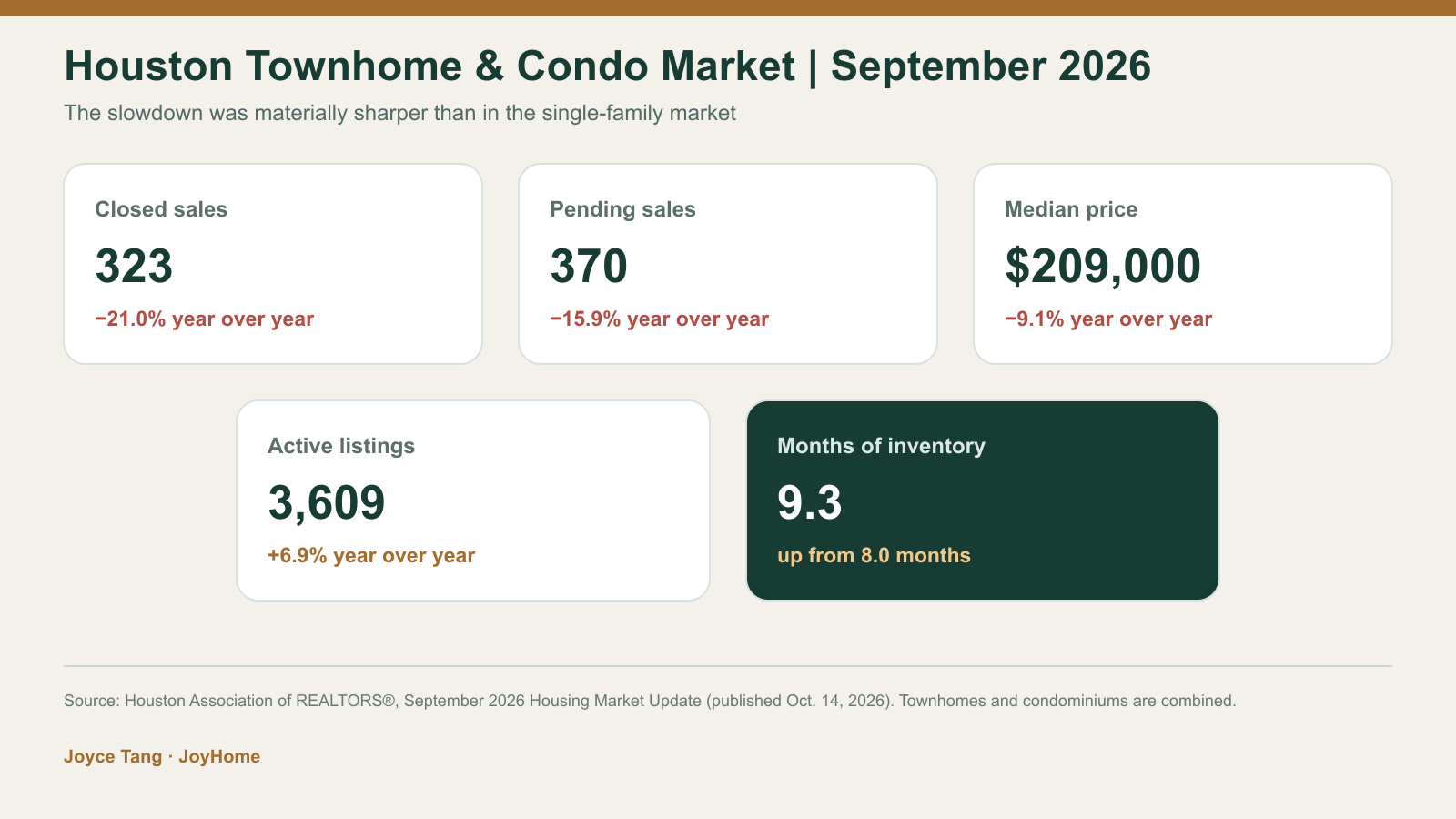
The Houston Association of REALTORS® September 2026 Housing Market Update reported 323 completed townhome and condominium sales, down 21.0% from a year earlier. Pending sales fell 15.9% to 370.
The median price declined 9.1% to $209,000, while the average price fell 4.6% to $261,052. Active listings increased 6.9% to 3,609, and inventory expanded from 8.0 to 9.3 months.
The contrast with detached homes matters. Single-family sales declined 5.7%, the median price was essentially unchanged at $325,000, and inventory reached 5.5 months. Townhomes and condos therefore showed a much sharper slowdown than the broader single-family market.
The report combines townhomes and condos—your purchase may not work the same way
HAR reports townhomes and condominiums as one market category. A specific property may be legally structured as a condominium, a fee-simple townhome or part of a planned development. That distinction affects what the owner insures, what the association maintains, what documents the lender reviews and how repairs are allocated.
The Texas Department of Insurance explains that townhouse coverage may insure only the interior or both the interior and exterior, depending on the association’s master policy. That is why I do not assume the listing label tells the whole insurance story. See the TDI home insurance guide.
Why a lower purchase price may not mean a lower monthly cost
A $209,000 median price looks more approachable than a $325,000 single-family median, but the useful comparison is the complete monthly and five-year cost. Add the mortgage, property tax, unit insurance, HOA dues, any special assessment, parking or utility charges and likely interior maintenance.
Some HOA dues cover services you would otherwise pay separately. Others mainly fund common-area operations. A low fee is not automatically good if reserves are weak, and a high fee is not automatically bad if it supports a well-maintained, well-insured project. The question is what the money covers and whether the budget is sustainable.
For the broader calculation, see Buying a Home in Houston: What Costs Come Beyond the Mortgage Payment?.
Condo financing evaluates the project, not only the borrower
A buyer can have strong credit and still encounter a financing problem if the condominium project does not meet the lender’s requirements. Project condition, insurance, reserves, delinquent assessments, litigation and special assessments may all affect review.
Under Fannie Mae’s current Full Review framework, lenders review whether the budget adequately funds operations and replacement reserves. The published standard generally calls for at least 10% of assessment income to be allocated to replacement reserves, and limits the share of units that are 60 days or more delinquent on regular or special assessments to 15%. Not every loan or project uses Full Review, so the lender must determine the applicable path. Review the Fannie Mae Full Review requirements.
Fannie Mae’s 2026 project-standards update also links underfunded reserves with critical repairs and the risk of unexpected special assessments or higher dues. That is a reminder to treat the HOA’s finances as part of the property inspection, not as paperwork to skim at the end. See Lender Letter LL-2026-03.
The resale certificate is a starting point, not a formality
For a Texas condominium resale, Property Code Section 82.157 requires a current resale certificate and governing documents in most ordinary owner-to-buyer sales. The certificate includes items such as current assessments, approved capital spending, reserves, judgments, pending litigation, insurance, the operating budget and balance sheet, and transfer-related fees. See Texas Property Code Section 82.157.
I would read those disclosures together rather than checking only the monthly HOA fee. A reasonable fee can still sit beside weak reserves, a pending repair or an insurance gap. Contract rights and deadlines are fact-specific, so buyers should have their agent, lender, insurer and, when needed, a Texas attorney review the current documents early.
The documents I would want before the option period expires
The current HOA budget, recent financial statements and the latest reserve study, if available.
Recent board and owner meeting minutes, with attention to repairs, insurance, litigation and proposed assessments.
The master insurance declarations and enough detail for the buyer’s insurer to identify any coverage gaps.
All current or approved special assessments, their balances, payment schedules and responsibility at closing.
Delinquency information, rental restrictions, short-term-rental rules and any pending rule changes.
Written lender confirmation that the project review is underway—not only a borrower pre-approval.
The timing matters. If the lender receives project documents late, the buyer may discover a financing or insurance problem after important contract deadlines.
When the current market can favor a careful buyer
Nine-plus months of inventory means buyers can often compare more units and negotiate more deliberately. I would look hardest at units where the seller has realistic expectations, the association maintains credible reserves and insurance, major repairs are identified and funded, and recent same-project sales support the price.
A slower market may create room to negotiate price, closing costs, repairs or assessment responsibility. It does not remove the need to verify the project. A discount on a unit with weak reserves, uncertain insurance or a large unfunded repair can disappear quickly.
For the wider inventory context, read Houston Inventory Hit a Record—So Why Haven’t Home Prices Fallen More?. For a property-level checklist, continue with Buying a Houston Condo or Townhome? Check These 9 HOA and Financing Risks Before You Offer.
My take
I would not avoid every Houston townhome or condo because the market is soft, and I would not buy one simply because the price has fallen. The opportunity is strongest when the unit is priced for today’s demand and the project can support normal financing, insurance, maintenance and resale.
In this segment, the cheapest listing can become expensive very quickly. A better buy is the unit whose price, monthly cost, HOA condition and future buyer pool all make sense together.
Frequently asked questions
Does 9.3 months of inventory mean every seller will accept a low offer?
No. Inventory describes the combined market at the current sales pace. Seller motivation, unit condition, building quality and competing listings still determine negotiating room.
Is a townhome the same as a condo?
Not necessarily. The architectural style and legal ownership structure are different questions. Confirm the recorded documents, association responsibilities, insurance and lender classification for the specific property.
Can a condo be difficult to finance even if I qualify?
Yes. The borrower and the project may both require review. Ask the lender to examine the project early, including insurance, reserves, repairs, assessments and any applicable eligibility requirements.
Is a falling median price proof that the same unit lost 9.1%?
No. A market median can change because the mix of sold properties changed. Value a unit using recent comparable sales in the same project or a directly competitive project, then adjust for condition, floor, view, parking and assessments.
Browse Joyce's Featured Listings

If you are comparing a condo, townhome and detached home at the same budget, start with Joyce's Featured Listings to see current options. Individual availability and pricing can change.
View Joyce's Featured Listings
Send me the address, HOA amount, financing plan and expected holding period. I can help organize the market, property and association questions before you decide whether the lower price is a real opportunity.
About Joyce Tang

Joyce Tang is a Greater Houston real estate agent and investor, co-founder of the North American Real Estate Association, founder of JoyHome and JoyNest, and co-leader of the Dr. Wang Real Estate Team.
She has helped more than 200 families buy or sell homes and has participated in more than 40 renovation projects. Her approach examines not only price, but also location, carrying cost, cash flow, risk and future exit options.
Disclaimer: This article uses HAR September 2026 market data, Texas Property Code provisions and current public guidance from Fannie Mae and the Texas Department of Insurance for general education. It is not a project approval, property valuation, lending decision, insurance opinion, legal advice or investment recommendation. Requirements vary by property, association, lender, insurer and loan type. Verify current documents and obtain advice from the appropriate licensed professionals before acting.