
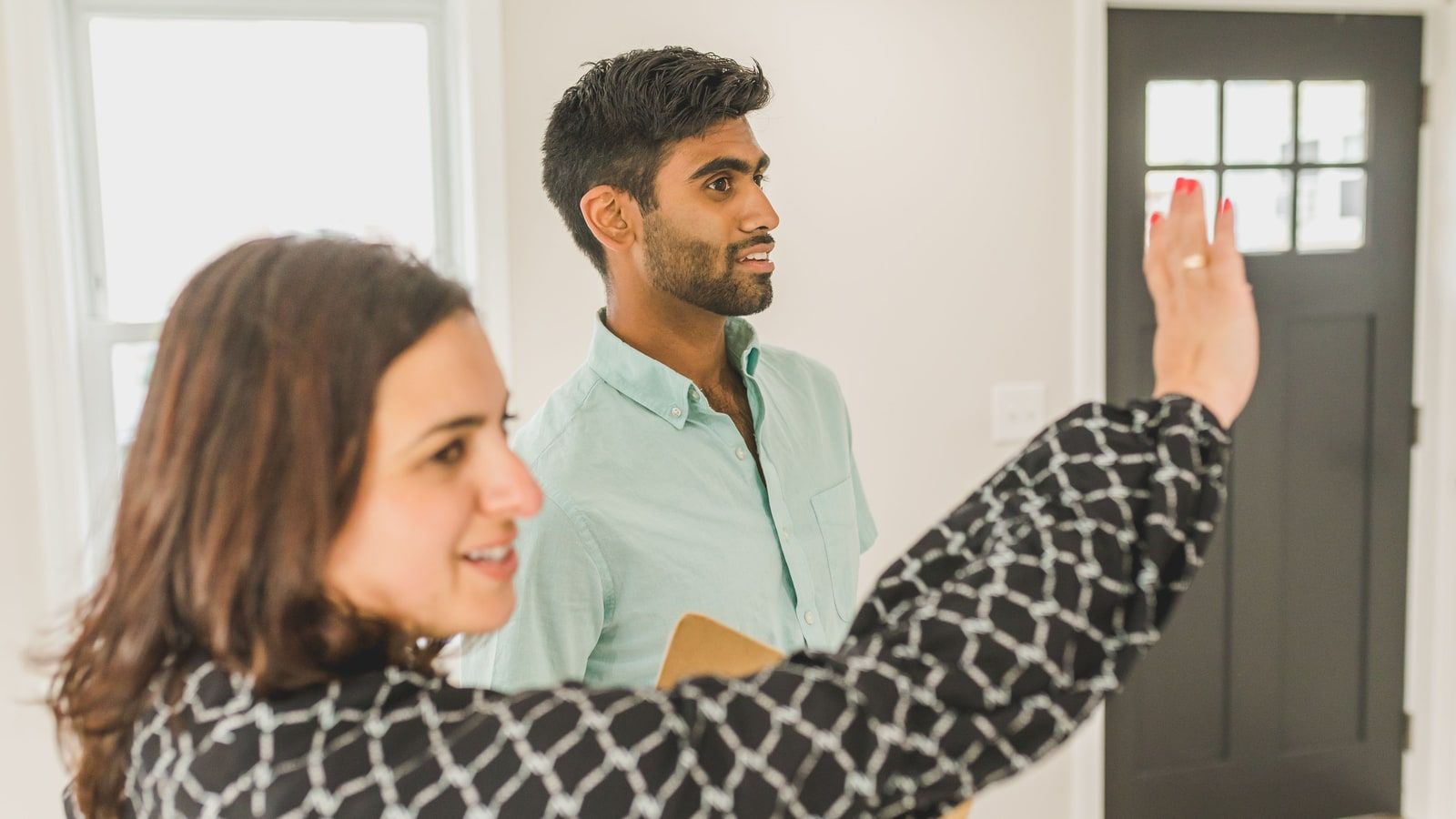
No. An open house is a tool for concentrated exposure and feedback, not a requirement for every Houston listing—and a larger crowd does not automatically mean stronger demand. The right decision depends on the property, showing access, privacy and security, and whether visitors take a meaningful next step afterward.
When price, photography, condition or showing restrictions are the real problem, an open house may create traffic for an afternoon without solving the sale.
A busy event can give the seller the wrong signal
A Sunday open house draws a steady stream of visitors. Several people compliment the kitchen, neighbors bring friends, and the sign-in list looks encouraging. The seller expects an offer within days.
Then no one schedules a second showing. No buyer’s agent asks for disclosures, roof or HVAC information, or a conversation about timing. The event was busy, but it did not create actionable demand.
The reverse can also be true. An open house with four or five groups may be more valuable when one visitor measures the primary bedroom, asks about repair records and returns the next day with an agent. Traffic is exposure. Follow-up is the demand signal.
What can an open house accomplish?
1. Concentrate otherwise scattered showings
For an occupied home—especially when children or pets must leave—one defined window may be easier to manage than several short appointments over multiple days.
2. Lower the barrier to a first visit
Some buyers are still comparing locations and budgets and are not ready to schedule a formal appointment. An open house lets them experience the home and neighborhood before deciding whether to investigate further.
3. Create a clear launch window
When the listing date, professional photography, online promotion and open house are coordinated, interested buyers know exactly when they can see the home.
4. Collect in-person feedback
Where visitors pause, what they ask repeatedly and which competing homes they mention are more useful than a polite “nice house.”
What can it not replace?
Accurate pricing and a current comparison against competing listings
Professional photography, complete listing information and online exposure
Cleaning, odor control, repairs and clear presentation
Reasonable access for scheduled private showings
A guarantee of an offer or a particular sale price
When private showing activity has already disappeared, simply holding another open house often repeats the underlying problem.
When is an open house more likely to help?
The home is newly listed and the seller wants a focused first-weekend launch
Entry, parking and visitor flow can be handled safely and clearly
The layout, light, yard or everyday flow is more persuasive in person than in photographs
The seller occupies the home and wants to consolidate some showing disruption
Nearby listings or community activity already bring buyers into the area
Condition, presentation and price are competitive enough to support the added exposure
When should it not be the primary strategy?
Privacy and security are difficult to control
A home containing medication, documents, valuables, collections or sensitive material that cannot be secured should not be opened to broad traffic until a real protection plan is in place.
A tenant objects or the lease arrangement is unclear
A tenant-occupied sale cannot be managed only for marketing convenience. Notice, access rights, lease terms and visitor control need to be resolved first. Scheduled appointments may be a better fit.
Gate, parking or entry logistics create confusion
Gated communities, high-rises, limited parking and construction areas require a clear entry process, waiting point and responsible host. A difficult arrival damages the experience before the tour begins.
The home is not ready
Odor, clutter, unfinished work or missing property information can turn wider exposure into a larger negative first impression.
The property calls for more controlled access
Certain luxury homes, special-use properties or privacy-sensitive sellers may be better served by appointments, advance qualification and agent-accompanied showings.
Six things the seller should check before the event
1. Is the home ready for close inspection?
Address odor, temperature, lighting, trash, pet items and obvious clutter. Multiple visitors may be in the home at once, leaving no reset time between groups.
2. Have personal items actually been removed?
Do not rely on a drawer. Medication, jewelry, cash, passports, bills, keys, garage remotes, computers, personal photographs, family calendars and mail showing names or addresses should leave the property or go into secure storage.
3. Who controls the entrance and visitor flow?
A sign-in sheet is a contact tool, not complete identity verification and not a substitute for supervision. The host should know who has entered, which areas are open and whether visitors have separated across different floors.
4. What is the plan for occupants and pets?
Sellers, children and pets generally should not remain during the event. Buyers need room to observe and talk, while pets should not face the stress or escape risk created by repeated entry.
5. Is the property information consistent?
Square footage, room use, major-system ages, HOA information, taxes, school boundaries and status should match the formal listing materials. Do not improvise facts simply to give a smoother answer.
6. What happens after the doors close?
Decide in advance what feedback will be recorded, who will contact buyer agents, when the seller receives a summary and what signals might trigger a change to photography, presentation, price or access.
After the open house, do not stop at the head count
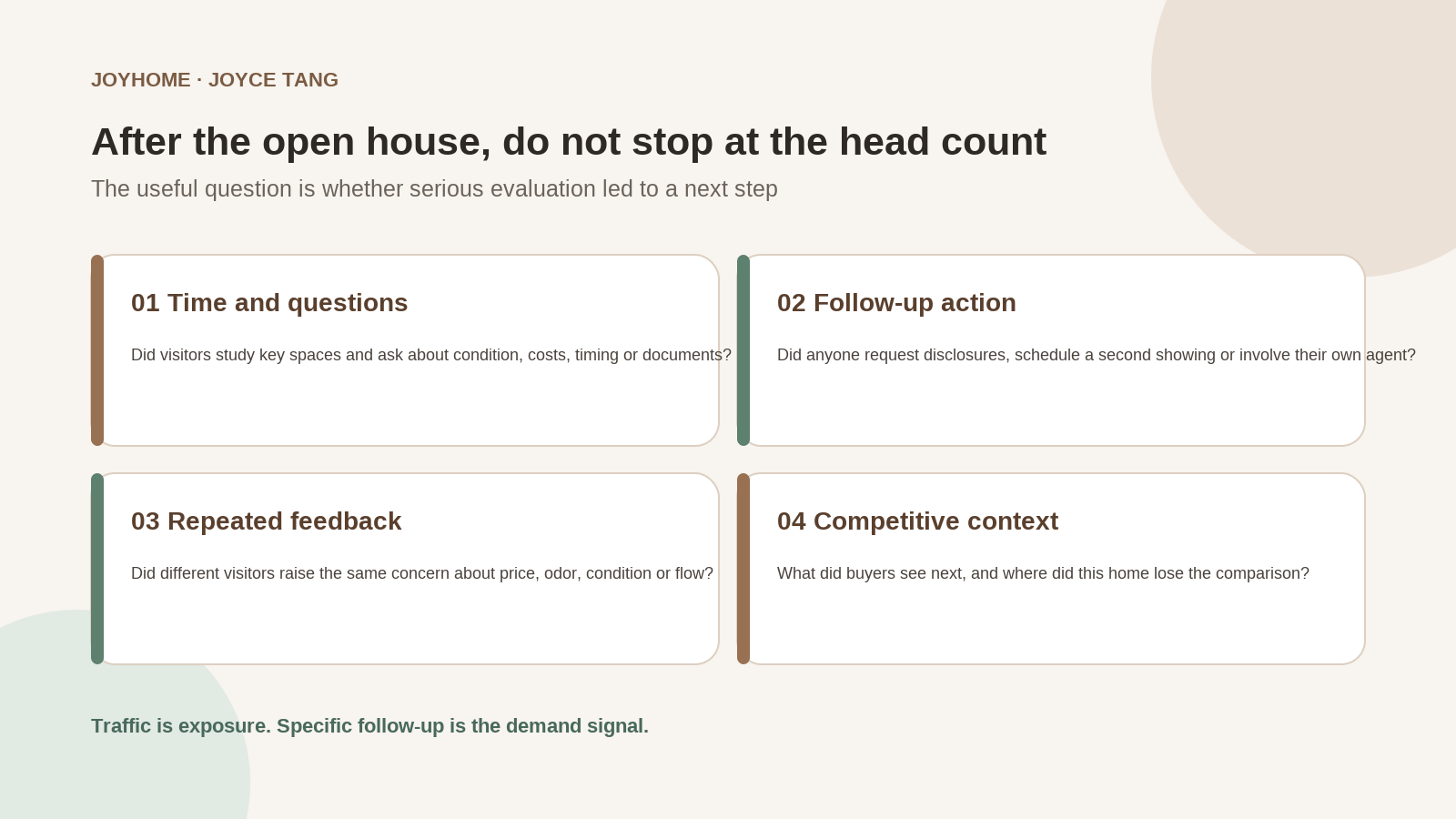
Serious interest cannot be judged by clothing, age, family composition or another personal characteristic. Relevant signals are financial and timing fit, whether the property meets the buyer’s needs, and whether the visitor takes a specific next step.
Time spent in key rooms and specific questions about condition, cost, timing or documents
Requests for the seller’s disclosure, survey or other available records
Follow-up from the buyer’s agent or a scheduled second showing
The same objection repeated by different visitors about price, odor, condition, light or flow
Which competing homes buyers visit next and where this property loses the comparison
A quiet event does not automatically mean an immediate price cut
One slow open house is not enough. Review weather, promotion, timing, traffic, competing events and scheduled showing activity. A single afternoon is a small sample, not a complete market verdict.
But when online activity, private showings and open-house traffic all remain weak—and the photography, information and access are sound—the seller should compare current competition and price again. The market often speaks first through buyers who never choose to walk in.
A busy event with no offer points to a different question
Many visitors were neighbors, early-stage shoppers or buyers not ready to act
The price attracted attention, but condition, monthly carrying cost or layout stopped the comparison
The home presented well, but competing listings offered stronger updates, lot, location or seller terms
Buyers liked the property but lacked confidence about the roof, HVAC, foundation, insurance or another major item
The event felt active, but no one recorded specific objections or follow-up needs
The answer is not automatically another identical event. Combine the feedback with competing inventory, then decide whether to provide better records, improve presentation, address a property concern, change access or revisit price.
Common seller mistakes
Counting neighbors as buyer demand
Neighbors can be useful and may refer someone, but their attendance should not be converted directly into buyer demand.
Allowing unsupervised movement to make the event feel welcoming
Privacy and safety matter more than atmosphere. The entrance, floors and sensitive areas need active management.
Talking so much that buyers cannot evaluate the home
Visitors need room to observe and discuss concerns. The host should answer, verify and learn—not follow every step with a sales pitch.
Collecting only “like” or “do not like” feedback
“Nice kitchen” does not guide a seller. Better questions are: Would you schedule a second showing? If not, what is the main reason? Which other homes are you comparing?
Frequently asked questions
Should the open house happen at launch or after the home sits?
Launch weekend can concentrate fresh exposure. A later event can also work when there is a new reason—revised presentation, new photography or a meaningful market change. Repeating the same event without a change rarely creates a different result by itself.
Should the seller stay home?
Usually no. Buyers tend to be more guarded and less candid about concerns. The seller is better served by leaving and allowing the agent to record questions and feedback.
Must every room be open?
If an area cannot be opened safely, explain that in advance and reconsider whether a public event is appropriate. Locking large amounts of personal property in a room can protect access, but it also prevents buyers from evaluating the whole home. Removing important items is usually the cleaner solution.
How soon should the seller change strategy afterward?
Evaluate the event with days on market, online activity, private showings, follow-up and changes in competition. One afternoon should not drive the entire strategy, but the same objection repeated across several buyers should not be ignored.
Related reading
Is home staging worth it when selling in Houston?
Priced at market but getting no showings—should you cut the price?
Plenty of showings but no offers—what should a Houston seller check?
Joyce's Featured Listings

AI-generated illustration: a Greater Houston housing scene, not a real or currently available listing.
After reviewing how an open house should be evaluated, browse Joyce's Featured Listings to see how current homes present their spaces, condition and key features.
View Joyce's Featured Listings →
Preparing to sell and unsure whether an open house fits the property?
Send me the address, expected launch date, whether the home is occupied, showing restrictions and any privacy or security concerns. I can help determine whether an open house makes sense and how it should work with photography, pricing, private showings and follow-up.
About Joyce Tang

Joyce Tang is a Greater Houston real estate agent and investor, co-founder of the North American Real Estate Association, founder of JoyHome and JoyNest, and co-leader of the Dr. Wang Real Estate Team.
She has helped more than 200 families buy or sell homes and has participated in more than 40 renovation projects. Her approach examines not only price, but also location, carrying cost, cash flow, risk and future exit options.
Disclaimer
This article provides general home-marketing, showing-access and privacy information. It is not an appraisal, a property-specific security plan, legal advice or a promise of sale results. Open-house suitability and notice, access, recording, tenant and visitor-management practices should be confirmed for the property, lease, community rules and actual risk. Consult the appropriate professional when legal or security questions arise.