
Houston renters were active in October, but the data do not support a simple “rents are taking off” story. Single-family lease volume rose 3.5% year over year while the average rent increased only 1.2%, which tells me demand is holding up but landlords still need to price against real competition.
Townhomes and condos posted faster lease and rent growth, yet active inventory also increased and the average property still took 48 days to lease. The useful question is not whether Houston rent went up; it is whether one specific property, at one specific price, can compete without sitting vacant.
1. October rental activity improved, but pricing power stayed uneven
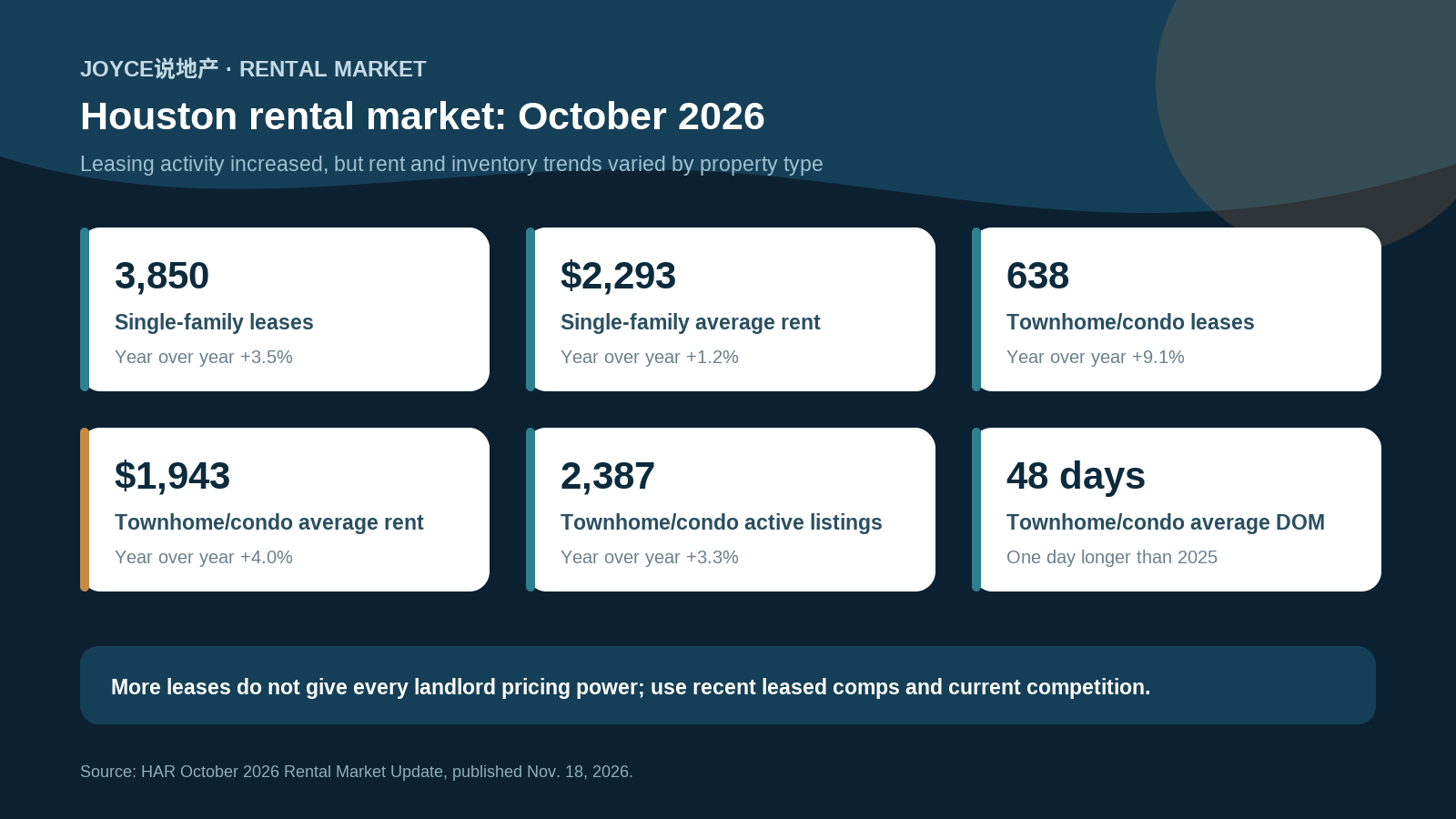
HAR reported 3,850 single-family leases in October 2026, up 3.5% from 3,720 a year earlier. The average single-family lease price rose 1.2% to $2,293 from $2,266. Source: HAR October 2026 Rental Market Update.
Townhome and condominium leasing increased 9.1% to 638 units. Average rent rose 4.0% to $1,943 and median rent increased 2.9% to $1,800. At the same time, active listings grew 3.3% to 2,387, and average market time lengthened by one day to 48 days.
Those numbers can all be true at once: more renters signed leases, rents moved up, and tenants still had more choices. A metro average does not tell a landlord how much one property can command in a particular subdivision, school boundary, condition and lease month.
2. More leases do not mean every landlord should raise rent
I would start with leases signed in the same subdivision or a genuinely comparable pocket during the past 30 to 60 days. Active competition matters too, because a renter chooses from what is available now, not from last year’s average.
The cost of overpricing is easy to underestimate. At the October single-family average of $2,293, losing one extra month of rent to chase an additional $100 per month takes roughly 23 months at the higher rent just to recover that vacancy—before cleaning, utilities, lawn care or turnover work.
That does not mean every owner should cut rent. It means a rent increase should be supported by the property’s condition, timing and nearby leased comps. A good renewal with a reliable tenant can be worth more than testing the top of the market and absorbing a full turnover.
3. Renting still requires less income, but the buy-versus-rent decision is more than $325 a month
HAR’s Q3 affordability report found that 42% of Greater Houston households could afford the median-priced home, while 44% could afford the median single-family lease. The estimated monthly home payment was $2,520, including principal, interest, property taxes and insurance, versus a median lease of $2,195. Required annual household income was $100,800 to buy and $87,800 to rent. Source: HAR Q3 2026 Housing and Rental Affordability Report.
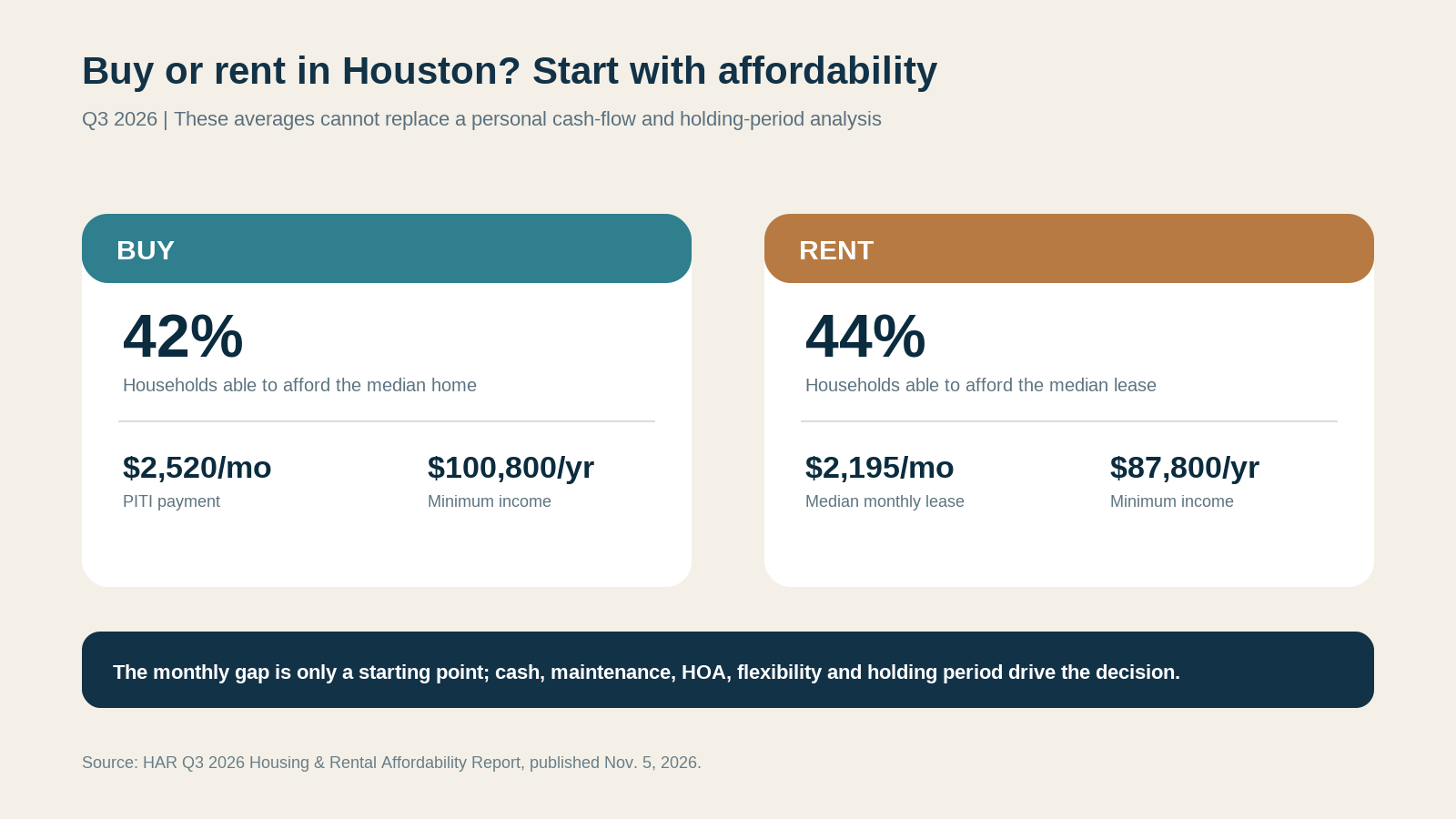
The $325 monthly difference is useful, but it is not the decision. A buyer also needs down payment and closing cash and should budget for maintenance, HOA dues and repairs. A renter may face deposits, fees, moving costs and limited control over renewal terms.
As of November 18, Freddie Mac’s latest published weekly survey was still the November 12 reading of 7.11% for a 30-year fixed mortgage; the November 19 release was not yet available. Source: Freddie Mac PMMS archive. A future rate move should not be assumed in today’s budget.
My practical test is time and resilience: how long do you expect to stay, how much cash remains after closing, and can the monthly budget absorb taxes, insurance and repairs? Renting can be the better choice for flexibility; buying can make sense when the property, holding period and reserves line up.
4. The apartment market is improving operationally, but rents remain under pressure
Greater Houston Partnership’s Q3 multifamily update reported overall occupancy of 87.6%, down from 88.1% a year earlier, and average asking rent of $1,362, down from $1,373. The market absorbed 11,929 units over the prior 12 months, while 13,847 units remained under construction and 4,795 were delivered in Q3. Source: Greater Houston Partnership multifamily update.
This is a different dataset from HAR’s MLS-based single-family and townhome/condo rental report. Apartment occupancy and asking rent cannot be mixed directly with MLS lease prices. The direction is still useful: demand is absorbing units, but recent supply keeps broad rent growth restrained.
For a closer look at apartment operations and investment underwriting, see Is Houston multifamily stabilizing?.
5. What I would do as a landlord
Price from recent leased comps and current active rentals in the same pocket, not from a citywide average.
Compare the cost of a modest renewal increase with the risk and expense of vacancy and turnover.
If showings are weak during the first two weeks, review price, condition, photography and pet or lease restrictions together.
Use a concession only after calculating its full-year effective rent; a free week can be cheaper than a long vacancy.
Keep taxes, insurance, HOA, management, repairs and realistic vacancy in the cash-flow model instead of assuming rent growth will cover them.
6. What I would check as a renter
Compare total move-in cost, not only advertised rent: deposit, application fees, pet charges, utilities, lawn care and required insurance matter.
Ask whether the quoted rent changes with lease length, move-in date or renewal terms.
Use longer market time and competing listings as negotiation evidence, but do not assume every neighborhood has the same supply.
Document condition at move-in and read maintenance, notice and early-termination provisions before signing.
7. The investor lesson: underwrite flat rent before underwriting growth
For a rental purchase, I would use the lower of the supported lease comp or the actual in-place rent, then stress-test a 45- to 60-day lease-up period. Property tax, insurance, HOA, management, repairs, capital reserves and financing should be visible line items.
The broader housing backdrop still matters. October brought a 14-year high in for-sale inventory and weaker pending sales, which can create purchase opportunities, but a lower acquisition price does not repair an unrealistic rent assumption. The full residential and commercial market context is in the November 16 Houston real estate weekly.
Common questions
Are Houston rents rising right now?
Some averages rose in October: single-family average rent increased 1.2%, while the townhome/condo average increased 4.0%. That does not mean every property or submarket can support the same increase.
Is it cheaper to rent than buy in Houston?
The Q3 median monthly lease was lower than the estimated median home payment, and the income threshold was lower for renting. Buying also involves upfront cash and maintenance, while renting trades ownership control for flexibility. The right answer depends on the exact home and expected holding period.
Can I use the citywide average rent to price my property?
Only as a broad reference. Same-area leased comps, property condition, bedroom count, school and tax boundaries, competing inventory and timing are more useful for setting the actual rent.
Is the apartment market the same as the single-family rental market?
No. They use different property types, data sources and operating assumptions. Apartment asking-rent and occupancy data should not be substituted for an individual house or townhome lease comp.
Browse Joyce's Featured Listings

If you are comparing rent with ownership, browse Joyce's Featured Listings to see what current asking prices look like at different budgets. This is the stable listings hub; individual prices and availability can change.
View Joyce's Featured Listings
Want to compare one rental or purchase?
Send me the address or target area, monthly budget, available cash and expected timeline. I can help compare recent leases, current competition, purchase carrying costs and the tradeoffs before you commit.
About Joyce Tang

Joyce Tang is a Greater Houston real estate agent and investor, co-founder of the North American Real Estate Association, founder of JoyHome and JoyNest, and co-leader of the Dr. Wang Real Estate Team.
She has helped more than 200 families buy or sell homes and has participated in more than 40 renovation projects. Her approach examines not only price, but also location, carrying cost, cash flow, risk and future exit options.
Rental, market and financial disclaimer
Market figures reflect the cited sources and dates and may change. Affordability and payment examples are market estimates, not personal loan or lease quotes. Rental terms, deposits, fees, taxes, insurance and investment results vary by property and applicant. Verify lease terms with the property owner or manager, financing with a licensed lender, and legal or tax questions with the appropriate licensed professional.