

Age alone does not mean an air conditioner must be replaced as soon as you get the keys. At the same time, “it still blows cold air” does not prove that it will carry the house reliably through another Houston summer. The real decision is about current condition, the cost of the next failure and how long you plan to own the property.
When I help a buyer evaluate an older system, I do not use the age to create panic, and I do not rely on a seller saying it has “never had a problem.” I put these seven factors together before deciding whether to keep it, repair it or prepare a replacement budget and negotiation strategy.
First, confirm what “original AC” actually means
A central system is more than the outdoor condenser. It may include an indoor evaporator coil, furnace or air handler, thermostat, refrigerant lines, condensate drainage and ductwork. Those components may have been replaced in different years.
A photo of the outdoor data plate identifies only that unit. Photograph the model and serial numbers on the outdoor unit, indoor coil and furnace or air handler, then request invoices and service records. Without records, do not assume that a system was fully replaced just because one component looks newer.
1. Is it cooling normally—or barely chasing the thermostat?
Houston heat and humidity make “cold air at the vent” an incomplete test. Watch whether the home holds the set temperature, indoor humidity feels controlled, rooms stay reasonably balanced and the equipment runs in stable cycles.
The system runs continuously on a hot afternoon while indoor temperature keeps rising.
It starts, stops quickly and restarts over and over.
The second floor, west-facing rooms or distant rooms stay much warmer.
The house feels clammy, or water marks appear near returns, ducts or condensate drains.
New noise, burning odor, ice or repeated breaker trips appear.
These symptoms can come from the equipment, but they can also involve filters, duct leakage, insulation, drainage, refrigerant charge, sizing or controls. They justify an evaluation; they do not prove that the outdoor unit alone has failed.
2. What has been repaired—and is the same problem returning?
A one-time capacitor, contactor or drain cleaning is different from a compressor problem, coil leak or repeated loss of refrigerant. Before deciding whether a repair is worthwhile, ask a licensed air-conditioning contractor to put the diagnosis, measurements, recommended work and warranty in writing.
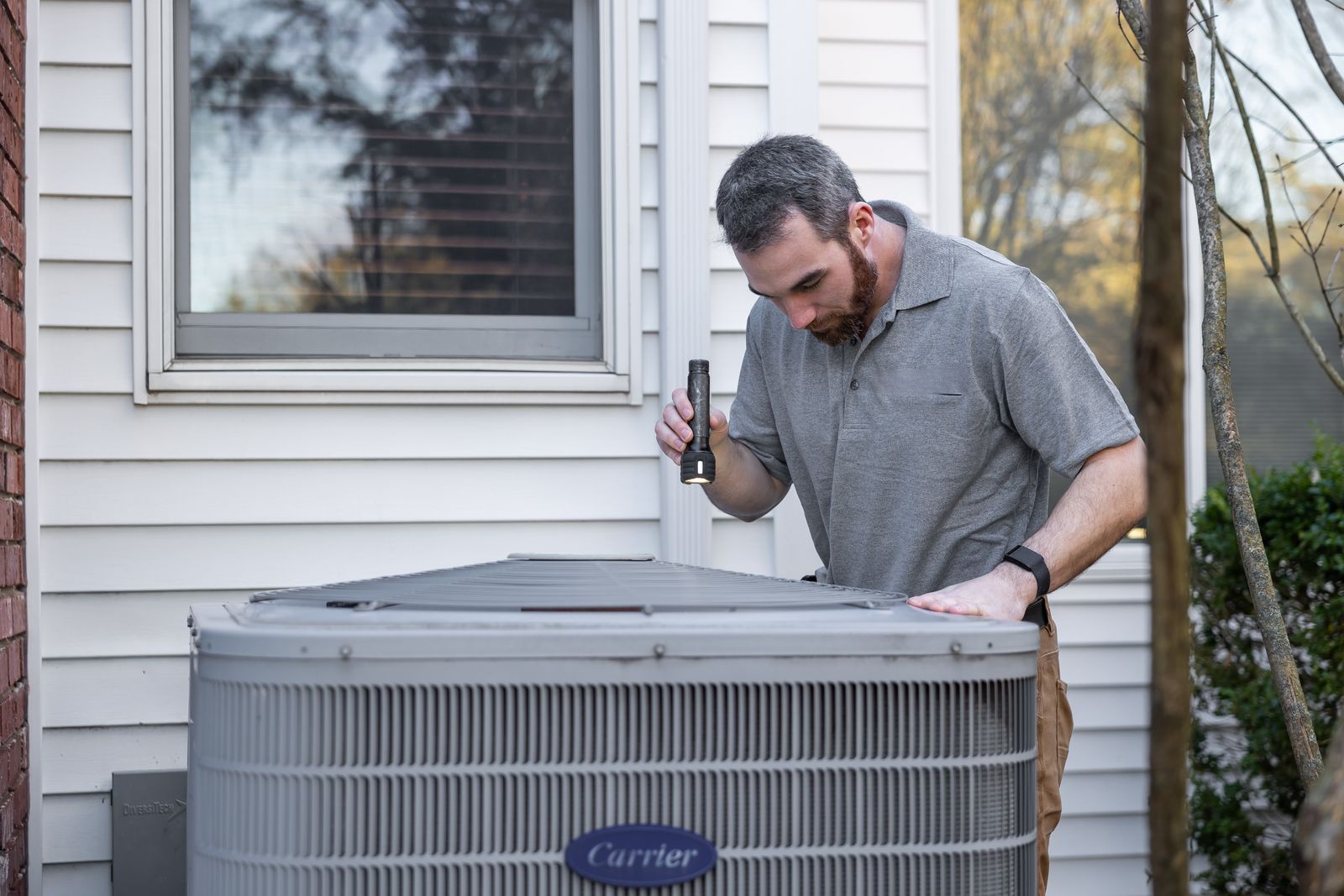
A technician inspecting a residential outdoor unit. A useful evaluation identifies the model, refrigerant, operating data, fault location and complete price—not only that the equipment is old.
I pay close attention to the last two or three years of service. If one repair is followed by another major component approaching failure, piecemeal work may become more disruptive than a planned replacement. If the system is stable and only a minor component failed, its birthday alone is not a reason to discard it.
3. Refrigerant affects future serviceability, not whether the system is legal to own
Older equipment may use R-22. The U.S. Environmental Protection Agency does not require homeowners to replace an operating R-22 system. Existing equipment can still be serviced with reclaimed, recovered or previously produced refrigerant. New production and import ended, however, so repair economics depend on the leak, supply and service cost.
Current replacement systems may use different lower-global-warming-potential refrigerants. Refrigerants are not interchangeable, and an alternative should not be added simply because someone calls it a “drop-in.” Confirm the refrigerant the equipment was designed for, the approved indoor-outdoor match and who will support the warranty and future service.
4. Compare five-year ownership cost—not only today’s repair bill
Online rules that use one fixed percentage can sound simple, but equipment configuration, failure type, labor, warranty and ownership period vary too much for one formula to decide every home. Put two paths side by side instead.
Repair path: current repair, known follow-up items, possible refrigerant cost, recent failure frequency, energy use and the risk of losing cooling during peak heat.
Replacement path: complete equipment and installation, needed duct or electrical corrections, warranty, financing cost, current incentives and expected years of ownership.
A higher utility bill does not prove the AC caused it. Weather, setpoint, occupancy, pool equipment and other loads matter. Compare similar months and usage, then ask for a technical evaluation before using one bill as the reason to replace the system.
5. Does the replacement quote describe the whole job?
The lowest number is not always the lowest-cost solution. Ask every contractor to identify these items so the quotes can actually be compared:
Exact outdoor, indoor coil, furnace or air-handler model numbers.
Refrigerant, capacity and SEER2 rating.
The approved system match and an AHRI certificate or reference number when applicable.
Refrigerant lines, drains, equipment pad, thermostat, electrical work and safety switches.
Duct repair, sealing, return-air changes and attic work, including exclusions.
Permits, removal, commissioning, labor warranty and manufacturer warranty.
Conditions on discounts, rebates or financing, including interest and prepayment terms.
A quote with only a brand and total leaves room for costly assumptions. Exact model numbers also help confirm that the equipment installed is the equipment that was proposed.
6. The old tonnage is not automatically the right answer for the new system
Bigger is not automatically better. Oversized equipment may cool the air quickly but remove less humidity and short-cycle; undersized equipment may never catch up on peak days. ENERGY STAR recommends a heating-and-cooling load calculation when replacing equipment instead of automatically copying the old capacity.
Ask whether the contractor considered the home’s area, orientation, windows, insulation, air leakage and ducts. A high-efficiency unit connected to leaky or undersized ductwork may still deliver disappointing comfort.
7. The same old AC can lead to different decisions for different owners
A long-term owner who needs dependable temperature control may make a different decision than someone planning a near-term renovation. A rental owner also needs to consider the effect of a summer outage on tenants and emergency service.
Planning to sell is not a reason to ignore safety or hide a known condition. An owner may reasonably choose not to replace the system in advance, but known facts should be disclosed and the price, records, credit or replacement plan handled clearly.
If you are buying, use the option period this way
Photograph every indoor and outdoor equipment data plate instead of relying on a verbal age.
Request service invoices, maintenance records, manufacturer warranty information and recent utility bills.
Let the inspector document visible issues; when symptoms appear, obtain a focused diagnosis from a Texas-licensed air-conditioning contractor.
Request both a written repair quote and a complete replacement quote before defining the cost range.
Negotiate repair, price or seller credit in the context of the whole contract. The seller may not agree, and every inspection item does not require replacement.
Before the option period ends, understand the choices available under the signed contract and obtain the appropriate professional advice.
Have these 5 items ready before you call
Data-plate photos for the condenser, indoor coil, furnace or air handler.
Prior service records and any remaining warranty information.
When cooling falls behind, which rooms are affected and whether it tracks afternoon heat.
Thermostat settings and photos or video of runtime, noise, ice, water or breaker trips.
Your plan: expected ownership period, renovation plans and whether upfront budget or future reliability matters more.
Do not open energized equipment, add refrigerant or bypass a safety switch. Texas air-conditioning contractor licenses can be checked through the state licensing agency.
Do not “watch it for a few more days” in these situations
Burning odor, smoke, repeated breaker trips, water approaching electrical components, or a condition involving a gas furnace or carbon-monoxide alarm calls for immediate attention. Prioritize personal safety, stop using the affected equipment if it is safe to do so, and contact a qualified professional. Call emergency services when there is an immediate hazard.
Frequently asked questions
The AC is 15 years old but still cools. Should I replace it preventively?
Not automatically. Equipment over 10 years old deserves evaluation and budget planning, but that is not a mandatory retirement line. Consider operating data, repair history, refrigerant, energy use and your ability to tolerate a peak-summer outage. Even if you keep it, you can define the future scope and funding plan now.
Does R-22 mean the system can no longer be repaired?
No. EPA rules allow existing systems to be serviced with reclaimed, recovered or previously produced R-22, although new production and import ended. Whether repair is technically and financially sensible depends on the leak, components, refrigerant cost and overall system condition.
Can I replace only the outdoor condenser?
Sometimes, but not always. The condenser, indoor coil, refrigerant, capacity and controls must be compatible, and the combination can affect efficiency certification and warranty. Ask the contractor to list exact models and the matching basis instead of relying on similar physical size.
Related reading
A 2004 Houston home with its original roof and AC: what should the inspection prioritize?
Inspection found problems: should the buyer ask for repairs, a price change or a credit?
Got the keys? 10 things new Texas homeowners should do in the first week
Sources
ENERGY STAR: When is it time to replace?
ENERGY STAR: clean heating and cooling, sizing and installation
U.S. EPA: purchasing and repairing R-22 home air conditioners
U.S. EPA: homeowner refrigerant FAQs
Texas Department of Licensing and Regulation: air-conditioning contractors
AHRI Directory of Certified Product Performance
Joyce's Featured Listings

AI-generated illustration: a Greater Houston housing scene, not a real or currently available listing.
Browse Joyce's Featured Listings to see current options. An older AC should not automatically eliminate a home, but its diagnosis, replacement budget and negotiating room should be part of the comparison.
View Joyce's Featured Listings →
Looking at a home with an older AC?
Send me the property age, indoor and outdoor data plates, inspection findings and how long you expect to own the home. I can help separate what needs prompt attention, what can be monitored and what needs a professional quote—then put that cost back into the full buying budget.
About Joyce Tang

Joyce Tang is a Greater Houston real estate agent and investor, co-founder of the North American Real Estate Association, founder of JoyHome and JoyNest, and co-leader of the Dr. Wang Real Estate Team.
She has helped more than 200 families buy or sell homes and has participated in more than 40 renovation projects. Her approach examines not only price, but also location, carrying cost, cash flow, risk and future exit options.
Disclaimer
This article provides general property and transaction information only. It is not HVAC, mechanical, electrical, engineering, environmental, warranty, lending or contract advice. Equipment condition, matching, capacity, refrigerant, repair scope, permits and safety should be evaluated on site by a Texas-licensed air-conditioning contractor and other appropriate professionals. Transaction choices depend on the signed contract and relevant professional advice.