

This home at 29627 Mahogany View Ln in Fulshear’s Cross Creek Ranch had been listed for about three months without selling. When our team took over, we did more than refresh the listing date: we reconsidered the home’s market position, staged the rooms that needed clearer scale, rebuilt the photo story and coordinated the relaunch. A team member brought the buyer, the seller accepted the offer after five days on market, and the $420,000 sale closed on October 25, 2026.
The lesson is not that staging guarantees a sale. It is that when a listing is not producing the right response, the seller needs to identify why buyers are not acting and invest in the changes most likely to address that problem.
Case details
Here are the verified property and transaction facts behind this case:
- Address: 29627 Mahogany View Ln, Fulshear, TX 77441
- MLS: 25473764
- Community: Creek Rush at Cross Creek Ranch, Fulshear
- Property: 2023 single-family home; 4 bedrooms; 3 full bathrooms
- Size: approximately 2,658 sq ft on an approximately 6,450 sq ft lot
- Layout: two stories; two bedrooms downstairs; dedicated study; upstairs game room; attached two-car garage
- Final list price: $435,000
- Sale price: $420,000
- Result: offer accepted after 5 days on market; closed October 25, 2026
- Seller's representative: Joyce Tang
Source note: Property facts, MLS number, final list price and days on market were verified against HAR MLS 25473764 on November 4, 2026. The sale price and closing date were confirmed from this transaction’s records.
Why strong fundamentals were not enough on their own
Built in 2023, the home offers approximately 2,658 square feet, four bedrooms and three full baths, with the primary suite and another bedroom downstairs, plus a dedicated study and an upstairs game room. The family room has a high ceiling and two levels of windows, while the kitchen opens directly to the main living area.
Those are meaningful features. But a home can have good fundamentals without communicating them quickly in the photos buyers first see on a phone.
A relaunch should not repeat the original strategy
About three months without a sale was a signal to reassess the listing, not simply post it again. Before the relaunch, we focused on five areas:
Reviewing recent sales, current competition and the price choices buyers had at that moment.
Identifying which vacant rooms were difficult to understand and concentrating the budget there.
Using appropriately scaled furniture to explain the living room, dining area, study and primary bedroom without overfilling the home.
Completing a new professional photo set with a consistent sequence, light and visual style.
Organizing showing feedback after launch and continuing to manage the offer and contract timeline.
Staging was one part of the plan. The larger change was treating pricing, presentation, photography and promotion as one coordinated listing project.
The buyer was brought by a member of our team
Before the home officially returned to the market, and within the seller’s authorization and applicable marketing rules, we began reviewing the needs of buyers already connected to our team and identifying people who might be a fit for the property.
Once the preparation, staging and professional photography were complete, the home was relaunched. The team then expanded promotion through our content channels, client network and direct collaboration among team members. Within five days, a team member brought the buyer whose offer the seller accepted.
Marketing is more than placing a listing in the MLS and waiting. Early buyer matching, concentrated exposure after launch and timely sharing of buyer leads across the team all contributed to the process.
How did the team’s reach expand exposure?
The team’s current marketing and client network includes:
More than 150,000 followers across platforms.
A network of more than 30,000 existing clients and long-term contacts.
More than 20 actively managed social media accounts.
These channels allow a listing to reach beyond organic MLS traffic through multiple team members, content accounts and client relationships. For a seller, the real value is not the numbers alone. It is the team’s ability to select appropriate channels for the property, share leads quickly and follow up consistently. That coordinated reach is a distinctive part of how the team serves sellers.
These figures describe the team’s combined platform scale. Audiences may overlap, and no individual listing is guaranteed to reach every follower or contact. The network can expand exposure and buyer-matching opportunities, but it does not guarantee a specific timeline or result. The promotion plan still needs to fit the property type, price, location and likely buyer.
Living room: help buyers understand the layout first
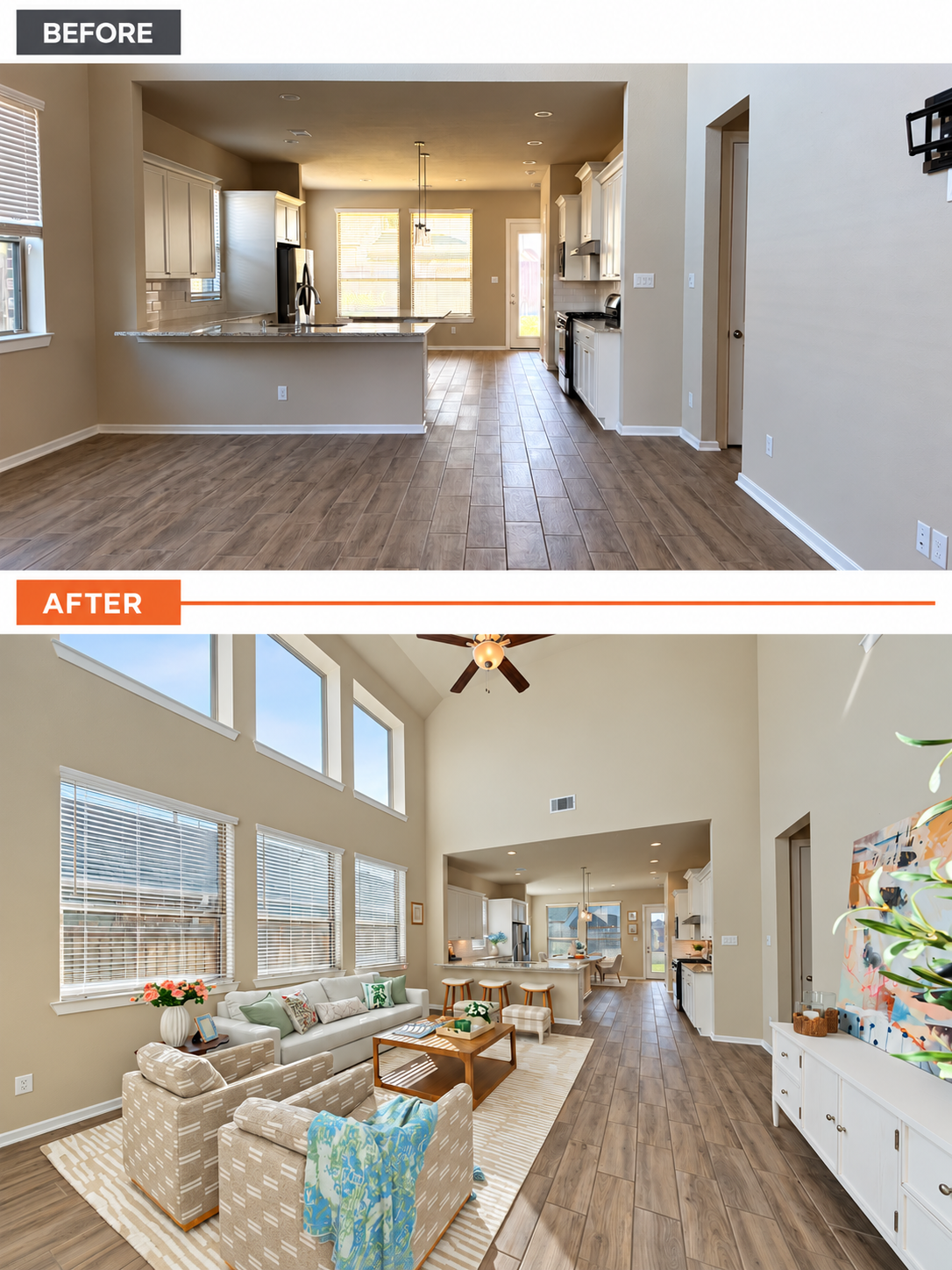
The vacant room showed square footage and ceiling height, but buyers still had to imagine where the sofa belonged, how large the main seating area would be and whether furniture would interrupt the route to the kitchen or back door.
After staging, the sofa, chairs, coffee table and rug created a clear conversation area. The furniture was not just decoration; it became a scale reference that explained how the high-ceiling family room and open floor plan could work in daily life.
A second angle made the ceiling height and light easier to read
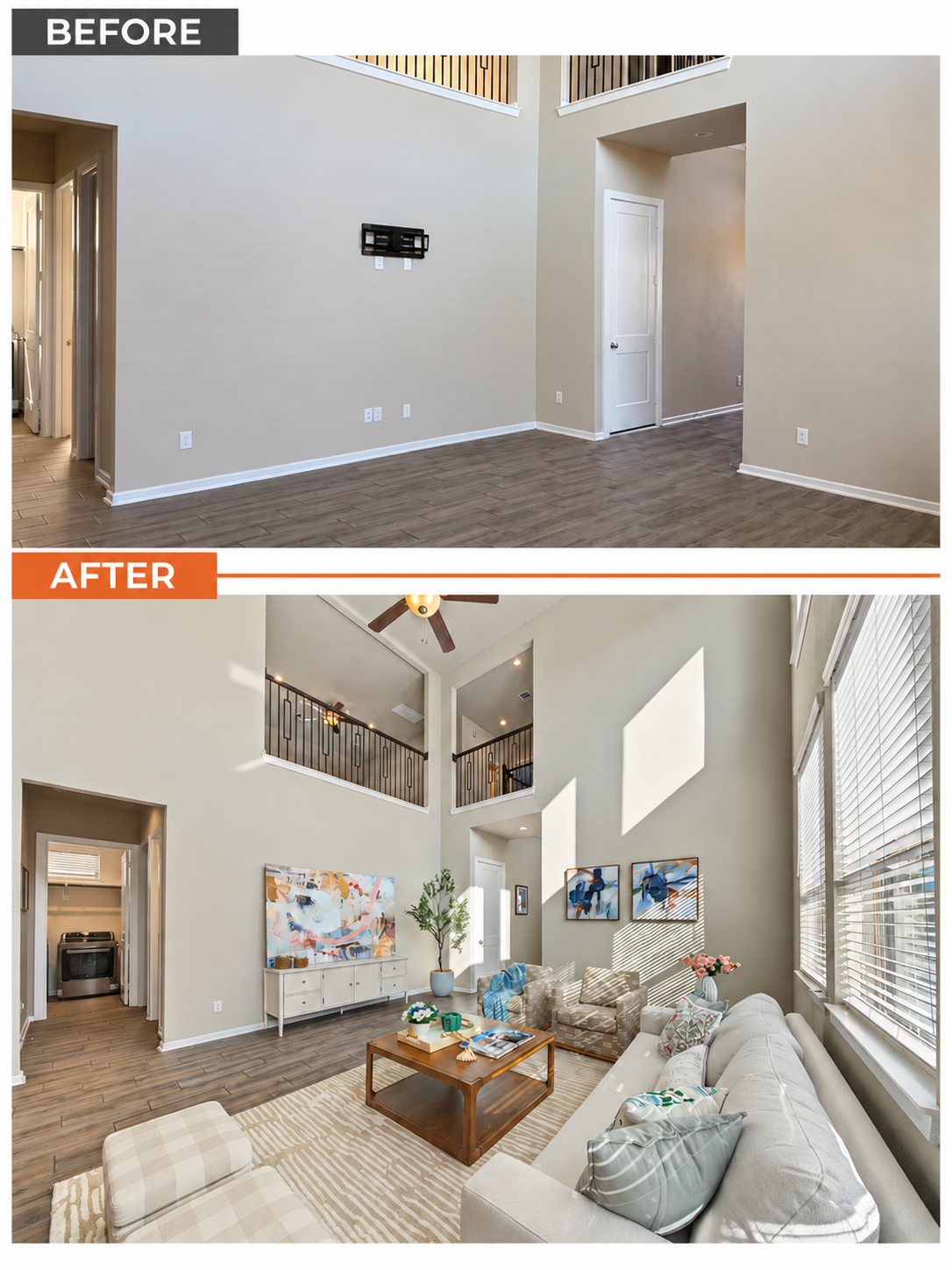
This comparison brings the upper windows, second-floor railing and main wall into the same frame. When the room was empty, the eye landed on a large expanse of wall and flooring. With furniture in place, the room gained a visual center without losing the height or natural light.
The purpose of the extra angle was practical: it helped buyers judge seating capacity, the likely media wall and the walking path through the room.
Dining area: one table clarified scale and circulation
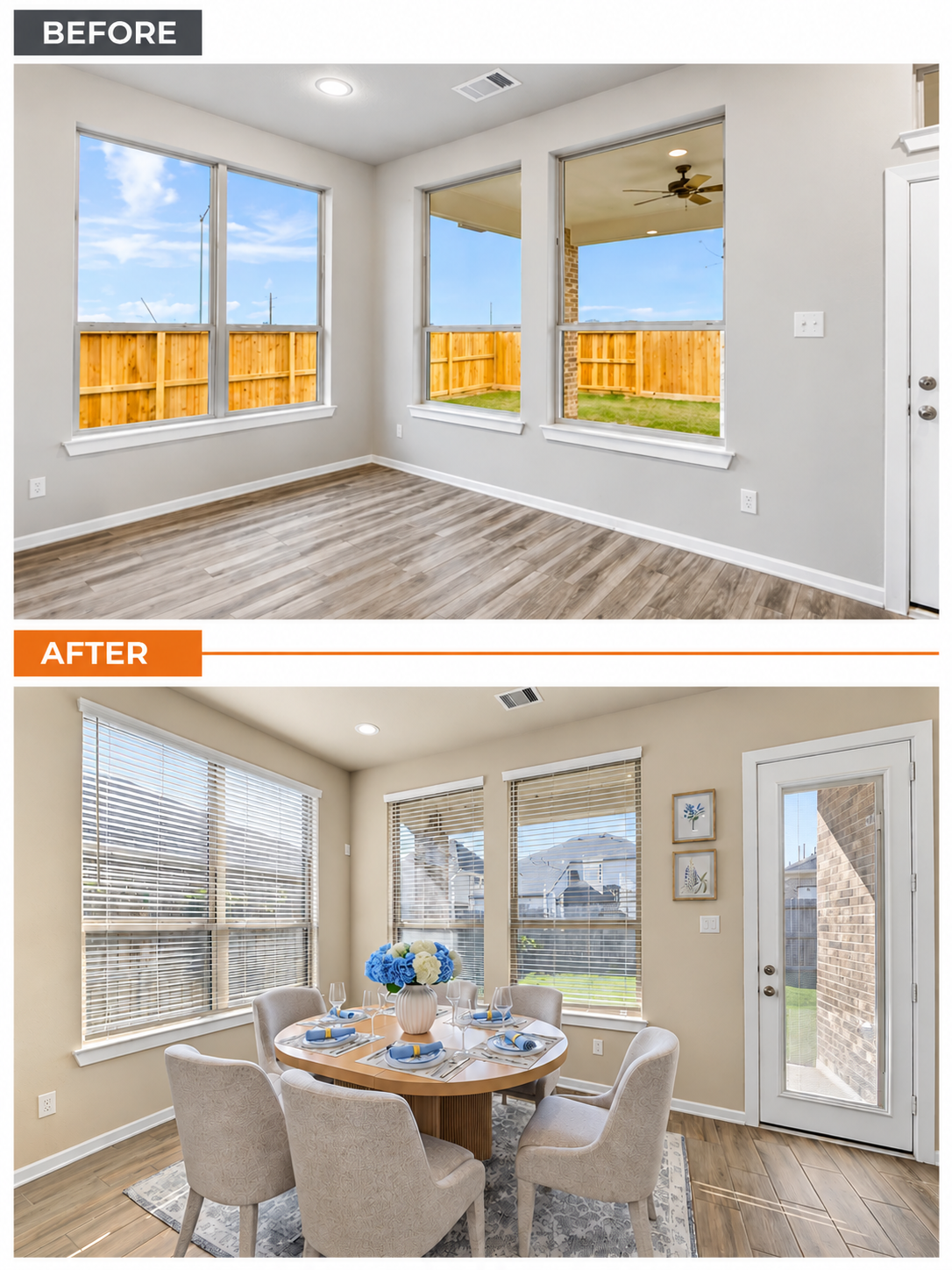
Empty, the dining area looked like unused floor space beside the kitchen. A round table and chairs made the seating capacity, chair clearance and relationship to the kitchen and back door immediately visible.
With an open plan, buyers can usually see the total square footage. What they may not know is whether several functions will fit comfortably together. Well-scaled furniture answers that question.
Study: give an important room a clear purpose
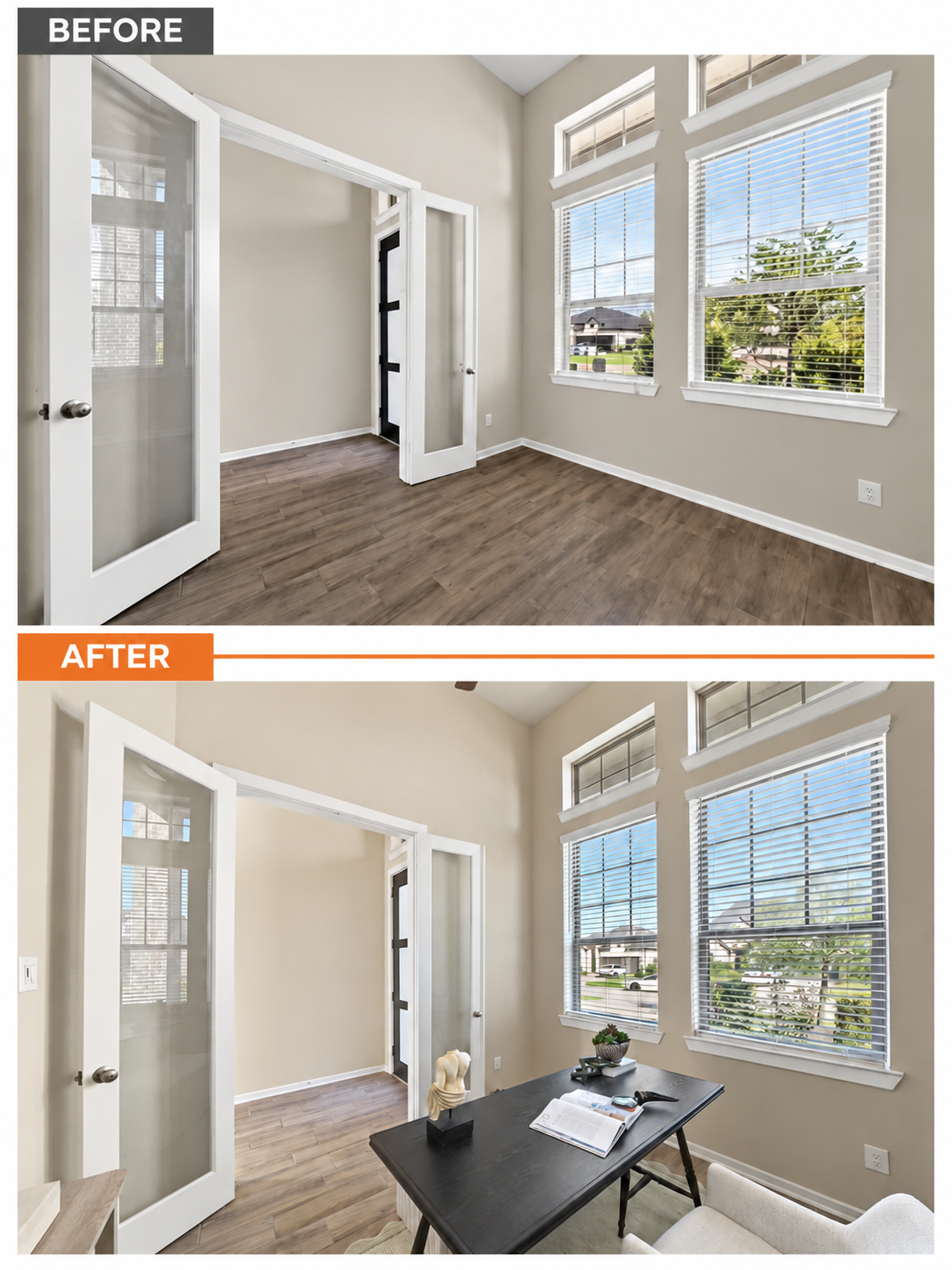
The vacant study showed its windows and floor area, but a first-time buyer could still be unsure how to use it. A desk, chair and restrained accessories made the home-office function clear while preserving enough open space to judge the actual room size.
That is why effective staging is not about filling every corner. Each item should clarify the room, not hide it.
Primary bedroom: answer the buyer’s practical questions
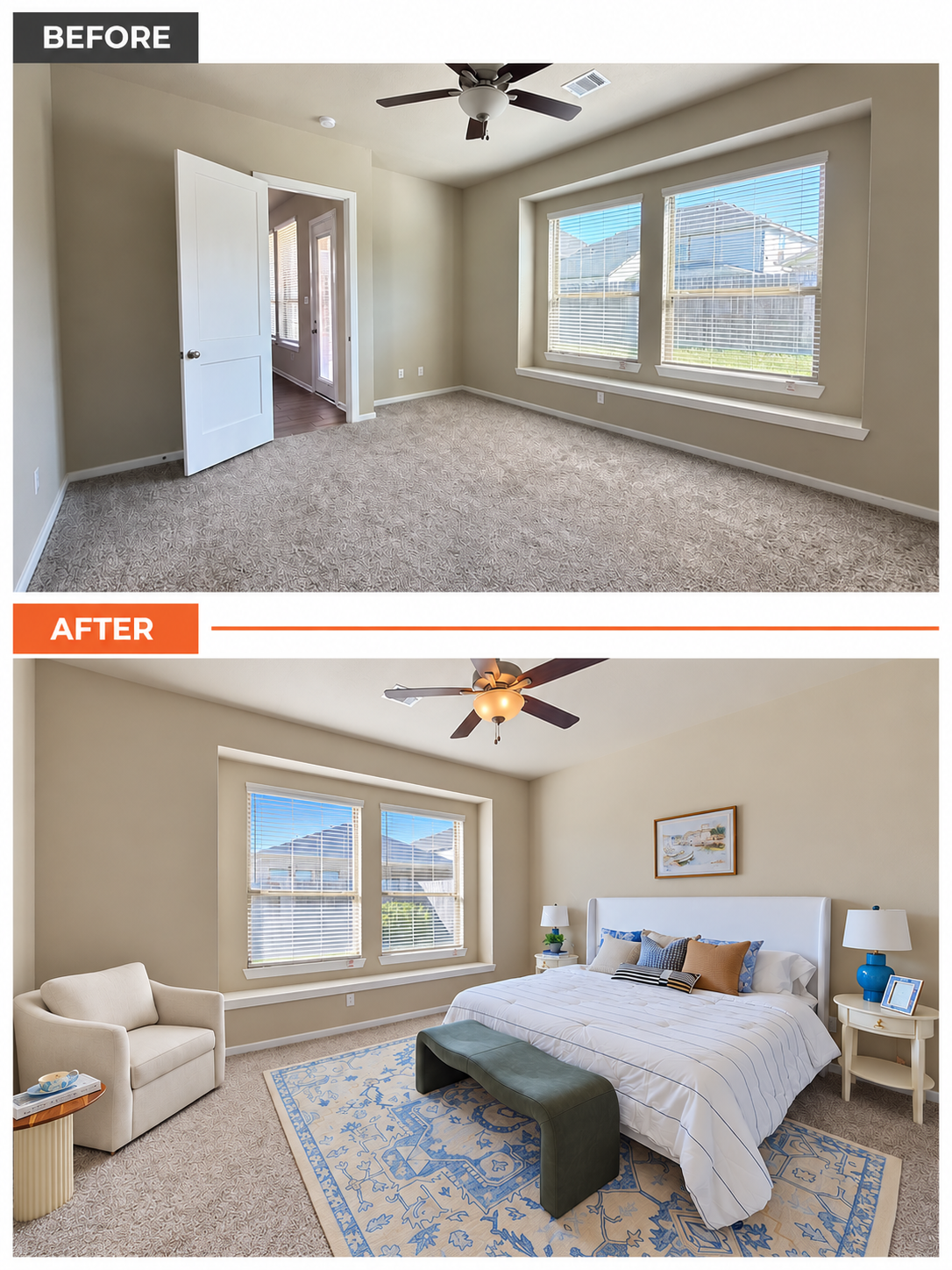
In a primary bedroom, buyers want to know how a bed fits, whether nightstands leave enough walking room and how the windows, closet and bathroom entry affect furniture placement. A vacant photo shows the shell but provides few familiar scale references.
The staged bed, nightstands, chair and bench made those relationships visible at a glance, reducing the amount buyers had to estimate for themselves.
Kitchen and breakfast area: aim for a complete story, not heavy decoration
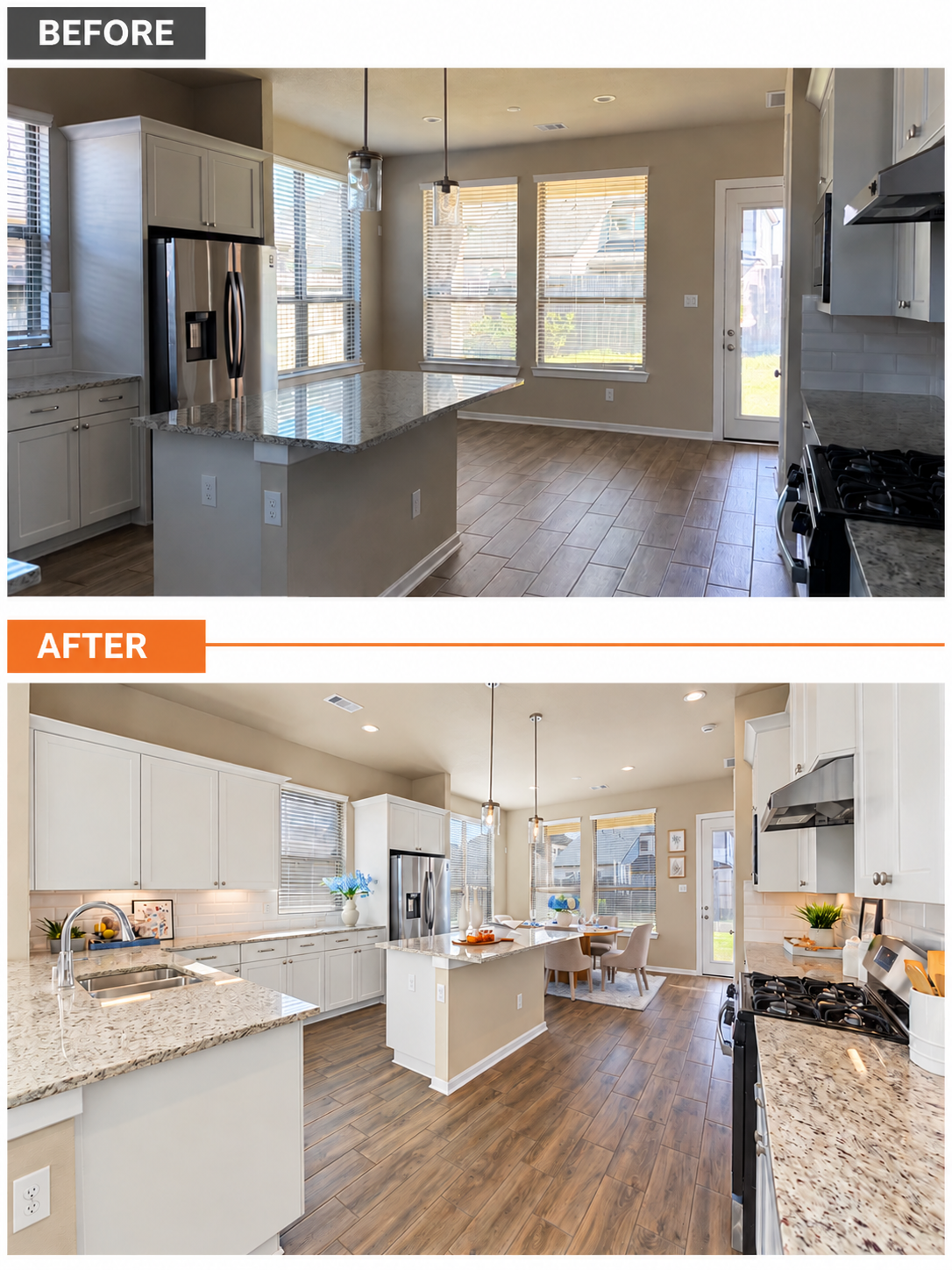
The kitchen already had an obvious function, so it did not need extensive styling. The work here was mainly lighting, restrained counter details, camera position and creating a continuous visual relationship between the island, breakfast area and back door.
The new photography made the kitchen feel connected to the staged living spaces instead of appearing as a separate, unrelated room.
Primary bath: some improvements come from light, details and camera position
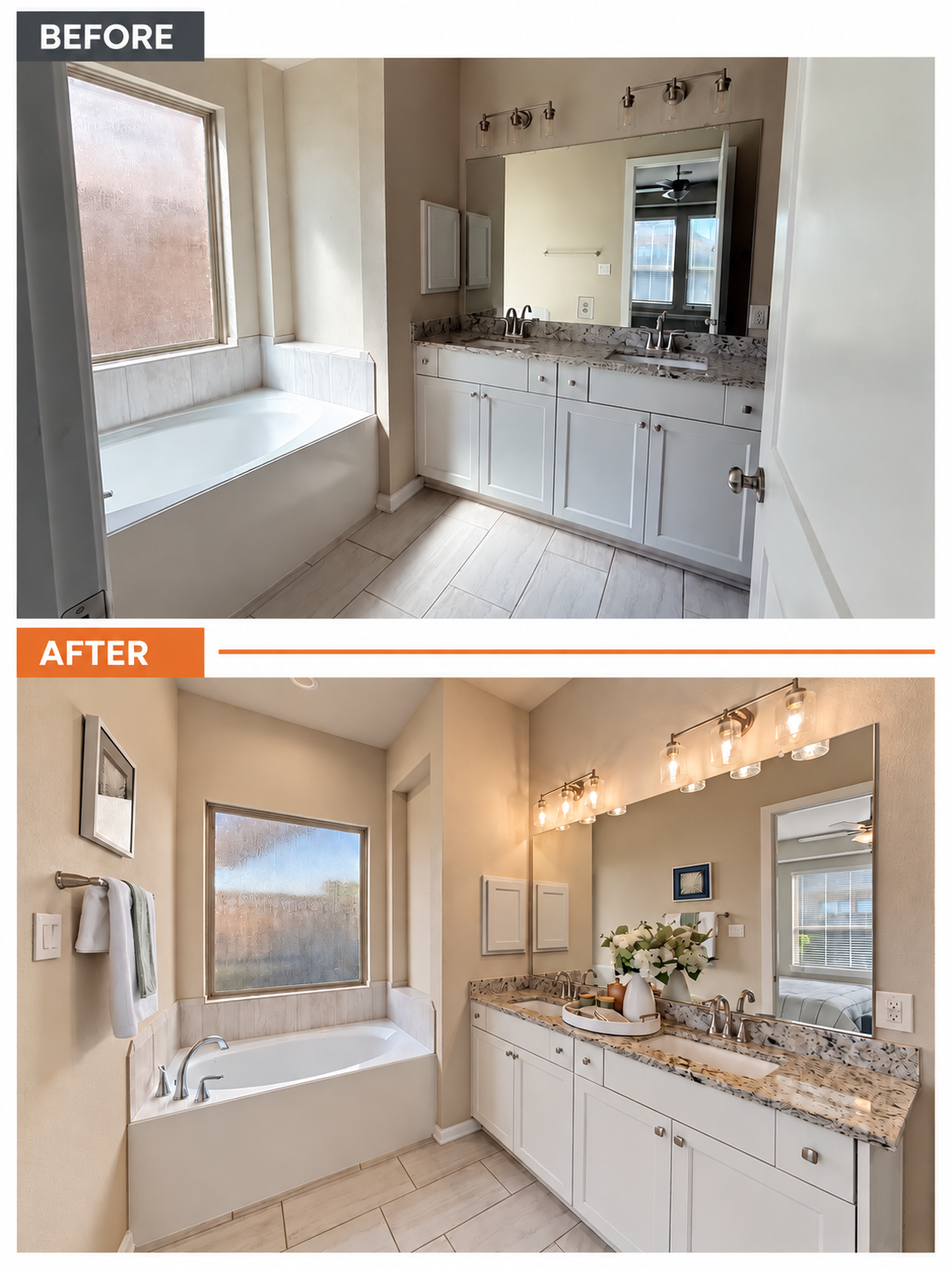
Not every improvement depends on furniture. In the primary bath, turning on the lighting, simplifying the counter, adding a few restrained details and choosing an angle that showed the tub, double vanity and room depth made the original features easier to notice.
Nothing structural was changed for the photo. The room was simply presented with less visual distraction and more useful information.
The result: an acceptable offer in five days, followed by closing
After the new positioning, targeted staging, professional photography and coordinated promotion were completed, the home returned to the market. Within five days, a team member brought the buyer whose offer the seller accepted. Our team then continued managing the contract deadlines and closing process, and the $420,000 sale closed on October 25, 2026.
I would not credit staging alone for the result. Market positioning, photo order, promotion, showing access, offer terms and contract execution all mattered. The value of this case is that those decisions were reconsidered together instead of changing only one piece.
What should a seller review when a home has been sitting on the market?
Does the price still reflect current competition, not just the market at the original launch?
Do the photos clearly explain the layout, scale, light and most important features?
Are repairs, cleanliness, odors, clutter or showing restrictions affecting the first impression?
Is there a repeated pattern in showing feedback, and which concerns can be fixed versus reflected in price?
Will the relaunch materially change the strategy, or only the MLS number and date?
When a home has been listed for a while, I prefer to separate these questions before assuming the market is simply bad or that a large price reduction is the only answer.
Frequently asked questions
Can relisting erase the history of a home that did not sell?
No. Buyers and agents may still see the prior history. If pricing, condition, photography and promotion do not materially change, a new listing date usually will not solve the original problem by itself.
Does every vacant home need staging?
No. A straightforward layout with clear room functions and strong photography may show well vacant. Open plans, high-ceiling living rooms and spaces without an obvious use are stronger candidates for targeted staging.
Where should a seller spend first when the budget is limited?
Issues affecting safety, function, inspection results and buyer confidence generally come first. Cleaning, minor repairs, targeted staging and photography should then be prioritized according to the specific presentation problem rather than spread evenly across every room.
Do the team’s marketing resources guarantee a five-day sale?
No. The team’s channels, client network and collaboration can increase exposure and buyer-matching opportunities, but the outcome still depends on pricing, condition, market demand, showing access, offer terms and contract execution. This case shows how a coordinated strategy worked together; it is not a promise of the same result for another property.
Related reading
Houston Home Staging Guide: When It Helps and How to Budget
Fulshear Area Guide: Homes, Commutes, Carrying Costs and Community Tradeoffs

Joyce's Featured Listings
After seeing how a relaunch can change the way buyers understand a home, browse Joyce's featured Greater Houston listings to see how current properties are being positioned and presented.
View Joyce's Featured Listings
Has your home been listed without the response you expected?
Send me the property address, time on market, target selling timeline and the showing feedback you have received. We can first review nearby sales and current competition, then decide whether pricing, preparation, photography, promotion or several items need to change together.
Contact Joyce about a selling plan
About Joyce Tang

Joyce Tang is a Greater Houston real estate agent and investor, co-founder of the North American Real Estate Association, founder of JoyHome and JoyNest, and co-leader of the Dr. Wang Real Estate Team.
She has helped more than 200 families buy or sell homes and has participated in more than 40 renovation projects. Her approach examines not only price, but also location, carrying cost, cash flow, risk and future exit options.
Case study note
This article is based on a real seller transaction that has closed and is intended to explain the decisions behind listing preparation, presentation and contract management. The property address, public MLS facts, list price and sale price are disclosed; other contract terms, negotiation details and personal client information are not. Relisting, staging, photography and promotion cannot guarantee a specific timeline or result; every pricing and launch plan should be evaluated for the property, competition and seller’s goals.