
Short answer: choose Montrose for the broadest mix of older homes, new townhomes, restaurants and neighborhood character; choose the Museum District when Hermann Park, Rice University, the Texas Medical Center and the Red Line shape your week; choose Midtown when Downtown access, rail and a lower townhome or condo entry point matter most. They sit minutes apart, but the ownership costs, street experience and future resale buyer can be very different.
This guide is for buyers who want an urban Houston address and need to decide what they are actually buying: land, walkable pockets, rail access, a high-rise service package, a townhome with shared drives, or a detached home with older systems.
The decision in one minute
- Montrose offers the widest lifestyle and property mix. The tradeoff is inconsistency: one block can be historic bungalows, the next recent townhomes, apartments or commercial activity.
- Museum District is strongest for Hermann Park, museums, Rice and Medical Center access. The label covers condos, townhomes and expensive detached homes, so one median never tells the whole story.
- Midtown is the most direct Downtown-and-rail choice. Attached housing and rental competition are central to both value and resale.
- None of the three should be chosen by ZIP code alone. School assignment, flood and ponding risk, parking, HOA documents, construction quality and street conditions must be checked by address.
Where are the boundaries?
Neartown/Montrose is west-central Houston around Montrose Boulevard, generally west of Midtown and north of the Museum District. The City defines Museum Park between the Southwest Freeway, Almeda Road, Hermann Park and Main Street. Midtown sits south of Downtown, west and north of I-69, and east of Montrose. Marketing labels overlap, so confirm the legal subdivision, parcel and HOA instead of relying on a listing headline.
Houston’s 2024 Super Neighborhood profiles estimate 34,271 residents in Neartown/Montrose, 6,804 in Museum Park and 13,741 in Midtown. Median household income was about $101,930, $114,586 and $96,473 respectively. Those are multi-year ACS estimates for broad planning areas—not a description of who belongs in a neighborhood or a prediction of any one property’s value.
How long are the drives?
Representative clear-road OSRM/OpenStreetMap routes checked October 25, 2026 put all three within roughly 5–7 minutes of Downtown or the Medical Center, depending on the starting point. Chinatown/Asiatown is about 11.1–12.7 miles and 17–18 minutes without congestion; Galleria is about 4.4–5.9 miles and 8–9 minutes. These are route estimates, not live-traffic promises.
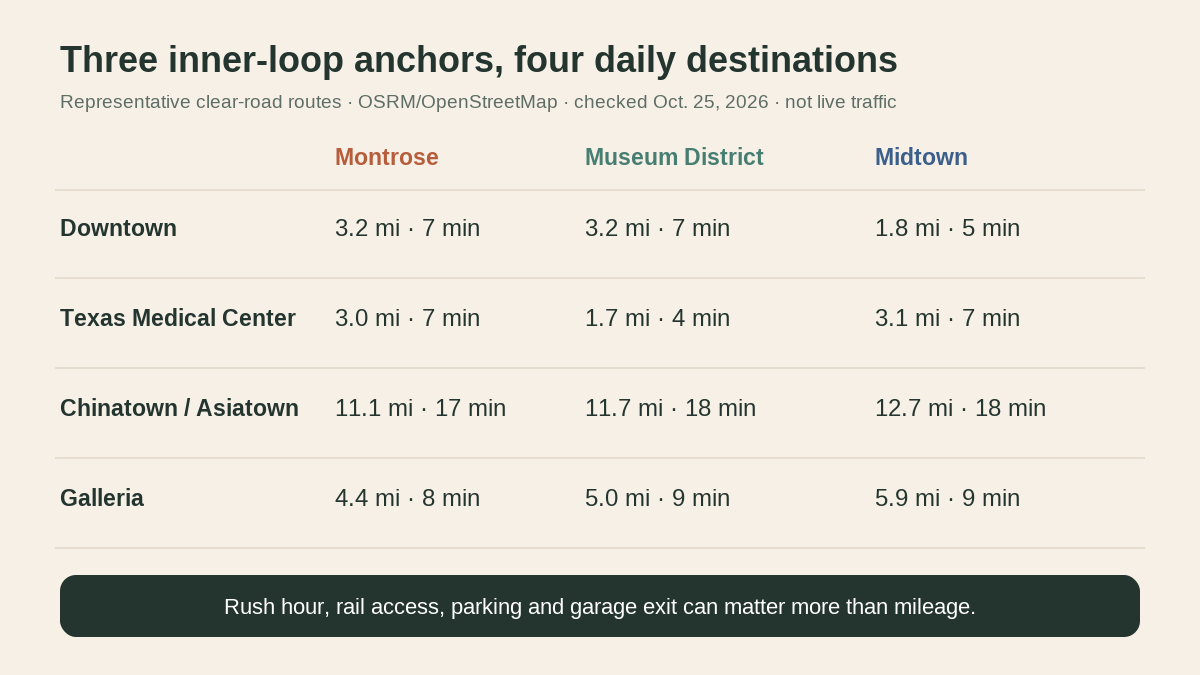
Midtown and Museum District add a real rail option. METRO’s Red Line runs through Midtown, the Museum District and the Texas Medical Center, generally every six minutes on weekdays and every twelve minutes on weekends during most operating hours. Montrose depends more on buses, driving, cycling and the exact walkable pocket.
Current prices: first separate the property types
HAR September 2026 public market-area data illustrates the problem with one “area price.” Montrose single-family sales had an $830,000 median across 19 closings. Rice/Museum District single-family sales had a $1,534,280 median across only 13 closings. Midtown’s single-family asking median was $475,000 across 42 listings. Attached homes in all three create lower price tiers, and small samples can move sharply from month to month.
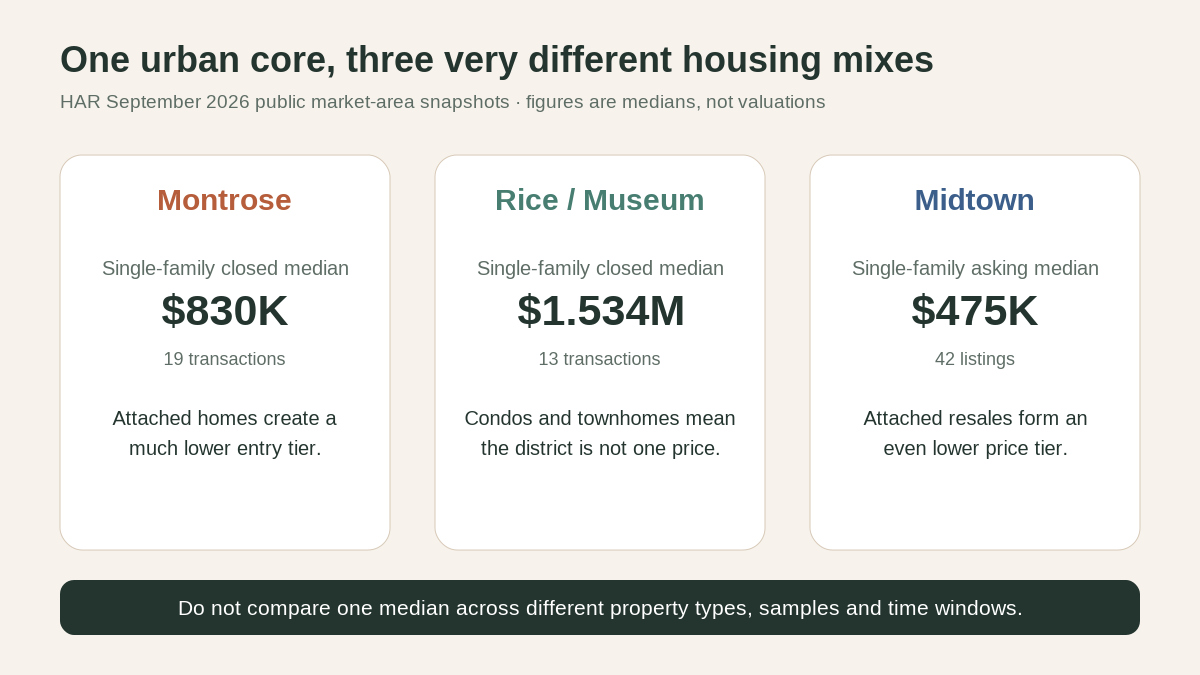
The practical range is broad. Older condos can begin in the low-to-mid six figures, Midtown and Montrose townhomes often occupy the mid-six figures, and detached homes can move from land-value opportunities into seven figures. High-rise fees, parking, age, view, reserves and special assessments can explain why two condos with similar square footage price differently.
Montrose: the most character, and the most block-by-block variation
Montrose works well for buyers who want independent restaurants, the Menil Collection, Rothko Chapel, University of St. Thomas, Buffalo Bayou access and a mix of old and new. The same variety creates due diligence: historic bungalows may have older sewer, plumbing, electrical or foundations; newer vertical townhomes may have many stairs, shared driveways, stucco or roof-deck details; condos add association documents and financing rules.
Noise and parking can change within one block. Visit the exact street on a weekday morning, evening and weekend. Check nearby commercial uses, trash pickup, guest parking, nightlife spillover and whether the route you plan to walk has continuous sidewalks and comfortable crossings.
Museum District: park, culture and Medical Center access—at several price levels
Museum District and Museum Park offer direct access to Hermann Park, Houston Zoo, major museums, Rice University and the Medical Center. The Red Line can reduce driving for some jobs and events. Detached homes can be expensive because land is limited, while condos and townhomes create very different entry points and monthly costs.
For a condo, review the master insurance, reserves, recent minutes, litigation, delinquency, special assessments, rental limits, parking and lender eligibility. For a townhome, inspect drainage between buildings, shared access, stucco or exterior wall systems, roof responsibility and how easily guests can park. For an older detached home, the expensive systems matter more than a fresh interior.
Midtown: strongest rail and Downtown logic, but supply matters
Midtown’s case is access: Downtown, the Red Line, HCC, MATCH, Midtown Park and nearby employment. It is also a market with many townhomes, condos and rental apartments. That can create a lower entry price than detached Montrose or Rice/Museum homes, but it also gives future buyers and tenants many substitutes.
Street position matters. A townhome facing an active corridor, rail, nightlife or a busy intersection may feel very different from one inside a quieter block. Compare parking, private outdoor space, stairs, guest access, security, sound, construction quality and upcoming development—not just interior finishes.
Schools: the address decides
All three areas are in Houston ISD, but campus boundaries cross neighborhood labels and can change. Use the current HISD School Locator for the exact property and verify any magnet or transfer requirement separately. Never treat a listing, ZIP code or nearby campus as an enrollment guarantee.
A rating is one data point, not a promise of fit or future resale. Review the current accountability profile, programs, enrollment, transportation and the student’s actual needs.
Parks, culture, shopping and Chinese daily life
Montrose has the Menil campus, Buffalo Bayou access, restaurants and grocery choices. Museum District centers on Hermann Park, museums, the zoo and Miller Outdoor Theatre. Midtown adds Midtown Park, Baldwin Park, MATCH, restaurants and quick Downtown event access. These are real lifestyle advantages, but “walkable” still depends on the exact block, weather, crossings and your daily destinations.
For larger Chinese supermarkets and the Bellaire Boulevard restaurant network, the representative routes are roughly 17–18 minutes without traffic. That is practical for weekly trips, but it is not the same as living inside Chinatown. The closer everyday Asian dining and grocery choice varies by the exact corridor.
Flood, ponding, drainage and insurance
Do not reduce flood risk to “inside or outside the FEMA zone.” Check the effective FEMA map, Harris County Flood Education Mapping Tool, seller disclosure, prior claims, elevation information, street ponding, garage level, roof drainage and the path water takes across the lot. A townhome can also have courtyard, shared-drive or foundation-level drainage problems without being in a mapped floodplain.
Get homeowners, flood and—when relevant—HO-6 quotes during the option period. For condos, understand the master-policy deductible and unit-owner coverage. Roof age, prior claims, plumbing, electrical systems and building maintenance can change the premium or availability.
Crime and personal safety: do not use one neighborhood score
HPD itself cautions that public crime data does not certify an area as safe or unsafe and that high-traffic locations may generate more reports. Check the blocks around the property, parking location, rail stop and the route you will actually use over a meaningful recent period. Then visit at the times you expect to be outside.
Taxes, HOA, parking and the real monthly cost
Pull the Harris Central Appraisal District account and verify taxing entities, exemptions and current tax rates. Do not project the buyer’s bill from the seller’s capped taxable value. Add insurance, HOA or condo dues, water, parking, elevator or common-area maintenance, special assessments and reserves for older systems.
A lower-priced condo can cost more per month than expected. A fee may include water, security, building insurance or amenities—or it may reflect deferred repairs. Read what it covers and what it does not.
Does the investment math work?
The renter pool can include Downtown, Medical Center, Rice, university, professional-services and central-Houston workers, but demand is not a guarantee of cash flow. Midtown and Montrose compete with large apartment supply; condos may restrict leasing; high-rise fees can absorb rent; and luxury detached homes usually have weak gross rent-to-price ratios.
Use current closed or leased comps for the same property type and micro-location. Subtract vacancy, management, repairs, taxes, insurance, HOA, utilities paid by the owner and capital reserves. Confirm long-term and short-term rental rules before assuming either strategy is allowed.
Who fits each area best?
Montrose may fit better if
- You want neighborhood character, restaurants and the broadest mix of old and new homes.
- You accept block-by-block variation and will inspect older systems or newer townhome construction carefully.
- You value proximity to Downtown, Galleria and the Medical Center without needing rail at the door.
Museum District may fit better if
- Hermann Park, museums, Rice or Medical Center access shape your weekly routine.
- You want a rail option and can compare condos, townhomes and detached homes on total cost.
- You prefer a quieter cultural-and-park setting over a nightlife-centered one.
Midtown may fit better if
- Downtown and Red Line access are the strongest priorities.
- A townhome or condo entry price matters more than a large yard.
- You are comfortable evaluating parking, apartment competition and the exact street environment.
My address-level checklist before an offer
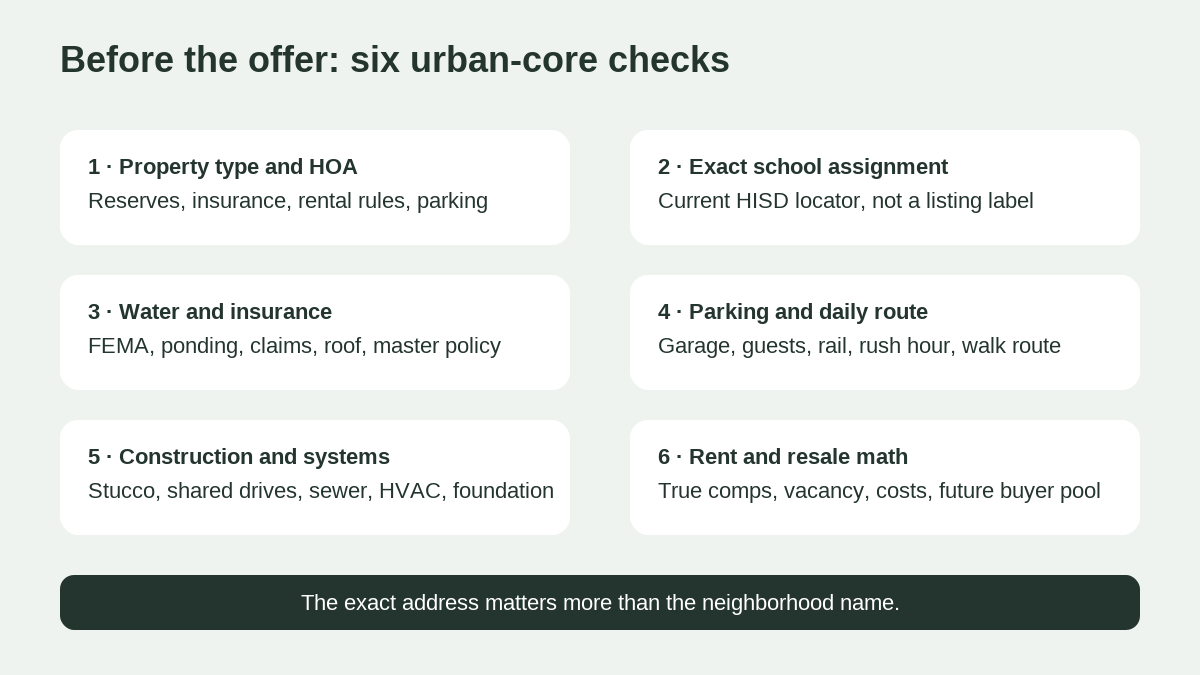
- Legal subdivision, property type, all associations, shared access and parking rights.
- Current HISD assignment and any separate admission requirements.
- FEMA and county mapping, claims, ponding, drainage and insurance quotes.
- Foundation, sewer, supply plumbing, electrical, roof, HVAC, stucco, windows and balconies.
- Taxing entities, HOA budget, reserves, master insurance, assessments and rental rules.
- True same-type sale and lease comps plus the likely future buyer and renter pool.
Frequently asked questions
Which area is the most walkable?
There is no area-wide winner. Midtown and Museum District have the clearest Red Line access; Montrose has more restaurant and retail pockets. Walk the exact route to groceries, work, rail and parking before deciding.
Is Museum District always more expensive?
No. Detached-home medians can be high, but condos and townhomes create lower entry points. Property type, monthly fee, parking, building condition and insurance must be compared together.
Is Midtown automatically the best rental investment?
No. Location and rail help demand, but apartment supply, HOA rules, maintenance and competing townhomes can limit rent growth and resale. Run the full net model.
Which one has the best appreciation potential?
No responsible answer can guarantee one. Scarce land, employment access and amenities help, while building condition, future supply, HOA health, flood history and the next buyer pool determine the individual property.
Related JoyHome guides
Houston condo and townhome buying guide explains reserves, master insurance, assessments and financing.
Houston flood risk beyond the FEMA zone shows how to check drainage and property history by address.
Buying in a Houston school zone explains why ratings and neighborhood labels are not enough.
Sources and date checked
Market data: HAR Montrose trends, HAR Rice/Museum District trends and HAR Midtown trends. Checked October 25, 2026.
Neighborhood and household data: City of Houston 2024 Super Neighborhood profiles for Neartown/Montrose, Museum Park and Midtown. Released January 2026; checked October 25, 2026.
Transit, schools, flood and crime: METRORail, HISD boundary and locator page, Harris County Flood Education Mapping Tool and HPD crime-data disclaimer. Checked October 25, 2026.
Drive estimates use representative coordinates and OSRM/OpenStreetMap route data checked October 25, 2026. They exclude live traffic and are not commute guarantees.
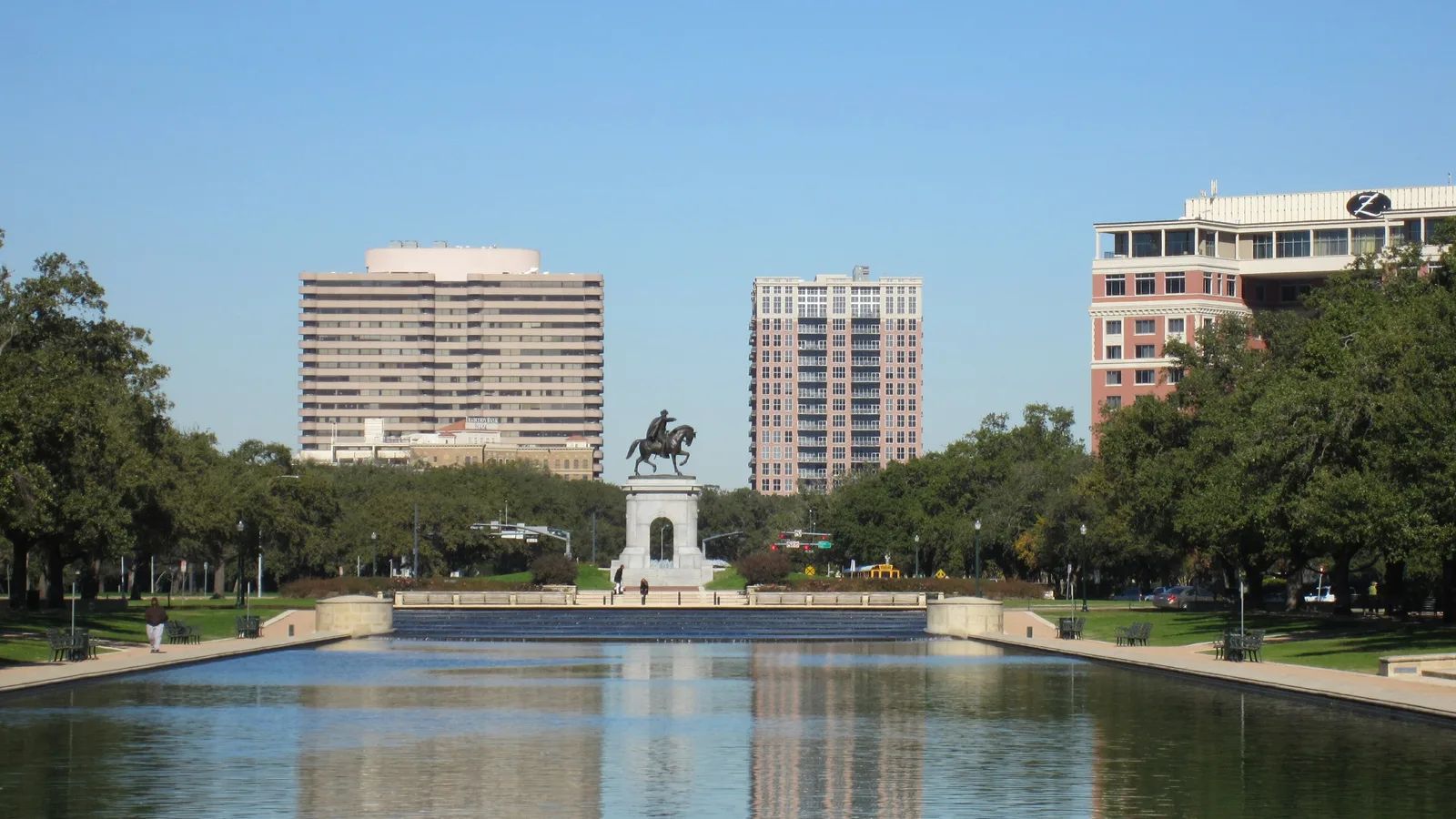
Cover photo: Another Believer, Hermann Park reflection pool, CC BY-SA 3.0. Center-cropped to 16:9, resized and converted to WebP.
Explore Joyce's Featured Listings
After comparing the three lifestyles, you can browse Joyce’s current Greater Houston selections to see what different budgets buy today. This long-term guide does not tie its advice to one listing whose status may change.

View Joyce's Featured Listings
Want to compare three exact addresses?
Send me the addresses, budget, work location and expected holding period. I can line up the school assignment, flood and drainage checks, HOA documents, insurance, major systems, parking and resale considerations before you decide which home deserves a second look.
About Joyce Tang

Joyce Tang is a Greater Houston real estate agent and investor, co-founder of the North American Real Estate Association, founder of JoyHome and JoyNest, and co-leader of the Dr. Wang Real Estate Team.
She has helped more than 200 families buy or sell homes and has participated in more than 40 renovation projects. Her approach examines not only price, but also location, carrying cost, cash flow, risk and future exit options.
This article provides general real estate information, not an appraisal, engineering or flood determination, insurance quote, school-enrollment guarantee, tax advice, legal advice or investment-return projection. Market data, boundaries, taxes, insurance, HOA rules, flood information and crime reports change. Verify the specific property with the relevant agencies and qualified professionals before acting.