
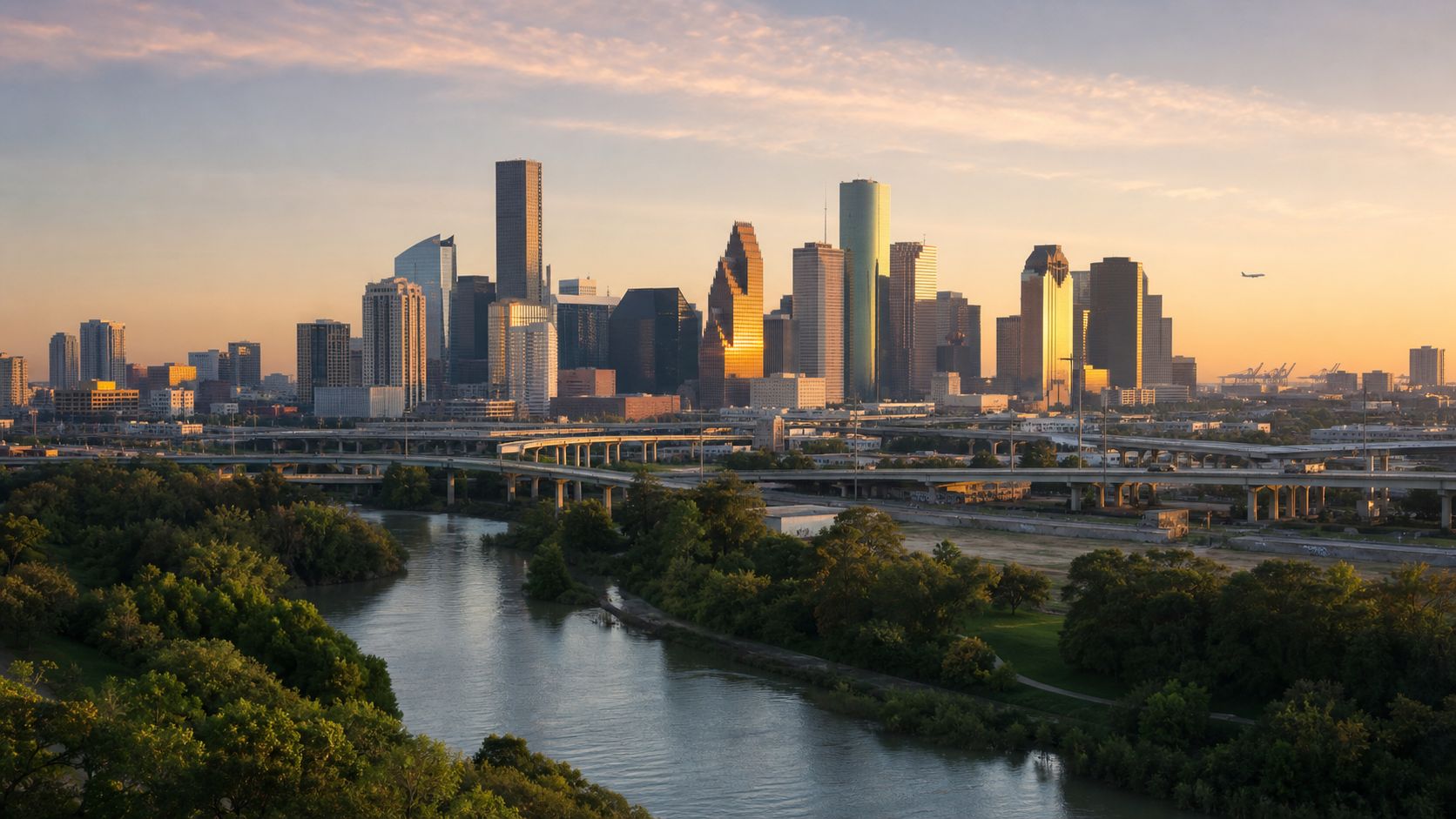
When I first speak with someone moving to Houston, one of the most common questions is whether Katy or Sugar Land is better. I usually ask them to pause, because Greater Houston is not a ranking of city names; workplaces, counties, school boundaries, tax districts and daily roads shape the real answer.
For a relocation or home search, the practical order is: understand Houston's position within Texas, identify the household's job centers and preferred direction, then verify the exact property's city, county, school district, special tax districts, insurance and flood considerations.
Houston's place in the United States and Texas
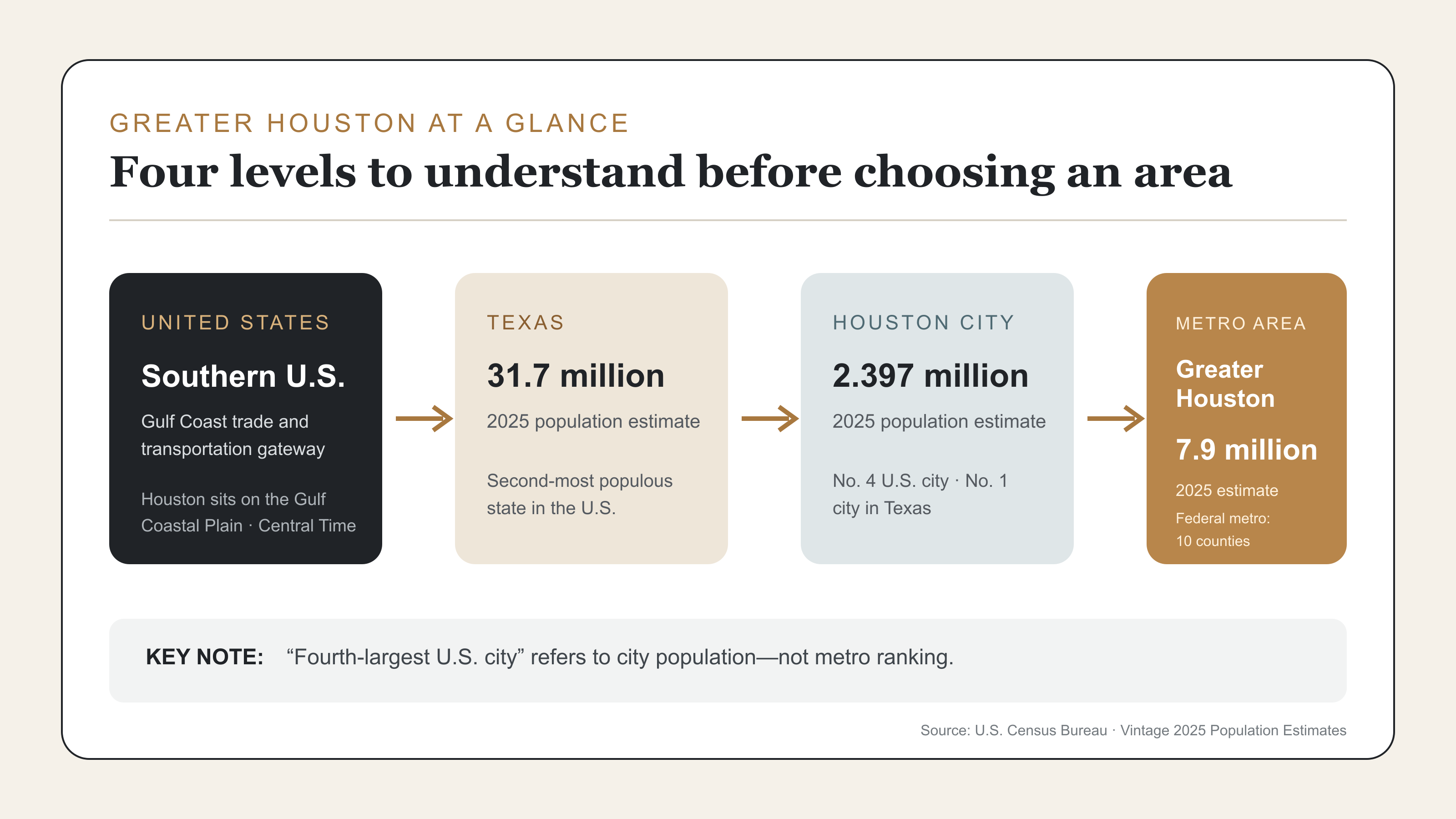
Houston is in southeast Texas on the upper Gulf Coast plain. Texas sits in the south-central United States, borders Mexico and faces the Gulf of Mexico. Houston uses Central Time and connects to the Gulf through the Houston Ship Channel.
Texas is the second-largest state by land area and the second most populous. The U.S. Census Bureau estimated its 2025 population at about 31.7 million. Energy remains important, but the state economy also includes technology, semiconductors, advanced manufacturing, healthcare, aerospace, finance, trade, agriculture and real estate.
Texas has no state individual income tax. That does not mean residents pay no state or local taxes: sales taxes, locally administered property taxes, insurance and special-district costs still matter.
What “fourth-largest city” means
The Census Bureau estimated Houston city's 2025 population at about 2.397 million, behind New York City, Los Angeles and Chicago. That makes Houston the fourth most populous U.S. city and the largest city in Texas.
Two different geographies are involved:
Houston City is the incorporated city, with about 2.397 million residents.
Greater Houston is the larger metropolitan region, with about 7.9 million residents.
The city ranking uses city-limit population, not metropolitan population. Katy, Sugar Land, Pearland and The Woodlands are commonly discussed as part of the Houston region, but they do not share the same municipal structure.
How many counties and cities are in Greater Houston?
Under the current federal Houston–Pasadena–The Woodlands metropolitan definition, the region has 10 counties: Harris, Fort Bend, Montgomery, Brazoria, Galveston, Waller, Austin, Chambers, Liberty and San Jacinto.
The Houston-Galveston Area Council uses a separate 13-county planning region representing 109 cities. A statement about the size of “Greater Houston” should therefore identify the statistical or planning definition being used.
For housing decisions, the most commonly discussed directions include the Harris County core; the Fort Bend corridor around Sugar Land, Richmond, Rosenberg and parts of Katy and Fulshear; Montgomery County around The Woodlands and Conroe; Brazoria County around Pearland and Manvel; and Galveston County toward Clear Lake, League City and the coast.
City names, mailing addresses and communities do not always align
Katy spans Harris, Fort Bend and Waller counties. Pearland spans Brazoria and Harris counties. The Woodlands is not incorporated as a conventional city. Cypress and Spring are commonly used place and postal names, while Kingwood is part of Houston.
A mailing address alone does not establish municipal services, school assignment or tax obligations. Verify each property by address for county, city limits, school district, MUD or PID, HOA and deed restrictions, flood information, utilities and emergency services.
Three rings and several major corridors
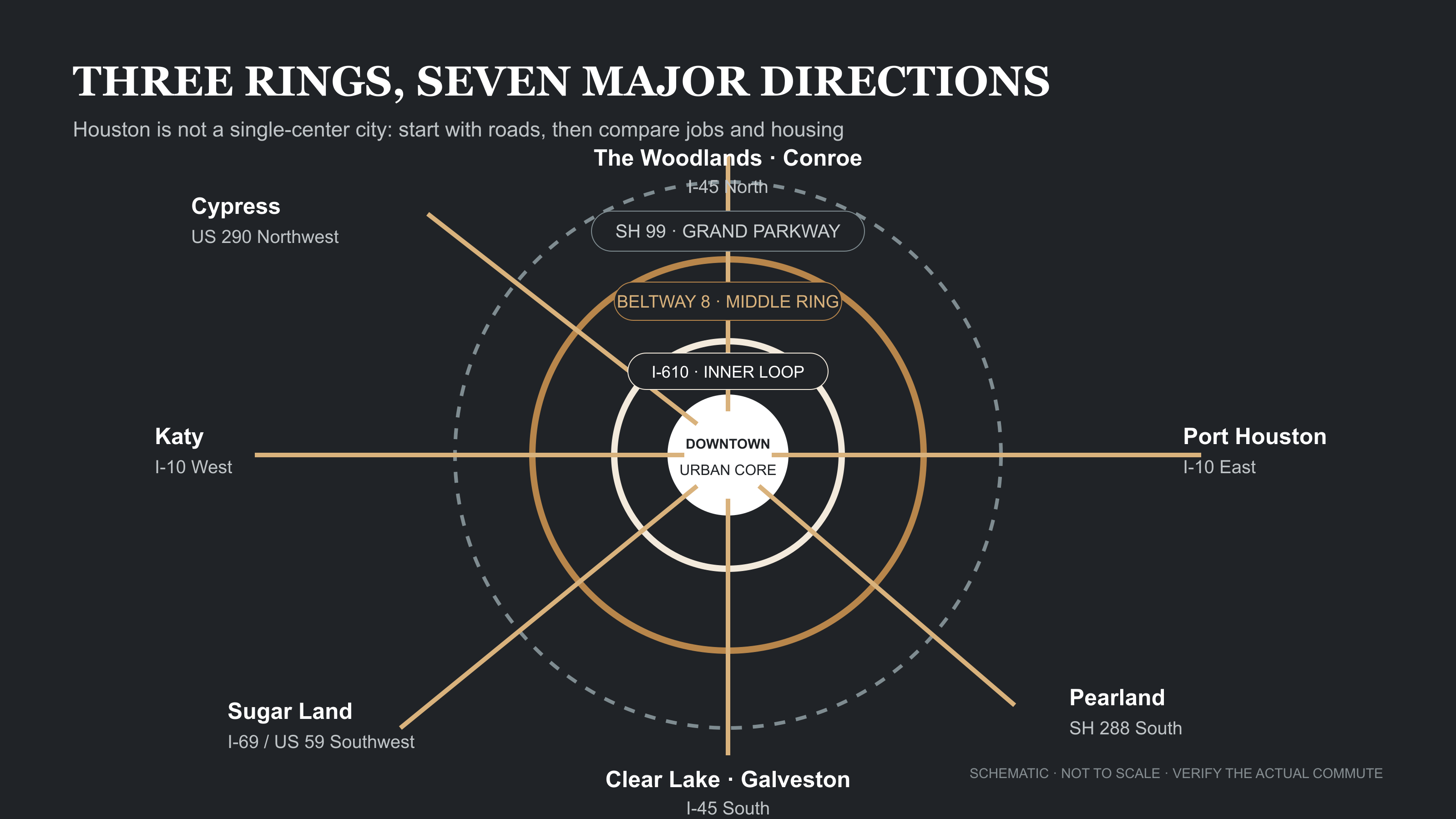
I-610 is the Inner Loop. Beltway 8 / Sam Houston Tollway functions as a middle ring, and SH 99 / Grand Parkway is the expanding outer ring.
I-10 runs west toward Katy and east toward Baytown and the port. I-45 connects The Woodlands and Conroe to the north and Clear Lake and Galveston to the south. I-69 / US 59 serves Sugar Land and the southwest. US 290 serves Cypress and the northwest, while SH 288 connects central Houston and the Medical Center with Pearland and Brazoria County.
SH 288 is a southbound corridor, not a line that divides all of Houston into east and west halves.
Houston is a multi-center employment region
Downtown is only one job center. Texas Medical Center anchors healthcare and research. Uptown/Galleria, Greenway Plaza and Westchase contain major office and commercial districts. The Energy Corridor is a concentration of energy and engineering firms. The Woodlands has its own corporate and medical center. NASA/Clear Lake supports aerospace, while Port Houston, Pasadena and Baytown support port, petrochemical, manufacturing and logistics employment.
For many households, proximity to the relevant job center matters more than distance to Downtown. Test a commute during actual weekday peak hours before choosing an area.
METRORail, buses, Park & Ride service and HOV/HOT lanes serve parts of the region, but most Greater Houston households still rely heavily on cars.

Roads, airports, port and a diverse economy
The region's primary airports are George Bush Intercontinental Airport, William P. Hobby Airport and Ellington Airport/Houston Spaceport. Bush and Hobby together served about 62 million passengers in 2025, while Ellington supports NASA, military, general-aviation and commercial-space activity.
The Houston Ship Channel connects the inland city to the Gulf. The port complex includes more than 200 private terminals and eight public terminals and ranks first in the United States by waterborne tonnage.
Houston is still a global energy center, but the economy also includes medicine and life sciences, aerospace, international trade and logistics, petrochemicals, manufacturing, engineering, construction, finance, technology and corporate headquarters. Greater Houston Partnership estimated 2024 real metro GDP at about $758.3 billion and reported 26 Fortune 500 headquarters in the Houston area in 2025.
No state individual income tax does not mean low carrying cost
Property taxes are locally administered and can include county, city, school district and special-district components. A housing budget should also account for homeowners insurance, possible flood insurance, HOA dues, MUD or PID obligations, maintenance, vehicles, toll roads and commute costs.
Houston does not have a traditional citywide comprehensive zoning ordinance, but development is still governed by subdivision, building, parking, setback and floodplain rules. Deed restrictions and HOA documents may also regulate use, leasing and alterations.

K–12 schools, higher education and healthcare
Texas public education follows a K–12 system. School district, city and county boundaries are separate. One city may contain multiple school districts, and one district may cover multiple cities or unincorporated areas.
Common Greater Houston districts include Houston ISD, Katy ISD, Fort Bend ISD, Cypress-Fairbanks ISD, Lamar CISD, Pearland ISD, Alvin ISD, Clear Creek ISD, Conroe ISD and Tomball ISD. Verify current school assignment, programs, capacity and possible boundary changes by exact address. Texas Education Agency reports are useful, but a single rating should not determine a family's choice or a home's value.
Higher-education resources include Rice University, University of Houston, Texas Southern University, UH-Downtown, UH-Clear Lake, Baylor College of Medicine and UTHealth Houston, along with community-college and workforce pathways through Houston City College, Lone Star College and San Jacinto College.
Texas Medical Center is one of the world's largest medical complexes. Suburban medical networks have also expanded in Katy, Sugar Land, Pearland and The Woodlands, but access still depends on the specific location and commute.

Three important Asian commercial and service hubs
Chinese-speaking households often consider access to Asian groceries and restaurants, Chinese-language education, medical and professional services, banks, faith communities and cultural organizations. These are public amenities, not a basis for recommending housing by residents' ethnicity.
Houston Chinatown / Asiatown
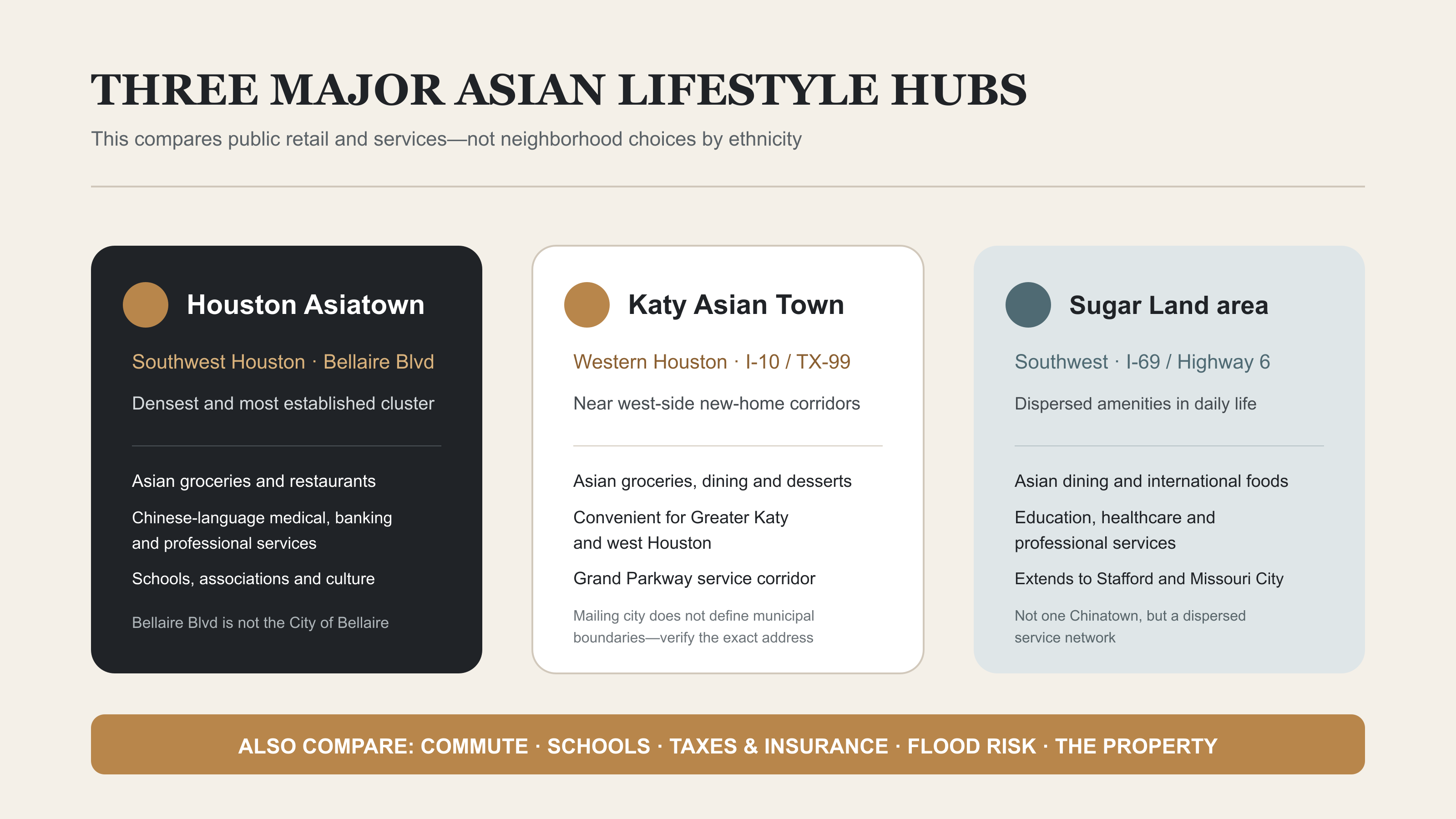
Houston's main Asiatown is along Bellaire Boulevard in southwest Houston, especially near Beltway 8. Bellaire Boulevard should not be confused with the separate City of Bellaire. The district has the region's deepest concentration of Asian groceries, restaurants, Chinese-language services, education and cultural organizations.
Katy Asian Town
Katy Asian Town is near I-10 and Grand Parkway / TX-99. It serves western Houston and Greater Katy with Asian grocery, dining, desserts, beverages and retail. A “Katy” mailing address still does not establish that a property lies within Katy city limits.
The Sugar Land-centered southwest network
Sugar Land's Asian amenities are more dispersed through Sugar Land, Stafford, Missouri City and corridors around Highway 6 and I-69 / US 59. It functions as a daily-life network rather than one concentrated Chinatown.
Asian restaurants and services are also growing in Pearland, Cypress, The Woodlands and parts of Clear Lake. Those areas are better addressed in their individual city guides.
Housing choice, climate and risk
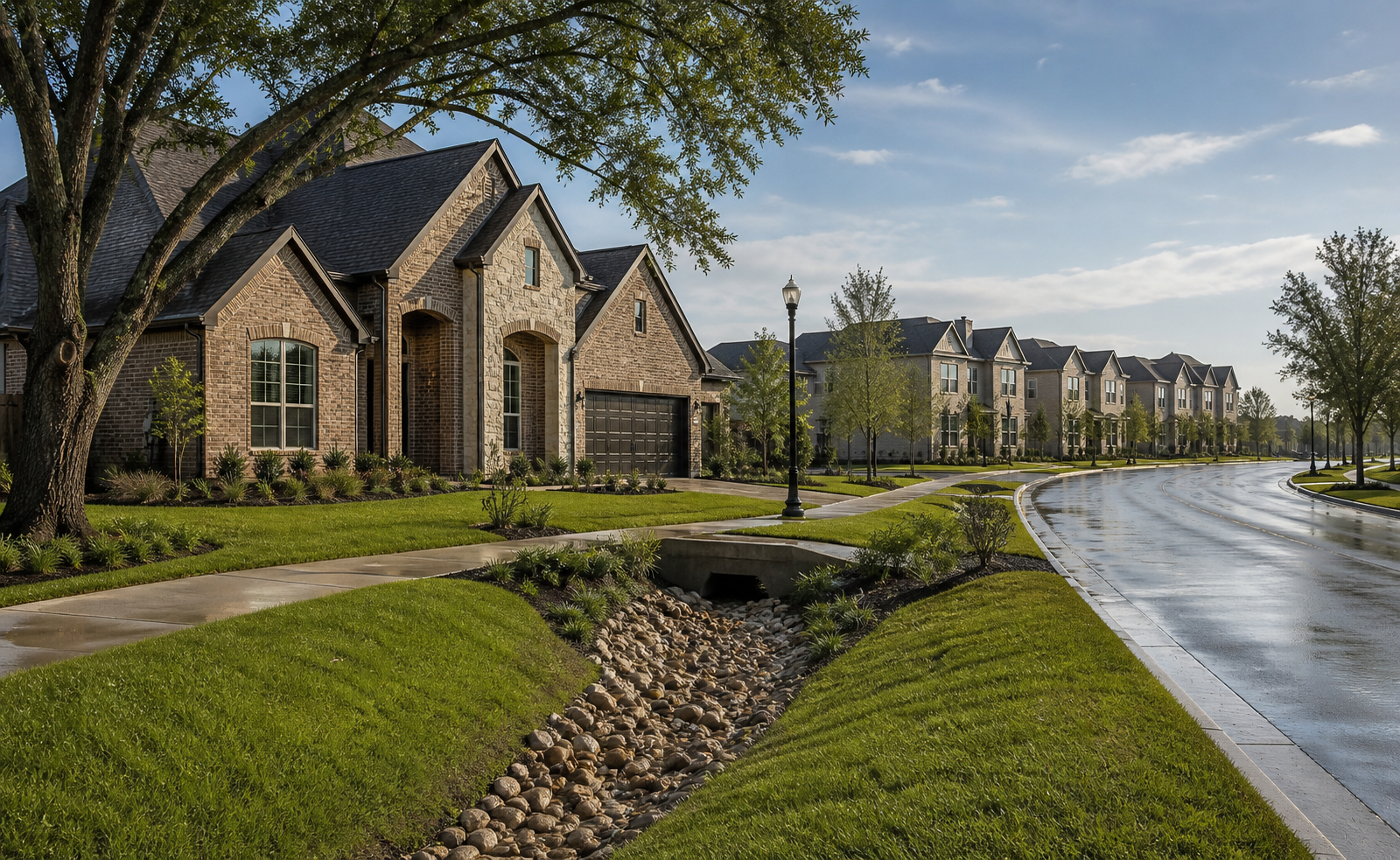
Inside and near the Inner Loop, housing may include apartments, townhomes, renovated older houses and denser new construction. The middle and outer rings contain more detached homes, master-planned communities and new construction. Farther out, buyers may find larger tracts, rural homes, agricultural land and development property.
Houston offers diverse jobs, international connectivity, multiple housing types and strong medical and educational resources. The tradeoffs include car dependence, congestion and tolls, hot and humid summers, hurricanes and heavy-rain risk, property taxes, insurance costs and major differences between individual streets and addresses.
Crime and safety should not be reduced to a label for an entire city or ethnic commercial district. Review official local data for the exact area, visit at different times and evaluate the specific property and surroundings.
Joyce's perspective
I do not begin a Houston home search by asking which popular suburb a client prefers. I begin with work locations, real commute limits, total budget, monthly carrying cost, education needs, daily-life amenities and risk tolerance. Once those are mapped together, the county, city, school district and community choices become much clearer.
There is no single “best area” for every household. The right area balances budget, commute, education, Asian amenities, taxes, insurance and property-specific risk.
Frequently asked questions
Are Katy, Sugar Land and Pearland part of Houston?
They are part of the everyday Greater Houston region, but they are not part of Houston city. County, city, school and tax obligations vary and should be verified by address.
Does Greater Houston have 10 counties or 13?
Both figures can be correct under different definitions. The current federal metro definition uses 10 counties. H-GAC uses a 13-county planning region. Always identify the source definition.
Which Asian hub is most convenient?
Asiatown has the most concentrated services, Katy Asian Town is convenient for western Houston and the Grand Parkway corridor, and Sugar Land offers a more dispersed southwest network. The answer depends on work, schools, budget and commute.
Does no state individual income tax make Houston housing inexpensive?
Not automatically. Property taxes, insurance, flood considerations, HOA or special-district costs, maintenance and transportation can materially change monthly carrying cost.
About Joyce Tang

Joyce Tang is a Greater Houston real estate agent and investor, co-founder of the North American Real Estate Association, founder of JoyHome and JoyNest, and co-leader of the Dr. Wang Real Estate Team.
She has helped more than 200 families buy or sell homes and has participated in more than 40 renovation projects. Her approach examines not only price, but also location, carrying cost, cash flow, risk and future exit options.
To discuss a Greater Houston relocation or area search, contact Joyce through https://www.joyhomerealty.com/en/contact.
Sources and disclaimer
Primary references include the U.S. Census Bureau, Houston-Galveston Area Council, Greater Houston Partnership, Houston Airports, Port Houston, Texas Comptroller, Texas Education Agency, Texas Medical Center and City of Houston.
This article is for general regional and real estate information. It is not legal, tax, insurance, lending, securities or investment advice. Population, school assignment, tax rates, flood information, insurance and jurisdictional boundaries may change. Verify current information for the exact property address.