

Short answer: Galleria, Briargrove and Tanglewood sit within a compact west-central Houston circle, but they are not three versions of the same market. Around Galleria, a buyer may be comparing a $200,000 condo with a townhome or detached house; Briargrove is an established deed-restricted single-family neighborhood; Tanglewood adds larger lots, custom estates and much more land value. The right choice starts with the property type and total carrying cost—not the name on the mailing address.
This guide is for buyers who want access to Uptown jobs and shopping, Chinatown, the Texas Medical Center, Downtown or the Energy Corridor and need to decide whether convenience, land, school assignment, lower maintenance or rental flexibility matters most.
The decision in one minute
- Galleria/Uptown: the broadest range of prices and property types. Condos can lower the purchase price, but HOA dues, reserves, insurance structure, special assessments and financing eligibility can change the real monthly cost.
- Briargrove: mostly detached homes on established streets, with original or renovated ranch houses mixed with replacement construction. You are paying for location, lot and neighborhood controls as much as finishes.
- Tanglewood: larger lots and a higher land-value floor, with custom estates, older homes and teardown opportunities. Rental yield is usually not the main reason to buy here.
- All three are inside Houston ISD territory, but a neighborhood label never guarantees one campus. Verify the exact address in the current district locator.
- Flood history, street drainage, old sewer lines, roof and HVAC age, deed restrictions and insurance belong in the first comparison—not after the option period starts.
Where exactly are these areas?
Galleria/Uptown centers on Post Oak Boulevard and The Galleria, generally around Loop 610 between Woodway and the Southwest Freeway. Tanglewood sits mainly west of Loop 610 and north of San Felipe. Briargrove is south of San Felipe and west of the Galleria, roughly between Chimney Rock and Fountain View. “Galleria area,” “Tanglewood area” and a 77056 or 77057 mailing address are broader marketing labels; the legal subdivision and parcel decide the rules.
Tanglewood Homes Association says the subdivision has about 1,220 lots in 23 sections. Briargrove is a separate deed-restricted neighborhood and should not be confused with Briargrove Park several miles west.
How long are the drives?
Using representative center points and OSRM/OpenStreetMap routes checked October 24, 2026, clear-road estimates run roughly 12–15 minutes to Chinatown, 13–16 minutes to Downtown, 12–17 minutes to the Medical Center and 17–19 minutes to the Energy Corridor. These are route estimates without live traffic; West Loop 610, Westheimer and Richmond can change the experience sharply at rush hour.
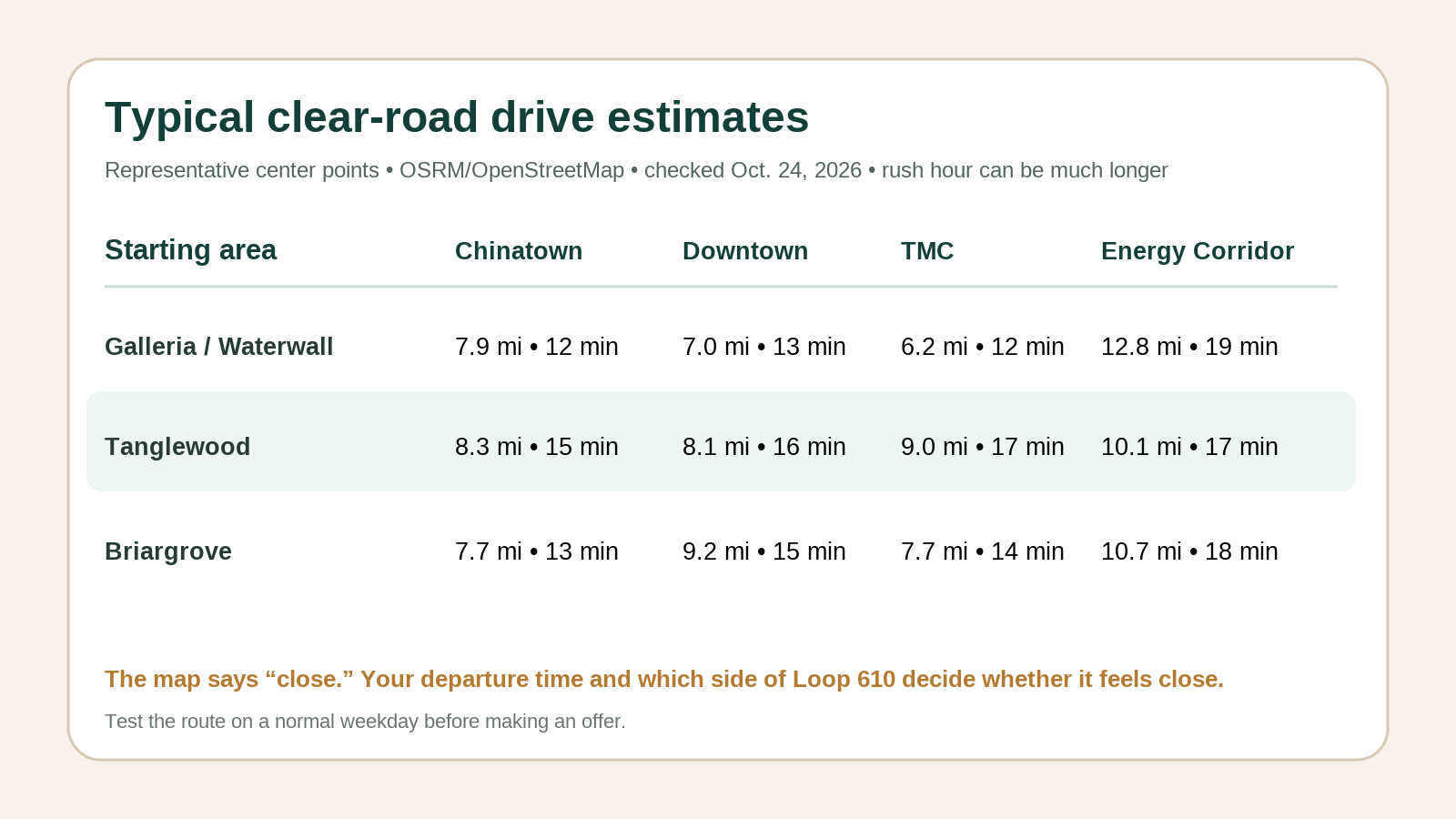
The practical test is simple: drive from the exact home to your actual workplace on a normal weekday. A house west of the Loop may be easier for the Energy Corridor; a condo near Post Oak may be easier for Uptown employment but slower when garage exit, elevator time and event traffic are included.
Current prices: why the same circle can span $200K to several million
HAR asking-price data shows how different the products are. In October 2026, the Galleria market area had 94 detached listings with a $756,000 median asking price and 224 condo listings with a $207,000 median. In September, Briargrove had 13 detached listings with a $1.90 million median, while the Tanglewood area had 30 with a $2.449 million median. These are asking-price snapshots, not appraisal values, and the smaller Briargrove and Tanglewood samples can move quickly.
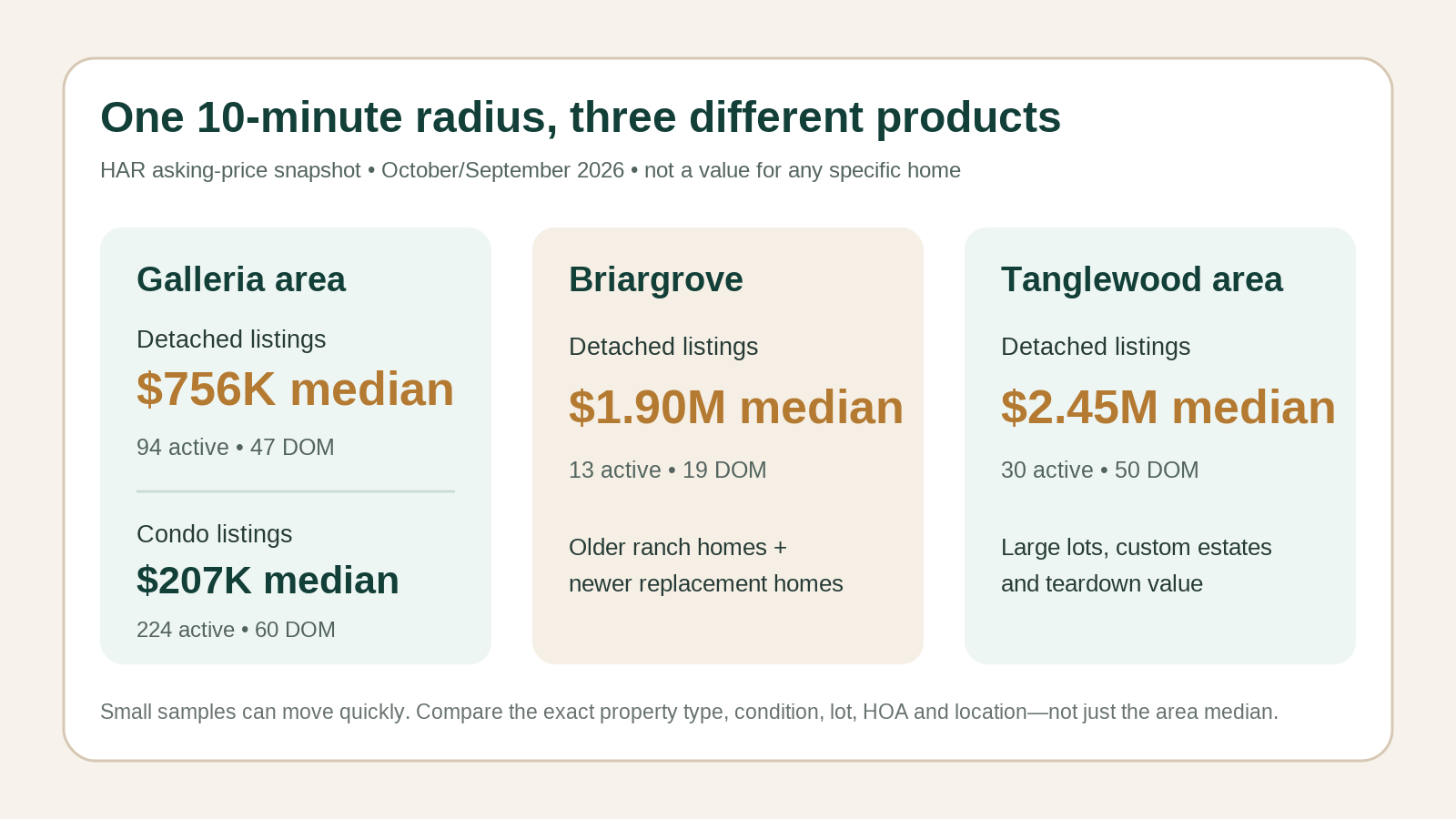
A useful working range is therefore much wider than one median: older Galleria condos may start below the detached-home market; townhomes and detached homes can move into the mid-six figures and above; Briargrove commonly reaches seven figures; and Tanglewood can run from land-value opportunities to multimillion-dollar estates. The exact minimum and maximum change daily, so I would never use one online range to value a specific address.
Galleria/Uptown: convenience comes with more documents
The strength of Galleria is choice. A buyer can find older garden-style condos, high-rise units, townhomes, patio homes and detached houses close to major retail, restaurants and Uptown employers. That also means two homes a few blocks apart may have completely different insurance, parking, rental rules, reserve funds and resale buyers.
For a condo or high-rise, I want the declaration, bylaws, current budget, reserve study if available, master insurance, recent meeting minutes, litigation, delinquency, special assessments, rental cap, pet and renovation rules, parking assignment and lender eligibility. A low price with a high monthly HOA or weak reserves is not automatically a bargain.
Briargrove: lot and neighborhood character drive the value
Briargrove began with many 1950s and 1960s one-story ranch homes. Today, original houses, renovated homes and larger replacement construction sit side by side. That creates opportunity, but also means price per square foot can mislead: one sale may reflect usable improvements while another is mostly a land purchase.
I would compare lot dimensions, setback and deed restrictions, drainage, tree condition, additions and permit history before comparing finishes. An older home can work very well when the expensive systems are understood; a new-looking interior does not prove the sewer, supply pipes, electrical service, foundation, roof or HVAC has been addressed.
Tanglewood: a large lot is valuable, but it is not all usable yard
Tanglewood combines mature streets, larger lots, custom homes and a strong teardown-and-rebuild cycle. Its association maintains common areas, collects assessments, administers patrol and private trash service, and enforces deed restrictions. Those neighborhood controls are part of what buyers pay for.
On a large custom home, check how the building sits on the lot, the setbacks, drainage paths, pool and tree placement, generator and mechanical locations, and future renovation limits. A 15,000-square-foot lot can still feel tight if the building footprint consumes most of the usable area.
Schools: use the address, not the neighborhood reputation
The current TEA profiles checked in October 2026 show Briargrove Elementary rated B/84, Tanglewood Middle B/86 and Wisdom High B/86 for 2025–26. Lamar High is also rated B, but a buyer should not assume Lamar is zoned just because a home is near Uptown. HISD publishes 2026–27 boundary maps and an address locator; boundaries, transfer programs and magnet admissions can change.
I treat a school score as one data point, not a promise about fit or future value. Confirm the exact zoned campuses in writing for the address, then review programs, enrollment, transportation and the child’s actual needs.
Shopping, parks, culture and Asian daily life
The Galleria, Post Oak Boulevard and Westheimer supply a dense mix of retail, restaurants, hotels and services. Waterwall Park is the recognizable neighborhood landmark; Memorial Park and the Houston Arboretum are a short drive north. Uptown reports widened sidewalks, pedestrian lighting and more than 1,000 live oaks along Post Oak, while METRO’s Silver Line runs through the corridor.
For Chinese groceries and the larger Bellaire Boulevard restaurant network, the representative routes in this guide are about 7.7–8.3 miles from these three areas before traffic. That is convenient enough for regular trips, but it is not the same as living inside Chinatown.
Flood, drainage and insurance: do not use one neighborhood answer
I would not label any of these areas simply “safe from flooding.” Check the current FEMA flood map, Harris County’s draft MAAPnext viewer, prior claims and seller disclosures, elevation information, street and yard drainage, nearby channels, garage level and the path water takes during a heavy storm. Harris County says the 2026 MAAPnext data is still draft and not regulatory, but it uses updated rainfall and modeling and is useful as an additional risk screen.
Obtain homeowners, flood and—when applicable—condo HO-6 quotes during the option period. For condos, understand what the master policy covers and what remains the unit owner’s responsibility. For older detached homes, roof age, plumbing, electrical and prior claims can materially change availability and premium.
Safety and crime: compare blocks, routes and time periods
Commercial centers, parking facilities and major roads can inflate broad area counts. Use HPD’s public crime map and monthly NIBRS data to check the blocks around the exact address, the walking or driving route you will use, and a meaningful recent period. Visit on a weekday morning, evening and weekend rather than relying on a single score.
Taxes, HOA and recurring ownership cost
These established neighborhoods are generally different from outer-suburb MUD communities, but the parcel’s actual taxing entities still control the bill. Pull the Harris Central Appraisal District account, verify exemptions and current tax rates, and do not calculate future taxes from the seller’s capped taxable value.
Add HOA or maintenance assessments, condo dues, insurance, utilities, pool and landscape care, reserves for older systems and possible special assessments. A $250,000 condo can carry a higher monthly non-mortgage cost than expected; a large Tanglewood estate can have modest association dues but substantial maintenance.
Employment access and growth potential
This location works because it sits between several employment directions: Uptown offices and retail, Downtown, the Medical Center and the Energy Corridor. Uptown has continued investing in Post Oak, San Felipe, sidewalks, lighting, transit and nearby park connections. That supports long-term usability, but appreciation is never guaranteed; new condo supply, building condition, traffic and the depth of the future buyer pool still matter.
Does this area work for investors?
It can, but each product needs a different model. Galleria condos may offer the lowest entry price and a larger renter pool, yet HOA dues, leasing restrictions, special assessments and competing inventory can compress cash flow and resale. Townhomes may balance land and lower shared expense, but street position and construction quality matter. Briargrove and Tanglewood detached homes are usually land-and-location purchases with high capital requirements, so the gross rent-to-price ratio is often less attractive.
Before calling any of them an investment, use current rent comps for the same property type, subtract vacancy, management, repairs, insurance, taxes, HOA and capital reserves, then model the exit buyer. Do not assume short-term rental permission or future appreciation.
Who is each area best suited for?
Galleria/Uptown may fit better if
- You want the broadest choice of price and property type near Uptown.
- You value restaurants, retail and a shorter local commute more than a large private yard.
- You are willing to read condo or HOA documents and compare the full monthly cost.
Briargrove may fit better if
- You want an established detached-home neighborhood close to Galleria and the Medical Center.
- You like a one-story ranch or a newer replacement home and will compare the systems and lot carefully.
- You value deed restrictions and a more residential street pattern.
Tanglewood may fit better if
- You prioritize a larger lot, custom-home market and long-term land value.
- Your budget can absorb higher purchase and maintenance costs.
- You are buying primarily for use and location rather than maximizing rental yield.
My address-level checklist before an offer
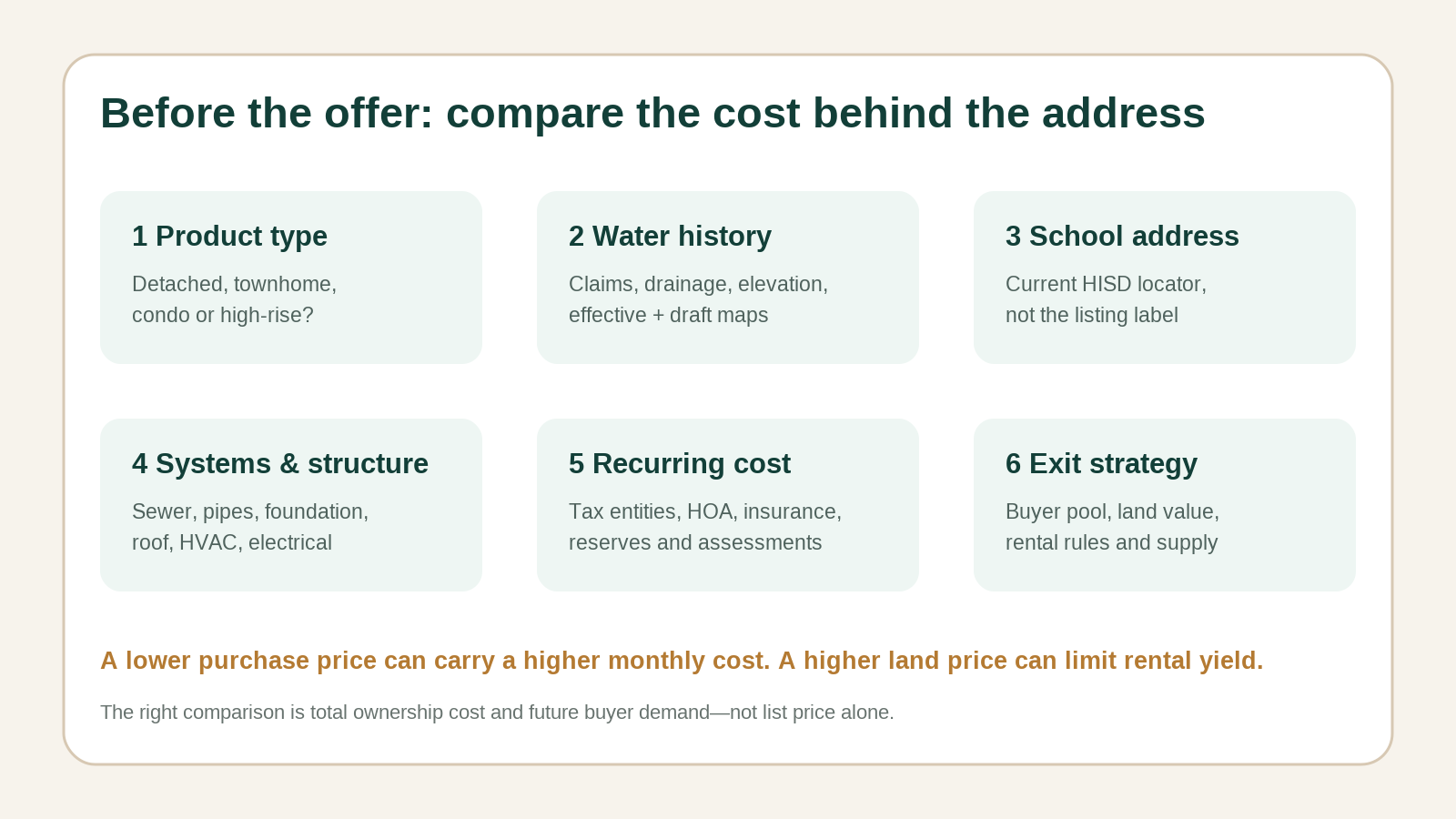
- Legal subdivision, parcel boundaries, property type and all governing associations.
- Current HISD assignment for the exact address and any admission requirements.
- Effective FEMA map, draft MAAPnext layer, claims history, elevation and drainage observations.
- Foundation, sewer, supply plumbing, electrical, roof, HVAC, windows, pool and generator condition.
- Taxing entities, exemptions, HOA dues, reserve condition, special assessments and insurance quotes.
- Comparable sales and rents for the same product type, plus likely future buyer and renter pool.
Common questions
Is a Galleria condo automatically the cheapest option?
It often has the lowest purchase price, but not always the lowest monthly cost. Add HOA dues, unit insurance, taxes, utilities, parking, assessments and reserves before comparing it with a townhome or detached house.
Are Briargrove and Briargrove Park the same neighborhood?
No. They are separate areas several miles apart with different locations, prices, associations and daily routes. Verify the legal subdivision rather than relying on the word “Briargrove” in marketing.
Does a Tanglewood address guarantee the same schools?
No neighborhood name should be treated as a school guarantee. Use the current HISD address locator and confirm the specific parcel before relying on an assignment.
Which one has the best appreciation potential?
There is no responsible one-name answer. Land scarcity can support Briargrove and Tanglewood, while Galleria offers broader price access and employment proximity. Building condition, supply, dues, street position, flood history and the future buyer pool determine how an individual property performs.
Related JoyHome guides
How to evaluate a Houston condo or townhome explains reserves, master insurance, assessments and financing.
Houston flood risk beyond the FEMA zone shows how to check claims, drainage and maps at the address level.
Memorial and Energy Corridor buyer guide helps compare the next major west-Houston alternative.
Sources and date checked
Market asking and sale data: HAR Galleria price trends, HAR Briargrove price trends and HAR Tanglewood Area price trends. Checked October 24, 2026.
Neighborhood and infrastructure: Tanglewood Homes Association, Uptown Houston projects and METRO Silver Line. Checked October 24, 2026.
Schools and flood: HISD 2026–27 boundaries and locator, Texas School Report Cards and Harris County MAAPnext update. Checked October 24, 2026.
Route estimates: OSRM with OpenStreetMap data using representative area and destination coordinates, checked October 24, 2026. They exclude live traffic and are not a promise of travel time.
Cover photo: Jules Verne Times Two / julesvernex2.com / CC BY-SA 4.0. Cropped to 16:9 and converted to WebP.
See what today's budget can buy
After comparing the three product types, browse Joyce’s current Greater Houston selection to see how condo, townhome and detached-home budgets look in the real market. The guide stays independent of any one listing whose status may change.

View Joyce's Featured Listings
Want to compare three actual addresses?
Send me the addresses, budget, daily commute and expected holding period. I can help place school assignment, flood history, HOA documents, insurance, major systems and resale in one comparison before you decide which property deserves the next visit.
About Joyce Tang

Joyce Tang is a Greater Houston real estate agent and investor, co-founder of the North American Real Estate Association, founder of JoyHome and JoyNest, and co-leader of the Dr. Wang Real Estate Team.
She has helped more than 200 families buy or sell homes and has participated in more than 40 renovation projects. Her approach examines not only price, but also location, carrying cost, cash flow, risk and future exit options.
This article provides general real estate information, not an appraisal, engineering or flood determination, insurance quote, school-admission guarantee, tax advice or investment-return projection. Market, school, tax, insurance, HOA, flood and crime information changes. Verify the specific property with the relevant agencies and qualified professionals before making a decision.