

On September 16, 2026, the Federal Reserve raised its target range to 3.75%–4.00%, its first rate increase in three years. For Houston buyers, the practical issue is not the quarter-point move by itself; it is how long-term Treasury yields, mortgage pricing and the terms of a specific home purchase combine to affect the total monthly cost.
My view: this hike does not mean every mortgage automatically rises by 0.25%, and it is not a reason to rush into a purchase. Buyers should rerun the budget and compare price, seller concessions, taxes and insurance under today’s financing conditions.
What did the Federal Reserve actually do?
The FOMC voted 12–0 on September 16 to raise the federal funds target range from 3.50%–3.75% to 3.75%–4.00%. Its statement said inflation remained elevated while economic activity was expanding at a solid pace. Read the Federal Reserve statement.
The Bureau of Labor Statistics reported that August CPI was up 3.4% from a year earlier. Energy prices were up 16.3%, while core CPI excluding food and energy was up 2.4%. Headline inflation has been pushed higher by energy, but underlying inflation did not rise to the same 3.4% rate. Review the BLS release.
It is fair to say inflation pressure remains. It is not supported, however, to treat a unanimous vote as proof that the Fed “surrendered” to the bond market. The vote shows agreement on the decision, not a single hidden motive.
Why is a mortgage rate different from the Fed’s rate?
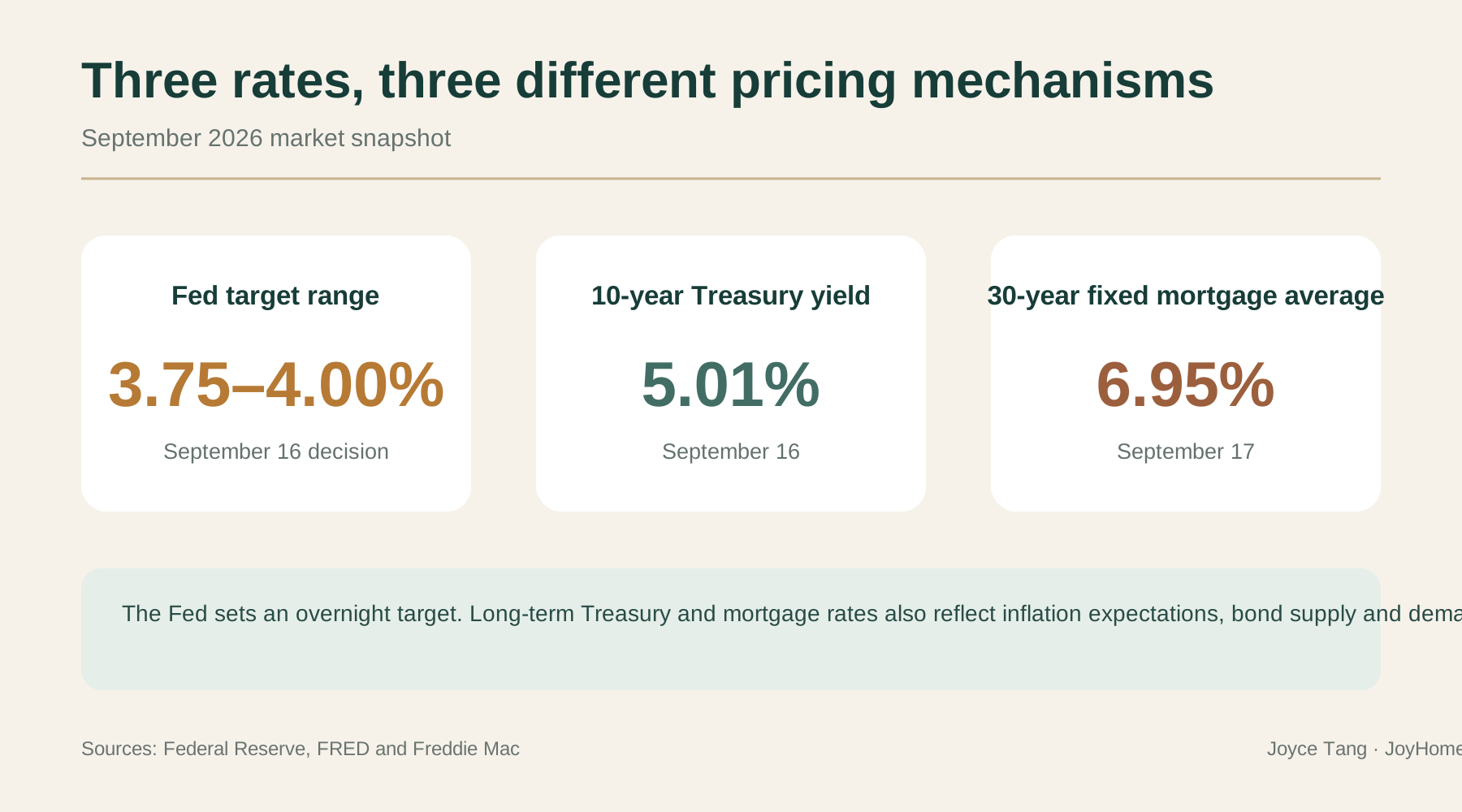
The Fed directly sets an overnight policy target. A 30-year fixed mortgage is a long-term price influenced by the 10-year Treasury yield, inflation expectations, Treasury and mortgage-bond supply and demand, risk premiums and lender pricing.
The 10-year Treasury yield reached 5.01% on September 16. See the FRED series.
Freddie Mac then reported a 6.95% national average for a 30-year fixed mortgage as of September 17, up from 6.76% one week earlier. See the latest Freddie Mac survey.
Mortgage markets were already repricing around inflation and long-term bonds. The Fed decision affects expectations, but lenders do not mechanically add the policy move to every mortgage. The average could move above 7%, or move back down as new data changes the market.
What is the bond market really telling us?
A better conclusion is not that “borrowers set the price of money.” Long-term financing costs are market prices. The Treasury issues debt, and investors decide what yield compensates them for inflation, maturity, supply and fiscal risk. When demand is weaker, yields often need to rise to attract buyers.
The Fed can directly set a short-term policy target, but it cannot unilaterally set long-term financing costs. Long rates reflect monetary policy, inflation, bond supply and demand, and risk assessment together.
Auction data for “indirect bidders” is sometimes used as a signal of institutional and overseas demand, but indirect bidders are not the same as foreign buyers. One auction result alone cannot prove that global investors have lost confidence in all U.S. assets.
What does a mortgage rate near 7% mean in dollars?
For a $400,000, 30-year fixed loan, principal and interest are approximately $2,597 per month at 6.76%, $2,648 at 6.95%, and $2,729 at 7.25%. The difference between 6.76% and 7.25% is about $132 per month, or $1,584 per year.
That calculation excludes property tax, homeowners insurance, HOA dues and possible MUD or PID costs. Affordability depends on the full payment and the cash left after closing, not one rate in a headline.
For a complete Houston cost checklist, continue with Buying a Home in Houston: What Costs Come Beyond the Mortgage Payment?.
Should a Houston buyer purchase now or keep waiting?
With mortgage rates already high, “buy now before rates go higher” is not a sound reason on its own. A purchase should work under today’s loan terms rather than depend on an early refinance.
Waiting can make more sense when
The current total payment is outside the household’s comfortable range
Income, job location or down-payment funds remain uncertain
Buying would use most emergency reserves
The expected holding period is too short to absorb transaction costs
Available homes do not fit the household’s real budget and needs
Evaluating a purchase now can make sense when
The payment works without assuming a future refinance
The property is fairly priced and fits a multi-year plan
Price, repairs or seller concessions produce a meaningful total-cost advantage
Down payment, closing costs and post-closing reserves are separately funded
The buyer has compared resale negotiations with nearby builder incentives
Houston inventory remains higher than it was several years ago, which creates more choice and negotiating room in some submarkets. Conditions still vary sharply by neighborhood, price point and property condition.
For the inventory side of the market, read Houston Inventory Hit a Record—So Why Haven’t Home Prices Fallen More?.
Four useful steps for buyers now
Request written Loan Estimates for different rate, points and down-payment combinations
Budget the mortgage together with property tax, insurance, HOA and any MUD or PID
Compare a price reduction with closing-cost assistance and a rate buydown based on total cost
Review days on market, price history, repairs and competing listings for the specific home
What does this mean for Houston sellers?
A mortgage rate near 7% makes buyers more sensitive to every cost. Sellers should evaluate current competition, builder incentives, property condition and buyer financing—not only older comparable sales.
In some transactions, closing-cost assistance or a rate buydown may improve the buyer’s payment more than the same nominal price reduction. The right structure still depends on seller net proceeds, appraisal and loan rules.
Could the Fed raise rates again?
The Fed’s September projections showed a 4.1% median federal funds rate for the end of 2026. From the current midpoint, that is consistent with the possibility of one more quarter-point increase, but projections are not commitments and future decisions will depend on inflation, employment and economic data. Review the Fed projections.
For a buyer, the more useful dashboard is the weekly mortgage quote, the 10-year Treasury trend, target-neighborhood inventory, the specific home’s market time and the seller’s willingness to adjust price or terms.
Frequently asked questions
Does a 0.25% Fed hike immediately add 0.25% to mortgages?
No. Thirty-year mortgage rates also reflect long-term Treasuries, the mortgage-bond market, inflation expectations and lender pricing. They can move before the Fed, by a different amount or even in the opposite direction.
Could mortgage rates move above 7%?
Yes. The Freddie Mac average was already 6.95% on September 17. Whether it remains above 7% would depend on inflation, bond markets and mortgage-market conditions. Individual quotes also depend on credit, down payment, loan type, points and lock period.
Should buyers wait until the Fed cuts rates again?
Waiting is reasonable when the current total payment does not work. When it does, the comparison should also include rent paid while waiting, available homes, current negotiating leverage and the possibility of more competition later. One Fed meeting should not decide the purchase date.
About Joyce Tang

Joyce Tang is a Greater Houston real estate agent and investor, co-founder of the North American Real Estate Association, founder of JoyHome and JoyNest, and co-leader of the Dr. Wang Real Estate Team.
She has helped more than 200 families buy or sell homes and has participated in more than 40 renovation projects. Her approach examines not only price, but also location, carrying cost, cash flow, risk and future exit options.
If you are comparing “wait” with “negotiate now,” share your budget, down payment, target payment, preferred area and expected holding period. We can calculate the full cost under current rates before deciding whether a specific home offers enough value or negotiating room.
Data and disclaimer
Data in this article is current as of September 20, 2026 and comes from the Federal Reserve, BLS, FRED and Freddie Mac. Rates and market conditions continue to change.
This article is general real estate and market education, not lending, investment, tax or legal advice. It does not guarantee rates, prices or refinancing results. Personal loan terms should be confirmed through a licensed lender’s formal quote and documents.
By Joyce Tang | Serving Greater Houston, Texas.